
IUI Procedure Step by Step: What to Expect Before, During and After IUI
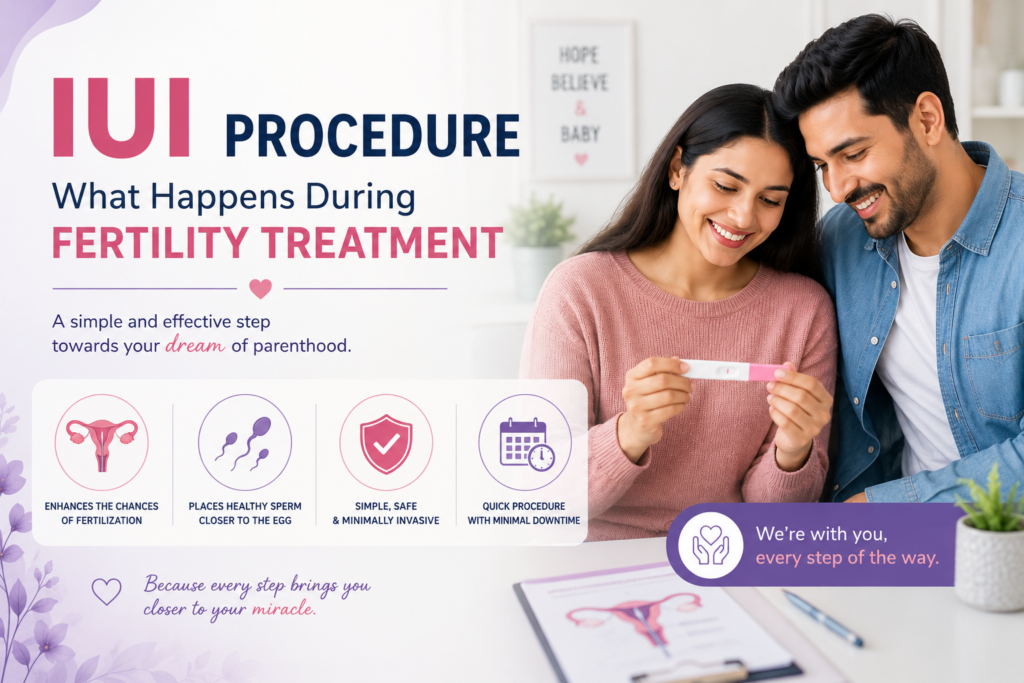
Intrauterine insemination, commonly called IUI, is a fertility treatment in which prepared sperm is placed directly into the uterus around the time of ovulation. The aim is to increase the number of motile sperm reaching the fallopian tubes while allowing fertilisation to occur inside the body.
IUI is usually less invasive than IVF, but it is not appropriate for every fertility problem. A fertility specialist should first assess factors such as ovulation, tubal patency, age, semen quality and the cause of infertility.
For related treatment information, explore IUI treatment in Hyderabad and IUI vs IVF. These resources provide additional context for the treatment choices discussed in this guide.
Step 1: Fertility Evaluation Before IUI
Before recommending IUI, the doctor may review menstrual history, ovulation, ultrasound findings, fallopian-tube status and semen analysis. The male partner may be advised to provide a semen sample, or donor sperm may be used when appropriate.
If both fallopian tubes are blocked, IUI generally cannot overcome the blockage because fertilisation still needs to occur in the fallopian tube. Severe male-factor infertility may also reduce the chance of IUI being effective.
Step 2: Natural Cycle or Ovarian Stimulation
IUI may be performed in a natural ovulation cycle or with medicines that encourage follicle development. If medicines are used, ultrasound monitoring helps the doctor assess follicle growth and reduce avoidable risks.
Step 3: Timing Ovulation
Correct timing is important. Ovulation may be detected naturally, monitored with ultrasound or coordinated using a trigger injection when clinically appropriate. The clinic then schedules insemination around the expected ovulation window.
Step 4: Semen Collection and Preparation
On the day of IUI, a semen sample is collected according to clinic instructions. The laboratory processes the sample to separate motile sperm from seminal fluid and other cells. This prepared sample is then used for insemination.
Sperm preparation is an important part of IUI because unprocessed semen should not be placed directly inside the uterus.
For additional context, review semen analysis. You can also explore Dr. Swapna Naik to understand related options before discussing the next step with your fertility team.
Step 5: The IUI Procedure
The patient lies on an examination table, similar to a routine gynaecological examination. A speculum is used so the cervix can be visualised. A thin catheter is passed through the cervix into the uterus, and the prepared sperm sample is gently deposited.
The procedure is usually brief. Many patients describe mild cramping or pressure, while others feel very little discomfort. Anaesthesia is generally not required for routine IUI.
Step 6: After the Procedure
Your clinic may ask you to rest briefly after IUI, although normal light activity is usually possible afterward. Some people notice mild spotting or cramping. Follow the fertility team’s instructions regarding medicines, exercise, intercourse and pregnancy testing.
Step 7: Pregnancy Test
A pregnancy test is planned after an appropriate interval. Testing too early can be misleading, particularly if a trigger medicine containing hCG was used.
Who Is a Good Candidate for IUI?
IUI may be considered in selected cases of unexplained infertility, ovulation-related infertility after appropriate treatment, mild male-factor infertility, cervical-factor infertility, or when donor sperm is used. Suitability depends on individual clinical findings.
When May IVF Be More Appropriate?
IVF may be considered instead of IUI when there are blocked fallopian tubes, severe male-factor infertility, markedly reduced ovarian reserve, significant age-related fertility decline, some cases of advanced endometriosis, or repeated unsuccessful IUI cycles.
Risks and Side Effects
IUI itself is usually a low-complexity procedure. Possible effects include temporary cramping, light spotting and a small risk of infection. When ovulation-stimulating medicines are used, the main additional concern is the possibility of multiple pregnancy and, less commonly, excessive ovarian response. Monitoring helps reduce these risks.
If you would like advice based on your reports, age, diagnosis and treatment history, book an appointment for an individual fertility assessment.
Frequently Asked Questions
1. What is the IUI procedure?
IUI places specially prepared sperm directly into the uterus around ovulation to shorten the distance sperm need to travel to reach the egg.
2. What happens before IUI?
The clinic reviews fertility history, confirms that IUI is appropriate, assesses ovulation and tubal factors when needed, and obtains a semen sample for preparation.
3. Do I need fertility medicines before IUI?
Some cycles are natural and others use ovulation-induction medication. The choice depends on diagnosis, age, ovulation, and risk of multiple pregnancy.
4. How is ovulation monitored for IUI?
Monitoring may include ultrasound, hormone tests, ovulation kits, or a trigger injection depending on the protocol.
5. How is sperm prepared for IUI?
The semen sample is processed in the laboratory to concentrate motile sperm and remove seminal fluid and debris.
6. How is IUI performed?
A thin catheter is passed through the cervix and the prepared sperm sample is gently placed into the uterine cavity.
7. How long does IUI take?
The insemination itself usually takes only a few minutes, though the visit is longer because sperm preparation and clinic procedures take time.
8. Is IUI painful?
Most patients experience little or brief cramping. Significant pain is not expected and should be reported.
9. Do I need anaesthesia for IUI?
No. IUI is usually performed without anaesthesia.
10. Should I keep my bladder full for IUI?
Some clinics may prefer a comfortably full bladder to help catheter placement, while others do not. Follow your clinic’s instructions.
11. Do I need bed rest after IUI?
Extended bed rest is generally unnecessary. Most patients can resume normal light activity shortly after the procedure.
12. Can sperm fall out after IUI?
The sperm are placed inside the uterus. A small amount of fluid discharge afterward does not mean the insemination has been lost.
13. Can I exercise after IUI?
Light normal activity is usually acceptable, but follow clinic-specific advice, especially if ovarian stimulation has enlarged the ovaries.
14. When can I have sex after IUI?
Many clinics allow intercourse around the IUI unless there is a specific medical reason to avoid it. Ask your doctor for personalized advice.
15. When should I take a pregnancy test after IUI?
Testing is usually planned about two weeks after insemination, but exact timing depends on the protocol and whether a trigger injection was used.
16. Can a trigger injection cause a false-positive pregnancy test?
Yes. hCG trigger medication can remain detectable for several days, so testing too early can be misleading.
17. What are the risks of IUI?
IUI itself has a low complication rate. Ovarian stimulation can increase the chance of multiple pregnancy and, rarely, ovarian hyperstimulation.
18. What happens if the first IUI fails?
The clinic reviews timing, follicle response, sperm preparation results, and diagnosis before deciding whether to repeat IUI or change treatment.
19. How many IUI cycles should be tried?
The number depends on age, diagnosis, ovarian response, sperm factors, and prior outcomes. Reassessment is important after repeated failures.
20. When is IVF preferred instead of IUI?
IVF may be more appropriate with blocked tubes, severe male factor, advanced reproductive age, low ovarian reserve, or repeated unsuccessful IUI.
21. What should I ask before my IUI procedure?
Ask about medication, number of follicles, ovulation timing, sperm preparation results, success expectations, post-procedure instructions, and when to test for pregnancy.
Next Step
For a personalised IUI assessment in Hyderabad, book a consultation with Sree Swapna Fertility Centre.
Medical References
Important: This article is for general educational information and is not a substitute for individualized medical advice.
