
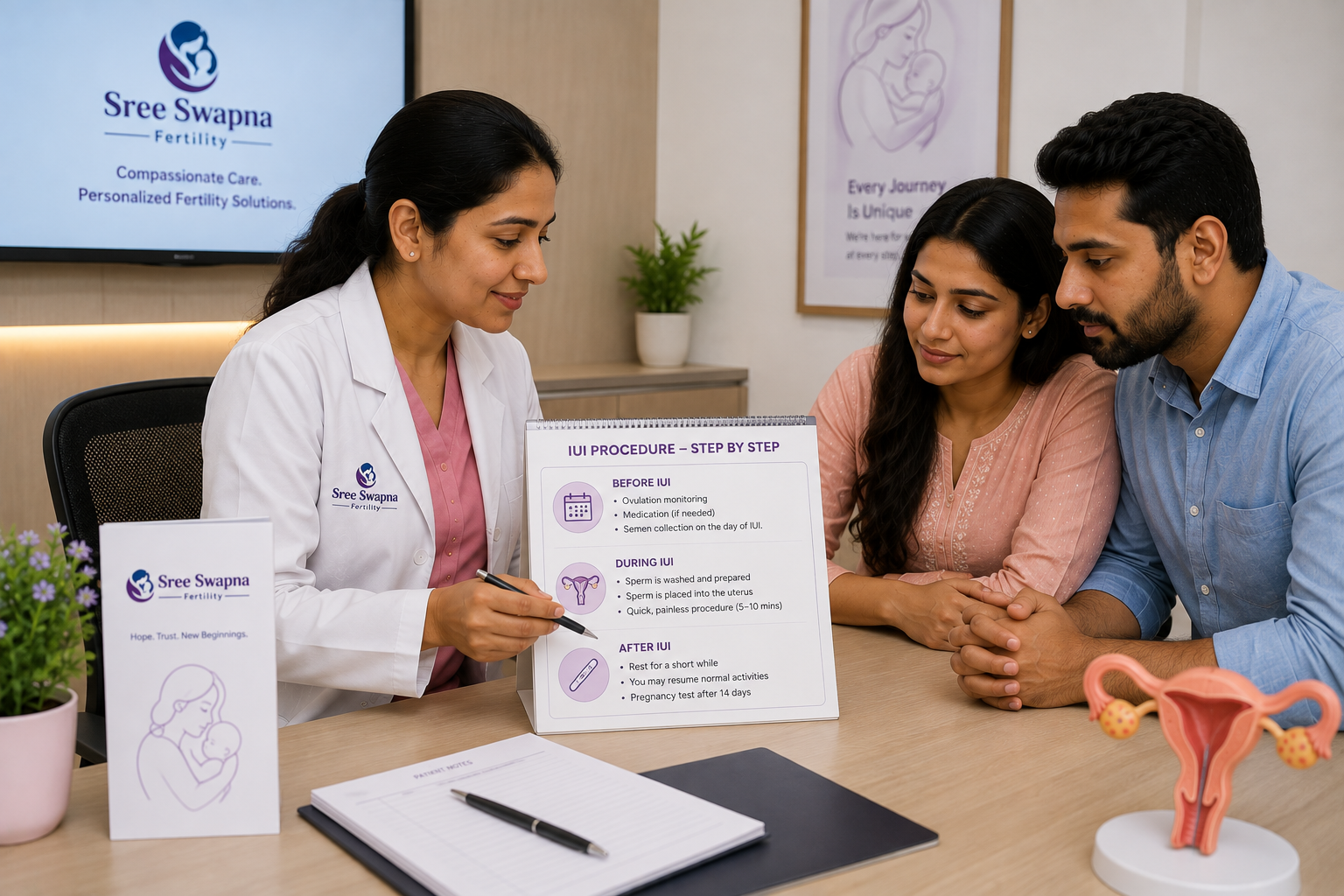
What Is IUI? Intrauterine Insemination Explained
IUI stands for intrauterine insemination. It is a fertility treatment in which specially prepared sperm is placed directly into the uterus close to the time of ovulation. The goal is to shorten the distance sperm must travel and increase the number of motile sperm available near the fallopian tubes.
Unlike IVF, fertilisation during IUI still occurs inside the body. This makes IUI a simpler treatment option for selected patients, but it also means that at least one functioning fallopian tube and a reasonable chance of sperm reaching and fertilising the egg are generally important.
For related treatment information, explore IUI treatment in Hyderabad and IUI procedure step by step. These resources provide additional context for the treatment choices discussed in this guide.
How Does IUI Work?
An IUI cycle usually involves three main parts: planning ovulation, preparing the sperm sample and placing the sperm into the uterus.
The cycle may be natural or may involve fertility medicines. Ultrasound monitoring can help the doctor identify developing follicles. A trigger injection may be used in some cycles to coordinate ovulation.
On the day of insemination, the semen sample is processed in the laboratory. The prepared sperm is then placed into the uterus using a thin catheter.
Why Is Sperm “Washed” Before IUI?
The semen sample contains sperm as well as seminal fluid and other cells. Laboratory preparation separates a concentrated population of motile sperm for insemination. This preparation is necessary because raw semen is not placed directly into the uterus.
Who May Benefit from IUI?
IUI may be considered for selected patients with unexplained infertility, ovulation problems after appropriate treatment, mild male-factor infertility, cervical-factor infertility or treatment using donor sperm.
Whether IUI is suitable depends on age, ovarian reserve, tubal status, semen quality, duration of infertility and previous treatment.
For additional context, review IUI vs IVF. You can also explore fertility clinic locations to understand related options before discussing the next step with your fertility team.
Who May Not Be a Good Candidate?
IUI is generally less useful when both fallopian tubes are blocked, when sperm numbers or motility are severely reduced, or when other factors make fertilisation inside the body unlikely. In such situations, IVF or IVF with ICSI may be discussed.
IUI vs IVF: What Is the Main Difference?
In IUI, sperm is placed inside the uterus and fertilisation occurs naturally in the reproductive tract. In IVF, eggs are collected from the ovaries and fertilised in a laboratory before an embryo is transferred to the uterus.
IUI is simpler and usually less costly, but IVF offers greater control over fertilisation and embryo development and may be more appropriate for complex infertility.
What Is the Success Rate of IUI?
There is no single IUI success rate that applies to everyone. Age, ovulation, sperm quality, tubal health, the cause of infertility and the number of treatment cycles all matter. Published success rates also differ depending on whether clinics report pregnancy or live birth and how patients are selected.
Ask your fertility specialist for an individual estimate rather than relying on a general percentage online.
Is IUI Safe?
IUI is generally considered a low-complexity fertility procedure. Temporary cramping or spotting can occur. Infection is uncommon. If fertility medicines are used, there can be an increased chance of multiple pregnancy, which is one reason careful monitoring is important.
What Happens After IUI?
Most people can return to usual activities after the procedure. Follow your clinic’s instructions for medications and testing. A pregnancy test is usually scheduled after enough time has passed to obtain a reliable result.
If you would like advice based on your reports, age, diagnosis and treatment history, book a consultation for an individual fertility assessment.
Frequently Asked Questions
1. What is IUI?
IUI, or intrauterine insemination, is a fertility treatment in which prepared sperm is placed directly into the uterus around the time of ovulation.
2. How does IUI help pregnancy occur?
IUI increases the number of motile sperm reaching the uterus near ovulation, but fertilisation still occurs naturally in the fallopian tube.
3. Who may benefit from IUI?
IUI may be considered for unexplained infertility, cervical-factor issues, ovulation problems with treatment, selected mild male-factor cases, or donor sperm use.
4. Who is not a good candidate for IUI?
IUI is generally not suitable when both fallopian tubes are blocked, severe male-factor infertility is present, or other factors make IVF more appropriate.
5. Do I need open fallopian tubes for IUI?
At least one functioning fallopian tube is generally needed because sperm and egg still need to meet in the tube.
6. Is IUI the same as IVF?
No. IUI places sperm in the uterus and fertilisation occurs inside the body. IVF involves egg retrieval and fertilisation in the laboratory.
7. Is IUI the same as artificial insemination?
IUI is a form of artificial insemination and is one of the most commonly used methods.
8. Does IUI require injections?
Not always. Natural-cycle IUI may use no stimulation injections, while medicated cycles may use tablets or injectable hormones.
9. How long does an IUI cycle take?
It usually follows one menstrual cycle, with monitoring before insemination and pregnancy testing about two weeks later.
10. Is IUI painful?
Most people report mild or brief cramping rather than significant pain.
11. How is sperm prepared for IUI?
The laboratory processes the semen sample to select motile sperm and remove seminal fluid before insemination.
12. Can IUI be done with donor sperm?
Yes. IUI is commonly used with donor sperm when appropriate screening and legal requirements are met.
13. What is the success rate of IUI?
Success varies with age, diagnosis, tubal status, sperm quality, and whether stimulation is used. A generic percentage should not be applied to every patient.
14. How many IUI cycles can be tried?
There is no fixed number. The plan should be reassessed after repeated attempts, especially if age or diagnosis reduces the likelihood of further benefit.
15. Can IUI cause twins?
The insemination itself does not cause twins, but ovarian-stimulation medicines can increase the chance of multiple ovulation and multiple pregnancy.
16. What are the side effects of IUI medicines?
Possible effects depend on the medication and may include bloating, headaches, mood changes, or ovarian enlargement. Your clinic should explain warning signs.
17. When is a pregnancy test done after IUI?
Testing is commonly scheduled around two weeks after insemination to reduce false results.
18. Can I go to work after IUI?
Most patients can return to normal daily activity the same day unless the clinic advises otherwise.
19. What happens after a failed IUI?
Your doctor may review response, timing, sperm results, and diagnosis before recommending another IUI or a move to IVF.
20. Is IUI cheaper than IVF?
IUI is usually less complex and less expensive per cycle, but total cost depends on medicines, monitoring, number of attempts, and whether later IVF is needed.
21. How do I know if IUI is right for me?
A fertility evaluation that reviews age, ovulation, tubal status, semen analysis, duration of infertility, and prior treatment can help determine suitability.
Next Step
If you are considering IUI in Hyderabad, schedule an evaluation with Sree Swapna Fertility Centre at Kondapur or Attapur.
Medical References
Important: This article is for general educational information and is not a substitute for individualized medical advice.
