
What Is Hysteroscopy?
Hysteroscopy is a procedure in which a thin camera is passed through the cervix to inspect the inside of the uterus. It can identify cavity abnormalities such as polyps, submucosal fibroids, adhesions or some structural changes. In selected cases, the same procedure can be used to treat an abnormality.
Is Hysteroscopy Required Before Every IVF Cycle?
No. Routine hysteroscopy is not automatically necessary for every patient starting IVF. Whether it is useful depends on symptoms, ultrasound findings, previous procedures, recurrent implantation problems and the likelihood of a uterine-cavity abnormality. A normal high-quality ultrasound may provide enough information for many patients.
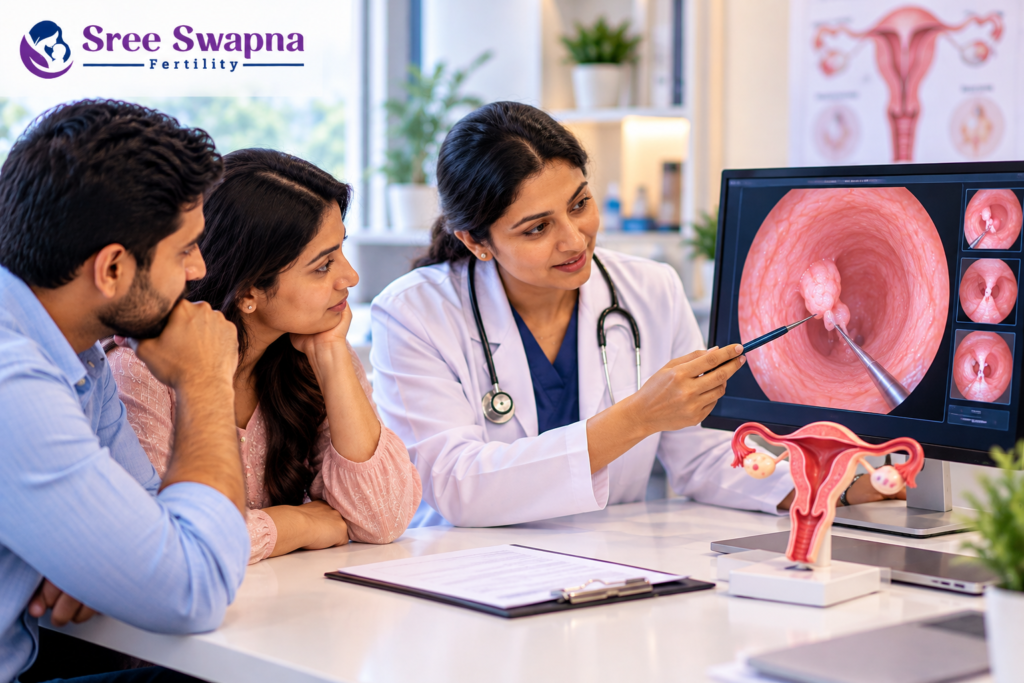
Uterine imaging may identify findings that need closer evaluation before IVF.
Hysteroscopy vs HSG
HSG mainly evaluates whether the fallopian tubes are open and also outlines the uterine cavity using contrast X-ray. Hysteroscopy directly visualizes the cavity but does not test tubal patency in the same way. The site’s HSG vs hysteroscopy comparison explains when each test may be used.
When Hysteroscopy May Be Considered Before IVF
Examples include suspected polyps or submucosal fibroids, abnormal bleeding, possible intrauterine adhesions, an irregular cavity on ultrasound or HSG, and selected cases after repeated implantation failure. The existing recurrent implantation failure guide explains why uterine assessment is only one part of a broader review.
What Can Be Treated During Hysteroscopy?
Operative hysteroscopy may be used to remove suitable polyps, small intracavitary fibroids or adhesions, and to address selected uterine abnormalities. The decision depends on whether treatment is expected to improve symptoms or reproductive outcomes. A finding should not be treated merely because it is visible.
Recovery and Timing Before IVF
Recovery depends on whether the procedure is purely diagnostic or includes surgery. Mild cramping and spotting can occur. The timing of ovarian stimulation or embryo transfer after hysteroscopy should be decided by the treating clinician based on the procedure performed and how the endometrium is healing.
Hysteroscopy After IVF Failure
After an unsuccessful IVF attempt, hysteroscopy may be considered when there is a reason to suspect a uterine-cavity issue, but it is not the only explanation for failure. Embryo factors, ovarian response, sperm factors and transfer-related factors may also matter. The IVF failure reasons guide provides that wider context.
Where Hysteroscopy Fits in the IVF Pathway
Hysteroscopy is best viewed as a targeted diagnostic or therapeutic tool, not a routine add-on. Patients beginning treatment can review the complete IVF process to understand when investigations are performed and how results influence treatment planning.
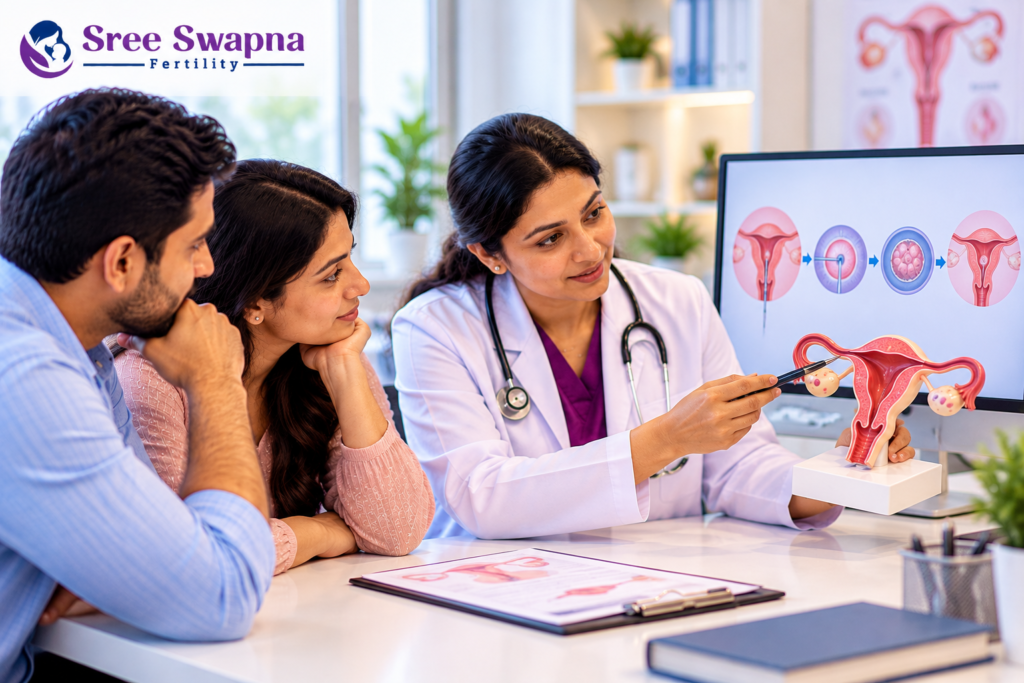
Hysteroscopy is a targeted procedure and is not automatically required for every IVF patient.
Related Fertility Topics to Understand
This topic is closely connected with several other parts of fertility evaluation and treatment. For a fuller picture, read the HSG vs hysteroscopy, then compare it with the recurrent implantation failure. Patients moving toward assisted reproduction may also find the IVF failure reasons useful, while the complete IVF process explains another related decision point. If treatment planning is already underway, the thin endometrium in IVF can help connect this topic with the next stage of care.
Fertility Guidance From Dr. Swapna Naik
At Sree Swapna Fertility Centre, patients can discuss hysteroscopy before IVF in the context of their complete fertility history rather than treating one test or symptom in isolation. Dr. Swapna Naik evaluates factors such as age, ovarian reserve, semen parameters, uterine and tubal health, previous treatment response and reproductive goals before recommending the next step. This individualized approach is especially important in fertility care because the same finding can have different implications for different patients.
Frequently Asked Questions
What is hysteroscopy?
Hysteroscopy Before Ivf refers to a fertility-related concept that should be interpreted in the context of age, symptoms, test results and the couple’s overall treatment plan. A fertility specialist can explain what it means for an individual case.
Is hysteroscopy mandatory before IVF?
It can influence IVF planning, but its importance depends on the broader clinical picture. The fertility team may adjust stimulation, embryo-transfer timing, medication support or additional evaluation based on the patient’s diagnosis.
Why is hysteroscopy done before IVF?
Several factors can contribute, and the exact cause may differ from one patient to another. Evaluation usually combines medical history, examination and targeted fertility tests rather than relying on one symptom or one laboratory value.
What can hysteroscopy detect?
The answer depends on the individual fertility history and clinical findings. For hysteroscopy before IVF, decisions are best made after reviewing the relevant tests, symptoms, age and reproductive goals with a fertility specialist.
Can hysteroscopy remove a uterine polyp?
The answer depends on the individual fertility history and clinical findings. For hysteroscopy before IVF, decisions are best made after reviewing the relevant tests, symptoms, age and reproductive goals with a fertility specialist.
Can hysteroscopy remove fibroids?
The answer depends on the individual fertility history and clinical findings. For hysteroscopy before IVF, decisions are best made after reviewing the relevant tests, symptoms, age and reproductive goals with a fertility specialist.
What is the difference between HSG and hysteroscopy?
Hysteroscopy Before Ivf refers to a fertility-related concept that should be interpreted in the context of age, symptoms, test results and the couple’s overall treatment plan. A fertility specialist can explain what it means for an individual case.
Can ultrasound replace hysteroscopy before IVF?
It can influence IVF planning, but its importance depends on the broader clinical picture. The fertility team may adjust stimulation, embryo-transfer timing, medication support or additional evaluation based on the patient’s diagnosis.
Is hysteroscopy painful?
The answer depends on the individual fertility history and clinical findings. For hysteroscopy before IVF, decisions are best made after reviewing the relevant tests, symptoms, age and reproductive goals with a fertility specialist.
Does hysteroscopy require anesthesia?
The answer depends on the individual fertility history and clinical findings. For hysteroscopy before IVF, decisions are best made after reviewing the relevant tests, symptoms, age and reproductive goals with a fertility specialist.
How long does hysteroscopy take?
Timing is individualized and can depend on the menstrual cycle, stimulation response, laboratory results and the treatment protocol. Follow the schedule given by the treating fertility team rather than changing medicines or appointments independently.
How long is recovery after hysteroscopy?
Timing is individualized and can depend on the menstrual cycle, stimulation response, laboratory results and the treatment protocol. Follow the schedule given by the treating fertility team rather than changing medicines or appointments independently.
When can IVF start after hysteroscopy?
Timing is individualized and can depend on the menstrual cycle, stimulation response, laboratory results and the treatment protocol. Follow the schedule given by the treating fertility team rather than changing medicines or appointments independently.
Can hysteroscopy improve implantation?
The answer depends on the individual fertility history and clinical findings. For hysteroscopy before IVF, decisions are best made after reviewing the relevant tests, symptoms, age and reproductive goals with a fertility specialist.
Is hysteroscopy useful after failed IVF?
It can influence IVF planning, but its importance depends on the broader clinical picture. The fertility team may adjust stimulation, embryo-transfer timing, medication support or additional evaluation based on the patient’s diagnosis.
Can hysteroscopy diagnose adhesions?
The appropriate tests depend on the clinical situation. A fertility evaluation may combine blood tests, ultrasound, semen testing, uterine or tubal assessment, and other investigations when clinically indicated.
Can hysteroscopy detect chronic endometritis?
The answer depends on the individual fertility history and clinical findings. For hysteroscopy before IVF, decisions are best made after reviewing the relevant tests, symptoms, age and reproductive goals with a fertility specialist.
Does hysteroscopy test the fallopian tubes?
The appropriate tests depend on the clinical situation. A fertility evaluation may combine blood tests, ultrasound, semen testing, uterine or tubal assessment, and other investigations when clinically indicated.
Are there risks with hysteroscopy?
Safety depends on the procedure, medical history and treatment protocol. Patients should discuss expected side effects, uncommon complications and warning symptoms with their fertility specialist before starting treatment.
Who should discuss hysteroscopy before IVF?
It can influence IVF planning, but its importance depends on the broader clinical picture. The fertility team may adjust stimulation, embryo-transfer timing, medication support or additional evaluation based on the patient’s diagnosis.
Conclusion
Hysteroscopy can be valuable when the clinical history or imaging suggests a uterine-cavity problem, but it should not be treated as a mandatory IVF step. Targeted use helps patients avoid unnecessary procedures while still identifying abnormalities that may need treatment.
Medical References
• ESHRE: Ovarian Stimulation for IVF/ICSI guideline update (2025)
• American Society for Reproductive Medicine: Practice Guidance
Medical review recommended before publication. Information is educational and does not replace individualized medical advice.
