
Thin Endometrium and IVF: Causes, Implantation Impact & Treatment Approach
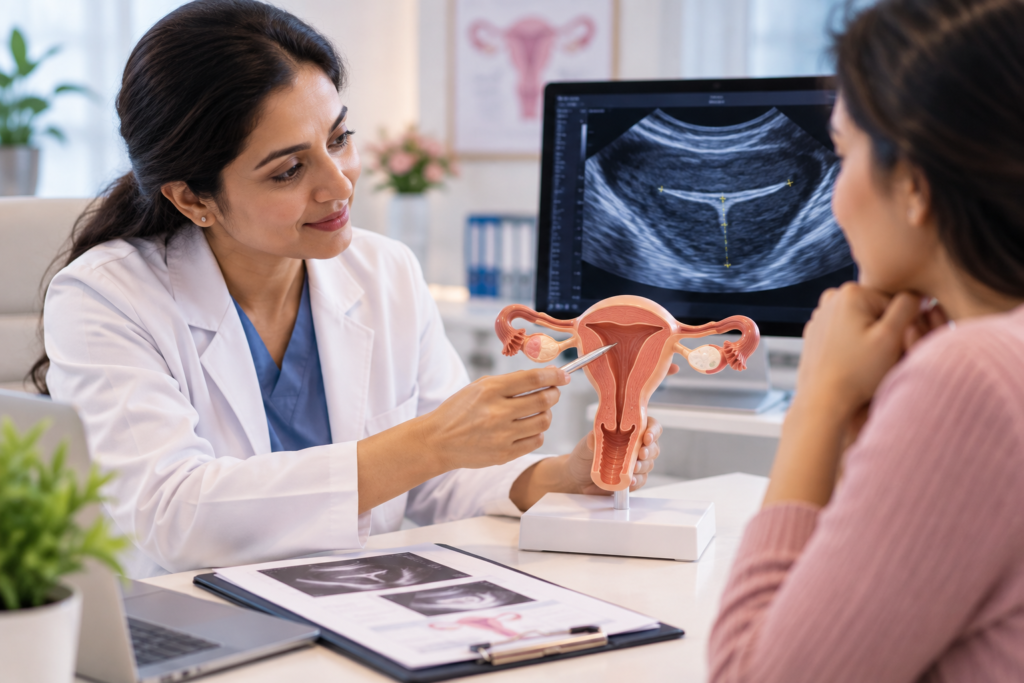
The endometrium is the inner lining of the uterus where an embryo implants. During IVF or frozen embryo transfer, ultrasound is commonly used to assess endometrial development. When the lining remains thinner than expected, patients often worry that implantation is impossible.
Thin endometrium is a clinical observation, not a complete diagnosis. Endometrial thickness is only one part of receptivity, and pregnancy can occur at a range of measurements. The useful question is why the lining is persistently thin in a particular patient and whether a correctable uterine or hormonal factor is present.
For a related clinical pathway, review IVF treatment.
You may also find hysteroscopy useful when planning the next step.
How Is Endometrial Thickness Measured?
Transvaginal ultrasound measures the endometrium in the midline, usually at its thickest point. Measurements can vary slightly between observers and with uterine position.
Searches for endometrial thickness IVF often focus on one target number. Clinics may use thresholds when deciding whether to proceed with transfer, but the relationship between thickness and outcome is continuous rather than a simple pass-or-fail line.
Possible Causes of a Thin Uterine Lining
A lining may remain thin because of inadequate estrogen exposure, previous uterine surgery or curettage, intrauterine adhesions, chronic endometrial injury or individual variation. Some patients have a thin lining without a clearly identifiable structural cause.
Medication response should be reviewed before assuming the uterus is abnormal. In frozen cycles, the route, dose and duration of estrogen or the timing of ovulation may affect development.
Related guide: recurrent implantation failure.
When Is Uterine Evaluation Needed?
If the lining is persistently thin, particularly after previous uterine procedures or with abnormal bleeding, the clinician may review the uterine cavity. Ultrasound, saline sonography and hysteroscopy answer different questions.
Hysteroscopy directly visualises the uterine cavity and can diagnose and sometimes treat intrauterine adhesions or polyps. It should be used when the history and findings make it clinically relevant, not as an automatic add-on for every thin lining.
Does Thin Endometrium Reduce Implantation?
Studies often show lower average implantation or pregnancy rates at very low endometrial measurements, but no single thickness perfectly predicts whether an embryo will implant. Embryo competence remains a major determinant of outcome.
Thin lining embryo transfer decisions therefore involve embryo availability, cycle history, the persistence of the thin measurement, cause, and whether further intervention is likely to improve the endometrium.
For additional context, see frozen embryo transfer timeline.
Treatment Approaches
Management begins with correcting the identifiable cause. In medicated cycles, estrogen exposure may be adjusted. If adhesions are present, hysteroscopic treatment may be appropriate. Other approaches advertised for thin endometrium have variable or limited evidence.
Patients should be cautious with expensive experimental treatments promoted as guaranteed lining boosters. Ask whether the intervention improves live birth rather than only changing ultrasound thickness.
Thin Endometrium Hyderabad: IVF Planning
For thin endometrium Hyderabad fertility care, bring records from previous cycles showing lining measurements, medication doses, hysteroscopy or surgery reports, and embryo information.
A useful plan should state whether the lining is consistently thin, whether the cavity has been adequately evaluated, what change is being attempted, and what the clinic will do if the target thickness is not reached.
Related Questions Patients Commonly Search
People researching this topic often use related phrases such as thin endometrium treatment, thin uterine lining IVF, endometrial thickness IVF, thin lining embryo transfer, thin endometrium implantation, and thin endometrium Hyderabad. These phrases describe overlapping questions, but diagnosis and treatment should be based on the individual clinical situation rather than on a search term.
When to Speak With a Fertility Specialist in Hyderabad
A specialist review is useful when symptoms, test results, age, previous treatment or the length of time trying to conceive make the next decision unclear. Bring previous reports and ask what finding is driving the recommendation, what alternatives are reasonable, and how success will be measured.
You can review fertility investigations for more context.
When you are ready for an individual review, book an appointment.
Practical Checklist Before Your Consultation
Before the appointment, use this checklist to turn online research into specific questions. It helps the clinician focus on findings that can change management and reduces the risk of ordering tests or procedures only because they are available.
- Is the lining consistently thin across cycles or only in one cycle?
- What estrogen route, dose and duration were used?
- Is there a history of uterine surgery, curettage, infection or abnormal bleeding?
- Has the uterine cavity been assessed with ultrasound, saline sonography or hysteroscopy when indicated?
- What evidence supports any proposed add-on treatment?
Bring previous reports, medication lists and procedure records where relevant. Ask for the reasoning behind each recommendation, the alternatives, the expected benefit and the point at which the plan would be reconsidered.
Frequently Asked Questions
1. What is thin endometrium?
It refers to an endometrial lining that remains thinner than expected during a fertility-treatment cycle.
2. What endometrial thickness is needed for IVF?
Clinics use different thresholds, and no single measurement guarantees or rules out pregnancy.
3. Can pregnancy occur with a thin lining?
Yes. Pregnancy is possible, although very thin measurements may be associated with lower average success in some studies.
4. What causes thin endometrium?
Possible causes include inadequate hormonal response, intrauterine adhesions, prior uterine procedures, chronic injury and individual variation.
5. Can previous D&C cause a thin lining?
It can be associated with intrauterine adhesions in some patients, especially when the lining is persistently thin afterward.
6. How is the uterine cavity checked?
Ultrasound, saline sonography and hysteroscopy may be used depending on the clinical question.
7. Does hysteroscopy increase lining thickness?
Hysteroscopy treats specific cavity problems such as adhesions; it is not a general thickness treatment when the cavity is normal.
8. Can estrogen improve a thin lining?
Adjusting estrogen may help in selected medicated cycles, but response varies.
9. Are PRP and G-CSF proven for thin endometrium?
Evidence remains limited for routine use. Ask whether an add-on has been shown to improve live birth.
10. Should embryo transfer be cancelled if the lining is thin?
The decision is individualized based on measurement, pattern, embryo availability, history and clinic protocol.
11. Does a trilaminar pattern matter?
Ultrasound pattern may be considered alongside thickness, but neither measure alone determines implantation.
12. Can thin endometrium cause recurrent implantation failure?
It may be one contributing factor in selected patients, but repeated failure requires a broader embryo and uterine review.
Key Takeaway
The best use of information about thin endometrium IVF is to improve the next clinical conversation. Use the article to understand the terminology and decision points, then confirm the diagnosis, evidence, risks and treatment options with the fertility team.
