
HSG vs Hysteroscopy: Which Test Checks Blocked Fallopian Tubes & Uterus?
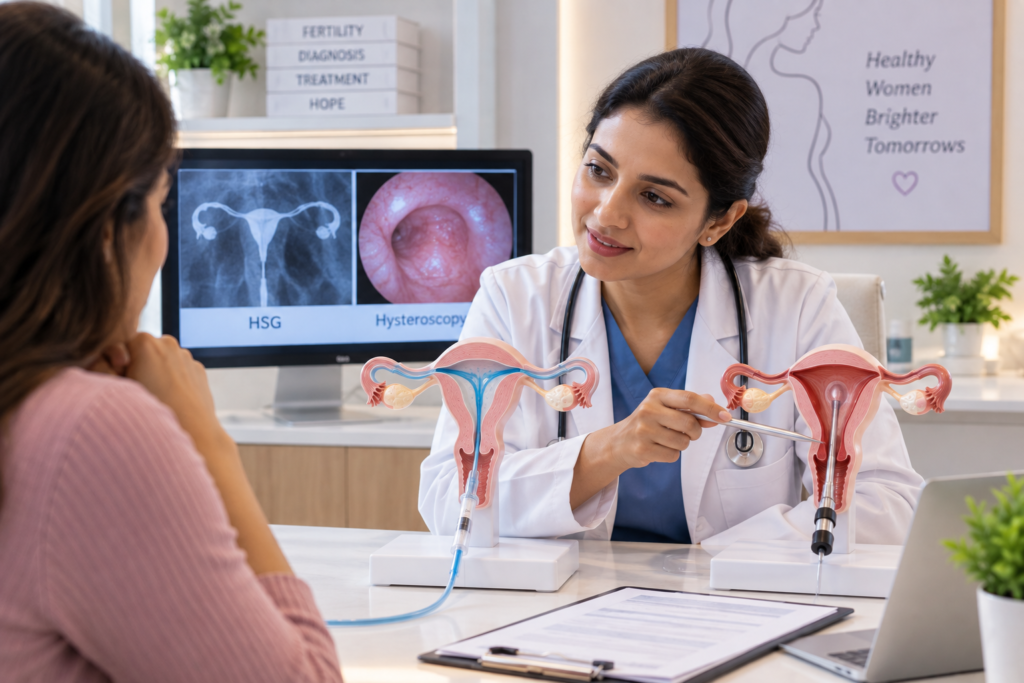
HSG and hysteroscopy are both used in fertility evaluation, but they answer different questions. Hysterosalpingography, or HSG, uses contrast and X-ray imaging to assess the uterine cavity outline and whether the fallopian tubes appear open. Hysteroscopy passes a small camera through the cervix to directly visualise the inside of the uterus.
Because the tests are different, one does not universally replace the other. HSG vs hysteroscopy should be chosen according to whether the main clinical concern is tubal patency, an intrauterine lesion, or both.
For a related clinical pathway, review fertility investigations.
You may also find hysteroscopy useful when planning the next step.
What Does an HSG Test Check?
HSG is commonly used to assess fallopian-tube patency. Contrast is introduced through the cervix and X-ray images show whether it passes through the tubes and spills into the pelvis.
HSG also outlines the uterine cavity and can suggest abnormalities, but it is less accurate than direct or sonographic cavity assessment for some polyps, submucosal fibroids and adhesions.
What Does Hysteroscopy Check?
Hysteroscopy allows direct visual examination of the uterine cavity. It can identify polyps, submucosal fibroids, adhesions and some uterine structural abnormalities.
It also has a treatment advantage: depending on the finding and setup, the clinician may be able to remove a polyp, divide adhesions or treat another cavity lesion during the procedure.
Related guide: secondary infertility causes.
HSG vs Hysteroscopy for Blocked Fallopian Tubes
If the clinical question is whether the fallopian tubes are open, HSG is generally more useful because hysteroscopy does not show the entire fallopian tubes. Hysteroscopy can see the tubal openings inside the uterus but cannot reliably demonstrate patency through to the pelvis.
A finding of blocked tubes on HSG sometimes requires interpretation or confirmation because temporary tubal spasm can mimic proximal blockage.
Which Test Is Better for the Uterine Cavity?
Hysteroscopy is considered the definitive method for diagnosing and treating intrauterine pathology. ASRM notes that it may be more invasive and costly than HSG or saline sonography when used only for diagnosis.
Ultrasound and saline infusion sonography may therefore be used before hysteroscopy depending on symptoms, history and the suspected lesion.
For additional context, see thin endometrium IVF.
Does Every Infertility Patient Need Both?
No. Test selection depends on age, duration of infertility, previous pregnancy, symptoms, pelvic infection or surgery history, ultrasound findings and the treatment being planned.
A patient going directly to IVF may need different tubal information from a patient planning natural conception or IUI. Similarly, abnormal bleeding or a suspected polyp may make cavity evaluation more important.
HSG Hyderabad and Hysteroscopy: Preparing for Testing
For HSG Hyderabad or hysteroscopy planning, ask when in the menstrual cycle the test is performed, whether pain medicine is recommended, what infection precautions are used, and how the result will change treatment.
Sree Swapna’s Investigation page lists HSG as a radiology test for cavity shape and tubal patency, while the Hysteroscopy page explains direct visualisation of the uterine lining and cavity.
Related Questions Patients Commonly Search
People researching this topic often use related phrases such as HSG test, hysteroscopy test, HSG vs hysteroscopy for infertility, blocked fallopian tubes test, uterine cavity test, and HSG Hyderabad. These phrases describe overlapping questions, but diagnosis and treatment should be based on the individual clinical situation rather than on a search term.
When to Speak With a Fertility Specialist in Hyderabad
A specialist review is useful when symptoms, test results, age, previous treatment or the length of time trying to conceive make the next decision unclear. Bring previous reports and ask what finding is driving the recommendation, what alternatives are reasonable, and how success will be measured.
You can review IVF treatment for more context.
When you are ready for an individual review, book a consultation.
Practical Checklist Before Your Consultation
Before the appointment, use this checklist to turn online research into specific questions. It helps the clinician focus on findings that can change management and reduces the risk of ordering tests or procedures only because they are available.
- Is the main question tubal patency, uterine-cavity pathology or both?
- Has ultrasound already shown a polyp, fibroid or suspected adhesion?
- Is HSG appropriate before IUI or natural-conception planning?
- Would hysteroscopy diagnose and potentially treat the suspected cavity lesion?
- How will the result change the fertility plan?
Bring previous reports, medication lists and procedure records where relevant. Ask for the reasoning behind each recommendation, the alternatives, the expected benefit and the point at which the plan would be reconsidered.
Frequently Asked Questions
1. What is HSG?
Hysterosalpingography is an X-ray test using contrast to evaluate the uterine cavity outline and fallopian-tube patency.
2. What is hysteroscopy?
It is direct visual examination of the uterine cavity using a thin telescope passed through the cervix.
3. Which test checks blocked fallopian tubes?
HSG is commonly used to assess whether contrast passes through the fallopian tubes.
4. Can hysteroscopy show blocked tubes?
It can see the tubal openings inside the uterus but does not evaluate the full tubes the way HSG does.
5. Which test is better for polyps?
Hysteroscopy directly visualises the cavity and can diagnose and often treat polyps.
6. Can HSG detect fibroids?
It may suggest submucosal or cavity-distorting abnormalities, but other imaging or hysteroscopy may better define them.
7. Is HSG painful?
Cramping can occur during contrast injection. Experience varies between patients.
8. Does hysteroscopy require anaesthesia?
Office diagnostic hysteroscopy may use little or no anaesthesia, while operative procedures may require more. Protocols vary.
9. Can HSG show false blockage?
Yes. Tubal spasm or technical factors can sometimes mimic proximal blockage.
10. Do I need both HSG and hysteroscopy before IVF?
Not automatically. Testing depends on history, prior imaging and the treatment plan.
11. When is HSG performed?
It is commonly scheduled after menstruation and before ovulation; follow the clinic’s specific cycle instructions.
12. Can hysteroscopy treat a problem at the same time?
Depending on the setup, polyps, adhesions or submucosal lesions may sometimes be treated during hysteroscopy.
Key Takeaway
The best use of information about HSG vs hysteroscopy is to improve the next clinical conversation. Use the article to understand the terminology and decision points, then confirm the diagnosis, evidence, risks and treatment options with the fertility team.
