
What Is an Endometrial Polyp?
An endometrial polyp is an overgrowth of tissue arising from the lining of the uterus. Polyps vary in size, number and location. Some are found incidentally during an ultrasound, while others are investigated because of irregular bleeding, infertility or an abnormal uterine-cavity finding. The presence of a polyp does not automatically mean it is the cause of infertility, so the finding should be interpreted alongside age, ovulation, tubal health and sperm factors.
From a fertility perspective, the most relevant question is whether a polyp changes the uterine cavity where an embryo may implant. A small lesion in one patient may have little clinical importance, while a larger or strategically located polyp may be more significant. This is why a fertility specialist evaluates the entire reproductive history rather than treating a scan report in isolation.

Endometrial polyps are focal growths arising from the uterine lining.
Can Endometrial Polyps Affect Fertility or Implantation?
Endometrial polyps may interfere with the uterine environment in some patients. Possible mechanisms include local inflammation, altered endometrial receptivity and physical distortion of the cavity. However, fertility is multifactorial. A patient with a polyp may also have diminished ovarian reserve, tubal disease, endometriosis or a male-factor issue, and those factors may contribute more strongly to the delay in conception.
For patients with repeated implantation problems, uterine-cavity assessment may be one part of a wider review. Read the existing Sree Swapna guide on recurrent implantation failure to understand why embryo, uterine, endometrial and treatment factors are considered together.
How Are Endometrial Polyps Diagnosed?
Transvaginal ultrasound is often the first test to suggest an endometrial polyp. Depending on the timing of the scan and the appearance of the cavity, a saline infusion sonography or hysteroscopy may provide a clearer view. Hysteroscopy has the advantage of directly visualizing the uterine cavity and can sometimes diagnose and treat a suitable polyp during the same procedure.
Different fertility tests answer different questions. HSG is mainly used to evaluate fallopian-tube patency and also outlines the cavity, while hysteroscopy directly examines the inside of the uterus. Patients can compare these investigations in the existing HSG vs hysteroscopy article.
When Is Hysteroscopic Polyp Removal Considered?
Hysteroscopic polypectomy is a minimally invasive procedure in which a camera and fine instruments are passed through the cervix to remove a polyp from inside the uterus. Removal may be discussed when a polyp is thought to distort the cavity, when abnormal bleeding is present, before certain fertility treatments, or when the clinical history suggests the finding may be relevant.
Not every tiny polyp requires immediate surgery. The decision should consider symptoms, size, location, age, fertility treatment plan and whether there are stronger competing causes of infertility. A targeted approach helps avoid unnecessary procedures while still addressing findings that may matter.
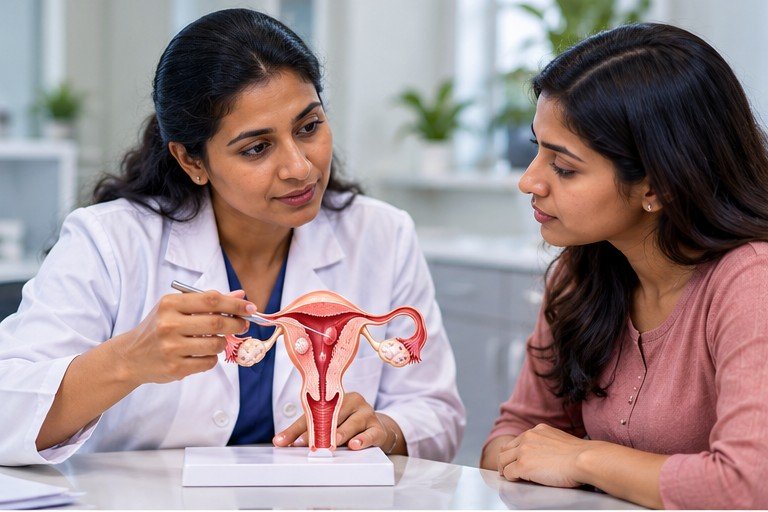
Uterine-cavity findings should be interpreted alongside the complete fertility history.
Endometrial Polyps Before IVF or Embryo Transfer
Before IVF or frozen embryo transfer, the fertility team may review the uterine cavity to make sure there is no clinically important lesion that could interfere with implantation. If a polyp is identified, the team considers whether removal is likely to improve the uterine environment enough to justify postponing treatment.
The complete IVF process includes ovarian stimulation, egg retrieval, fertilization, embryo culture and embryo transfer, but success also depends on a suitable uterine environment. For this reason, uterine findings are evaluated in the context of the whole IVF plan rather than as an isolated checklist item.
Polyps, Thin Endometrium and Other Uterine Findings
Endometrial polyps are different from a thin endometrium, fibroids, adhesions and chronic endometritis, although more than one condition can coexist. A thin lining refers to endometrial thickness, while a polyp is a focal tissue overgrowth. Fibroids arise from uterine muscle, and chronic endometritis is an inflammatory condition of the endometrium.
Distinguishing these conditions matters because the treatment is different. The existing Sree Swapna articles on thin endometrium in IVF and chronic endometritis provide useful background for patients undergoing uterine or implantation evaluation.
Can Polyps Return After Removal?
Endometrial polyps can recur in some patients after hysteroscopic removal. Recurrence does not mean that repeated hysteroscopy is automatically needed. Follow-up depends on symptoms, fertility plans, ultrasound findings and whether a new cavity abnormality is suspected.
For a patient preparing for fertility treatment, the fertility specialist may repeat imaging when clinically appropriate rather than following a fixed testing schedule for everyone.
When Should You Speak With a Fertility Specialist?
Consider a fertility review if pregnancy has not occurred within the expected time for your age, if there is recurrent pregnancy loss, repeated implantation difficulty, abnormal uterine bleeding, or a scan showing a possible cavity lesion. The aim of the consultation is to determine whether the polyp is actually relevant and what other fertility factors should be evaluated.
At Sree Swapna Fertility Centre, Dr. Swapna Naik can review the uterine finding in the context of ovarian reserve, fallopian-tube status, semen analysis, previous treatment history and reproductive goals. A complete plan is more useful than assuming every uterine finding requires surgery.
Fertility Guidance From Dr. Swapna Naik
At Sree Swapna Fertility Centre, Dr. Swapna Naik evaluates endometrial polyps in the context of age, ovarian reserve, tubal health, semen factors, previous fertility treatment and reproductive goals. This helps determine whether a polyp is likely to be clinically relevant and whether hysteroscopic treatment is appropriate before natural conception, IUI, IVF or embryo transfer.
Frequently Asked Questions
Can endometrial polyps cause infertility?
They may contribute to infertility in some patients, especially when they alter the uterine cavity, but they are not the only possible cause. A complete fertility evaluation is needed.
Can a uterine polyp prevent implantation?
A polyp may interfere with implantation depending on its size and location, but implantation also depends on embryo and other uterine factors.
Can I get pregnant naturally with an endometrial polyp?
Yes. Many people with small or incidental polyps conceive naturally. The clinical relevance depends on the full fertility picture.
Do polyps cause miscarriage?
Some cavity abnormalities may be associated with pregnancy loss, but a polyp does not prove the cause of a miscarriage. Recurrent loss needs a broader evaluation.
How are endometrial polyps diagnosed?
Transvaginal ultrasound, saline sonography and hysteroscopy may be used depending on the clinical situation.
Can ultrasound detect a uterine polyp?
Ultrasound can often suggest a polyp, although additional cavity imaging may be needed when the diagnosis is uncertain.
Can HSG detect polyps?
HSG may show a filling defect in the cavity, but hysteroscopy or saline sonography can provide more direct cavity assessment.
Is hysteroscopy the best test for polyps?
Hysteroscopy directly visualizes the cavity and can allow treatment, but the best test depends on the clinical question and prior imaging.
How are uterine polyps removed?
Suitable polyps are commonly removed with hysteroscopic polypectomy through the cervix without an abdominal incision.
Is hysteroscopic polyp removal painful?
Discomfort varies with the procedure and anesthesia approach. Patients should discuss pain control and recovery with the treating team.
Does every endometrial polyp need removal?
No. The decision depends on symptoms, size, location, fertility history and planned treatment.
Should a polyp be removed before IVF?
Removal may be considered when the polyp is thought to affect the cavity, but this should be individualized rather than automatic.
Should a polyp be removed before frozen embryo transfer?
The fertility team may recommend removal if the lesion is clinically relevant to the uterine cavity before transfer.
How long after polyp removal can IVF start?
Timing depends on the extent of the procedure, healing and the treatment plan. Follow the schedule recommended by the fertility specialist.
Can endometrial polyps return?
Yes, recurrence can occur. Follow-up is based on symptoms and fertility needs rather than routine repeated procedures for everyone.
Are endometrial polyps cancerous?
Most are benign, but tissue removed during hysteroscopy may be sent for histopathology when clinically indicated.
Can polyps cause irregular bleeding?
Yes. Irregular or heavy bleeding can occur, although some polyps cause no symptoms.
Can polyps be confused with fibroids?
Yes, imaging sometimes needs to distinguish an endometrial polyp from a submucosal fibroid because treatment planning differs.
Can polyps coexist with thin endometrium or endometritis?
Yes. Different uterine and endometrial conditions can coexist, so evaluation should identify the specific abnormality.
When should infertility patients be checked for uterine polyps?
Testing may be considered when symptoms, imaging, repeated implantation difficulty or treatment planning raises concern about the uterine cavity.
Conclusion
Endometrial polyps can be relevant to fertility when they alter the uterine cavity, but the best decision is individualized. Accurate diagnosis, appropriate hysteroscopic treatment when indicated, and assessment of the rest of the fertility picture can help avoid both missed problems and unnecessary procedures.
Medical References
• World Health Organization: infertility guidance
• American Society for Reproductive Medicine: practice guidance
