
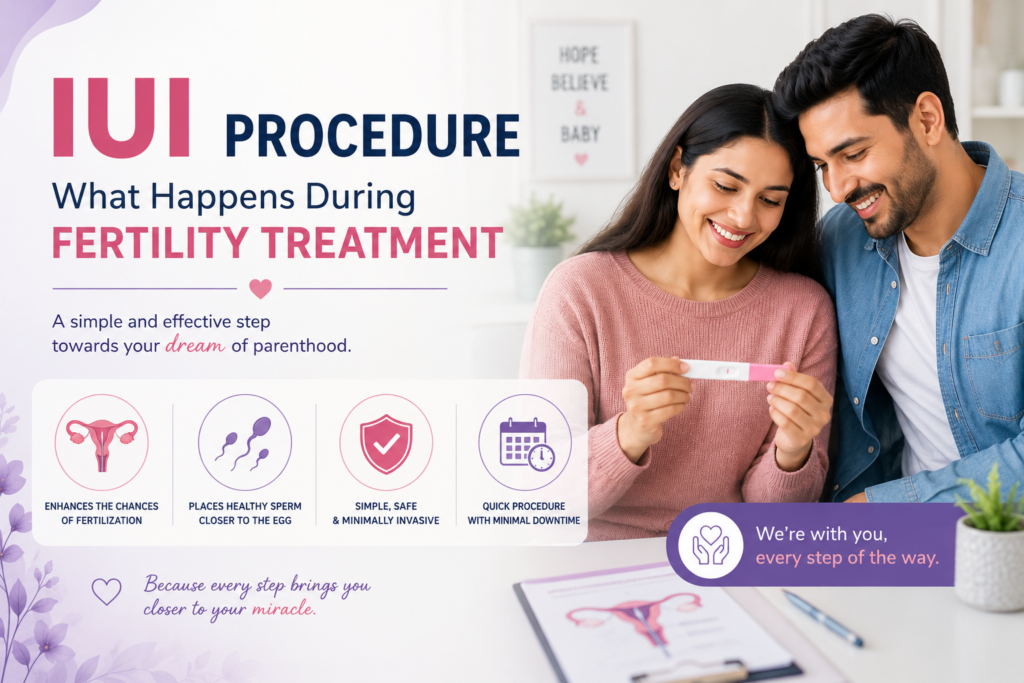
IUI Procedure Step-by-Step: What Happens During Fertility Treatment
The journey to parenthood is deeply personal, and for many couples, it can feel like an emotional rollercoaster. If you have been trying to conceive month after month without success, feelings of frustration, anxiety, and heartbreak are completely normal. However, medical advancements have made building a family more accessible than ever. If you are exploring fertility treatments, your doctor may have recommended an IUI procedure.
Understandably, stepping into the world of fertility treatments can feel overwhelming. You likely have questions about what the process involves, how much discomfort to expect, and what your actual chances of success are.
This comprehensive guide will walk you through the IUI procedure step-by-step, removing the mystery and helping you feel confident and prepared for your treatment.
What is an IUI Procedure? (Quick Answer)
An IUI procedure (Intrauterine Insemination) is a simple, non-surgical fertility treatment where concentrated, washed sperm is directly placed into a woman’s uterus around the time of ovulation. This process increases the number of healthy sperm reaching the fallopian tubes, significantly improving the chances of fertilization and a successful pregnancy.
Signs and Symptoms It Might Be Time for an IUI Procedure
Infertility is generally defined as the inability to conceive after one year of unprotected intercourse (or six months if the woman is over 35). While infertility itself does not always present physical symptoms, there are several signs that indicate it might be time to consult a specialist about an IUI procedure:
- Irregular Menstrual Cycles: Unpredictable periods can indicate ovulation issues.
- Painful Periods (Dysmenorrhea): Severe pelvic pain could point to mild endometriosis, which is often treated with IUI in its early stages.
- Previous Unsuccessful Conceptions: Trying naturally for 12+ months without a positive pregnancy test.
- Male Factor Indicators: Previous semen analysis showing slightly low motility or sperm count.
Common Causes Addressed by IUI
Why might a doctor recommend an IUI procedure over other fertility treatments? IUI is highly effective for specific medical scenarios, including:
- Unexplained Infertility: When standard tests show no obvious cause for infertility, IUI combined with ovulation-inducing medications is often the first line of treatment.
- Mild Male Factor Infertility: If a partner has a slightly below-average sperm count, weak motility, or poor morphology, the sperm washing process used in IUI concentrates the healthiest sperm for the best chance of success.
- Cervical Mucus Issues: Sometimes, a woman’s cervical mucus is too thick, preventing sperm from traveling to the egg. IUI bypasses the cervix entirely, placing the sperm directly into the uterus.
- Donor Sperm: IUI is the most common method used for single women or couples utilizing donor sperm to achieve pregnancy.
Risk Factors to Consider
While the IUI procedure is generally safe and minimally invasive, certain risk factors can affect its success rate or indicate that a different treatment might be necessary:
- Age: Success rates for IUI decline significantly for women over the age of 40 due to decreased egg quality.
- Tubal Blockages: IUI requires at least one healthy, open fallopian tube. If both tubes are blocked, IVF is the necessary alternative.
- Severe Male Infertility: If sperm count or motility is extremely low, IUI may not be effective.
- Multiple Pregnancies: When IUI is paired with fertility drugs (like Clomid or Letrozole), there is a slightly increased risk of having twins or multiples.
Diagnosis: Preparing for Your Treatment
Before beginning an IUI cycle, your fertility specialist will conduct a thorough diagnosis to ensure this is the right path for you.
- Ovarian Reserve Testing: Blood tests (such as AMH and FSH) and transvaginal ultrasounds to check egg supply.
- Hysterosalpingogram (HSG): An X-ray procedure to confirm that your fallopian tubes are open and the uterine cavity is normal.
- Semen Analysis: A detailed evaluation of the male partner’s sperm count, shape, and movement.
The IUI Procedure Step-by-Step (Non-Surgical Treatment)
Many patients are relieved to learn that an IUI procedure is a non-surgical, straightforward outpatient process. It closely mimics natural conception, just with a helpful medical boost. Here is exactly what happens during a typical cycle:
Step 1: Ovarian Stimulation and Monitoring
Depending on your specific needs, your doctor may recommend a “natural cycle” (using no medications) or a “stimulated cycle” (using oral or injectable fertility drugs to produce one or two mature eggs). During this time, you will visit the clinic for frequent ultrasounds and blood tests to monitor follicle growth.
Step 2: Triggering Ovulation
Once the ultrasound confirms that a follicle is mature, you will receive a “trigger shot” of hCG (human chorionic gonadotropin). This injection tells your ovaries to release the egg within the next 36 to 40 hours.
Step 3: Sperm Collection and Washing
On the day of the IUI procedure, the male partner provides a semen sample (or donor sperm is thawed). The laboratory then “washes” the sperm. This vital step removes seminal fluid, dead sperm, and impurities, leaving only a highly concentrated sample of the most active, healthy sperm.
Step 4: The Insemination Process
The actual insemination takes only a few minutes and is virtually painless. You will lie on an exam table, much like during a routine Pap smear. The doctor will insert a speculum, followed by a very thin, flexible catheter through your cervix and into your uterus. The washed sperm is then gently pushed through the catheter.
Step 5: Rest and Recovery
After the catheter is removed, yo u will be asked to lie flat for about 10 to 15 minutes. After that, you can resume your normal daily activities. You may experience mild spotting or light cramping, but this is completely normal.
Step 6: The Two-Week Wait
Approximately two weeks after the IUI procedure, you will return to the clinic for a beta hCG blood test to determine if you are pregnant.
IUI vs. IVF Comparison
Feature | IUI (Intrauterine Insemination) | IVF (In Vitro Fertilization) |
|---|---|---|
Location of Fertilization | Inside the woman’s body (fallopian tubes) | Outside the body (in a laboratory) |
Invasiveness | Low (Non-surgical) | High (Requires surgical egg retrieval) |
Medication Requirement | Minimal to moderate | High (Daily injections) |
Cost | More affordable | Higher investment |
Best For | Unexplained infertility, mild male factor, cervical issues | Blocked tubes, severe male factor, advanced age |
Prevention Tips: Maximizing Your IUI Success
While you cannot control every aspect of fertility, adopting certain lifestyle habits can optimize your body for a successful IUI cycle:
- Maintain a Healthy Diet: Focus on antioxidants, leafy greens, lean proteins, and whole grains to improve egg and sperm quality.
- Manage Stress: The fertility journey is stressful, but chronic stress can disrupt hormones. Incorporate yoga, meditation, or counseling into your routine.
- Limit Toxins: Quit smoking, limit alcohol intake, and reduce caffeine consumption during your treatment cycle.
- Take Supplements: Ensure you are taking a high-quality prenatal vitamin with folic acid at least three months prior to treatment.
When to See a Doctor
If you are under 35 and have been trying to conceive for a year, or if you are over 35 and have been trying for six months, it is time to consult a fertility specialist. Furthermore, if you have a known condition such as PCOS, endometriosis, or irregular periods, do not wait—seek professional guidance immediately.
The Benefits of Early Treatment
Time is one of the most critical factors in reproductive medicine. A woman’s ovarian reserve naturally declines with age, particularly after 35. Seeking an early evaluation allows your doctor to identify underlying issues before they worsen. Early intervention with an IUI procedure can save you valuable time, reduce emotional burnout, and often prevent the need for more invasive treatments down the road.
Why Choose Sree Swapna Fertility Centre?
Choosing the right clinic is a deeply personal decision that dramatically impacts your overall experience. As the Best IVF Centre in Hyderabad, Sree Swapna Fertility Centre is dedicated to providing compassionate, evidence-based care tailored to your unique biology.
Whether you are visiting us from nearby neighborhoods and searching for the Best IVF Centre in Kondapur, or you are traveling across the city looking for the Best IVF Centre in Attapur, our state-of-the-art laboratory and experienced clinical team are here to support you. We believe in transparency, ethical practices, and walking with you every step of the way until you bring your baby home.
Doctor Consultation: Meet Our Expert Fertility Specialists
Do not let confusion or fear delay your dreams of building a family. At Sree Swapna Fertility Centre, our expert fertility and reproductive specialists are ready to review your medical history, answer all your questions, and design a customized treatment plan.
During your consultation, we will honestly discuss whether an IUI procedure is your best starting point, ensuring you feel empowered and informed about your body.
FAQs
Q1: Is the IUI procedure painful?
No, the procedure itself is not typically painful. Most women compare the sensation to a routine Pap smear. You may experience minor cramping during the catheter insertion, but it passes very quickly.
Q2: How many IUI cycles should I try before moving to IVF?
Most fertility specialists recommend trying 3 to 4 cycles of IUI. If pregnancy has not occurred after multiple attempts, the chances of success with further IUI cycles drop, and transitioning to IVF is usually recommended.
Q3: Can I choose the gender of my baby with an IUI procedure?
No. Because fertilization happens naturally inside the body, there is no way to screen embryos for gender or genetic anomalies during an IUI. Gender selection and genetic testing are only possible with IVF.
Q4: How long does the sperm washing process take?
The laboratory typically takes 1 to 2 hours to carefully wash, analyze, and prepare the sperm sample before the insemination procedure can take place.
Q5: What should I avoid after an IUI procedure?
You can generally return to normal activities immediately. However, doctors advise against extreme heavy lifting, intense high-impact workouts, and hot tubs during the two-week wait to give the embryo the best environment for implantation.
Take the First Step Toward Parenthood Today
Your dream of having a baby is closer than you think. Don’t navigate the complex world of fertility alone. Schedule your consultation with the leading experts at Sree Swapna Fertility Centre and let us help you build the family you’ve always wanted.
Book Your Appointment Now!
📞 Call us at: 7670804424
🌐 Visit: https://sreeswapnaivf.com
