
Getting a semen analysis report back with the word “teratozoospermia” or “abnormal morphology” circled in red can be alarming — especially when everything else about the report looks normal. Many men come across this term for the first time only after months of trying to conceive without success, and the medical language doesn’t make it any less confusing.
Here’s the reassuring part: abnormal sperm morphology is one of the most common — and most treatable — causes of male infertility. It rarely means “no chance of biological fatherhood.” It simply means the path to conception may need a more targeted approach.
At Sree Swapna Fertility Centre in Hyderabad, we work with couples facing exactly this diagnosis every week. This guide explains what abnormal sperm morphology actually means, what causes it, how it’s diagnosed, and the treatment options available — including where low sperm morphology treatment in India typically starts, and when advanced techniques like ICSI become the better path forward.
What Is Sperm Morphology, and What Counts as “Abnormal”?
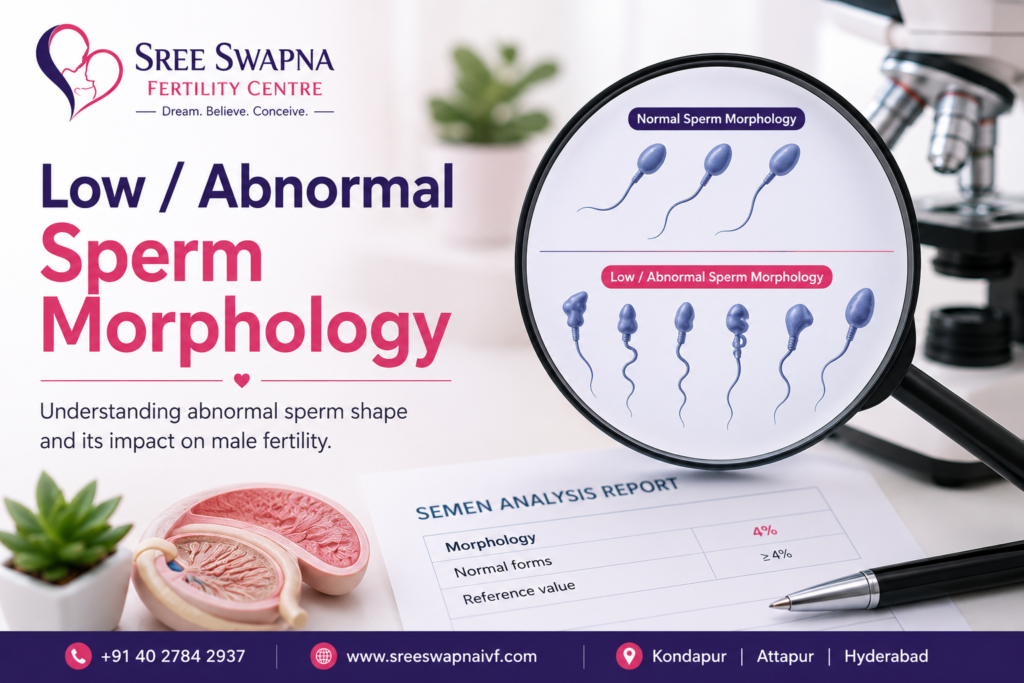
Sperm morphology refers to the size and shape of sperm cells — specifically the head, midpiece, and tail. A “normal” sperm has an oval head, a well-defined midpiece, and a single straight tail, all of which help it swim efficiently and penetrate an egg.
According to WHO 2021 laboratory guidelines, a semen sample is classified as having teratozoospermia (abnormal morphology) when fewer than 4% of sperm show normal shape under strict microscopic evaluation. This threshold often surprises people — even fertile men typically have a large proportion of abnormally shaped sperm, since sperm production is a naturally imperfect process. What matters clinically is whether the percentage of normal forms falls below this reference range.
Common structural abnormalities include:
- Head defects — large, small, tapered, or double heads
- Midpiece defects — bent or thickened midpieces
- Tail defects — coiled, short, or multiple tails
What Causes Abnormal Sperm Morphology?
In many cases, the exact cause remains unidentified — this is termed idiopathic teratozoospermia. However, several known contributing factors include:
- Varicocele — enlarged veins in the scrotum, one of the most common correctable causes of poor sperm morphology
- Oxidative stress — excess reactive oxygen species in semen have been linked to a higher proportion of abnormal sperm forms
- Infections — including untreated urogenital infections
- Lifestyle factors — smoking, alcohol use, prolonged heat exposure (tight underwear, laptop use on the lap, frequent sauna/steam use), and obesity
- Environmental toxin exposure — pesticides, heavy metals, and certain occupational chemical exposures
- Hormonal imbalances — including issues with testosterone or thyroid function
- Genetic factors — rare inherited conditions can cause more severe, uniform morphology defects
How Is Abnormal Sperm Morphology Diagnosed?
Diagnosis begins with a semen analysis, evaluated against WHO reference criteria. If morphology is found to be abnormal, your fertility specialist may recommend additional tests to identify an underlying cause and guide treatment, such as:
- Scrotal ultrasound, to check for varicocele
- Hormonal blood tests, to assess testosterone, FSH, LH, and thyroid function
- Sperm DNA fragmentation testing, since morphology abnormalities are sometimes associated with higher DNA fragmentation, which can affect embryo development
- Infection screening, if there are signs of a urogenital infection
It’s worth noting that morphology is just one of three parameters assessed in a semen analysis, alongside sperm count and motility. A diagnosis is always made in the context of the full report, not morphology in isolation.
Treatment Options for Abnormal Sperm Morphology
Treatment is tailored to the identified cause and the couple’s overall fertility profile. Options generally fall into three categories:
1. Lifestyle and Medical Management
For mild cases, especially where lifestyle factors are contributing, doctors often recommend:
- Quitting smoking and reducing alcohol intake
- Avoiding prolonged heat exposure to the scrotal area
- Weight management, where relevant
- Antioxidant supplementation, which some studies suggest may improve sperm parameters over a 3-month cycle (the approximate time needed for new sperm to mature)
- Treating any underlying infection with appropriate medication
2. Surgical Correction
If a varicocele is identified as a contributing factor, varicocele repair (varicocelectomy) may improve sperm morphology and other semen parameters over subsequent months. This is typically considered when the varicocele is clinically significant and correlates with the semen analysis findings.
3. Assisted Reproductive Technology (ART)
When lifestyle changes and medical management aren’t enough, or when morphology is severely abnormal, ART becomes the most effective route to conception:
- IUI (Intrauterine Insemination) may be considered for mild cases, particularly when combined with ovulation induction in the female partner, though success depends on morphology severity and other sperm parameters.
- IVF (In Vitro Fertilisation) allows embryologists to select the best-available sperm for fertilisation in a lab setting.
- ICSI (Intracytoplasmic Sperm Injection) is generally the preferred and most effective option for moderate-to-severe teratozoospermia. In ICSI, a single, carefully selected sperm is injected directly into an egg — bypassing the natural barriers that abnormal morphology would otherwise make difficult to overcome.
It’s important to set realistic expectations: no fertility treatment guarantees a specific outcome, and success depends on multiple factors beyond sperm morphology alone, including the female partner’s fertility profile and overall reproductive health.
Why the Right Diagnosis Matters Before Choosing Treatment
One of the most common mistakes couples make is jumping straight to “the strongest treatment” without first understanding the underlying cause. A varicocele-related morphology issue may respond well to surgical correction, avoiding the need for ART altogether. On the other hand, idiopathic or severe cases usually benefit more from moving directly to ICSI rather than spending months on treatments unlikely to make a meaningful difference. This is why a thorough diagnostic work-up — not just a single semen report — should always guide the treatment plan.
How Sree Swapna Fertility Centre Approaches Male Factor Infertility
At Sree Swapna Fertility Centre, male factor infertility — including abnormal sperm morphology — is evaluated as thoroughly as female fertility factors, rather than being treated as a footnote. Under the guidance of Dr. Swapna Naik (MBBS, MS in Obstetrics & Gynaecology, Fellowship in Reproductive Medicine & IVF), with over 15 years of experience and involvement in more than 5,000 successful IVF cycles, our approach starts with a complete diagnostic picture — semen analysis, hormonal assessment, and imaging where needed — before recommending a treatment path.
Both our Kondapur (flagship) and Attapur centres are equipped with an in-house andrology lab, allowing semen analysis and sperm preparation to be conducted on-site rather than through an external, disconnected lab. For couples requiring ART, we offer the full spectrum of options — IUI, IVF, and ICSI — along with advanced sperm retrieval techniques (TESA/PESA) for cases involving obstructive or severe male factor infertility. Every treatment plan is personalised, explained clearly, and supported by dedicated counsellors who help couples understand each step and what to realistically expect.
If a varicocele or other surgically correctable issue is identified, our team can also guide you through that pathway before considering ART, ensuring you’re not moved toward more intensive treatment than necessary.
Frequently Asked Questions
1. What is considered abnormal sperm morphology?
Under WHO 2021 criteria, a semen sample with fewer than 4% normal-shaped sperm is classified as teratozoospermia.
2. Can abnormal sperm morphology be cured?
It depends on the cause. Lifestyle-related or infection-related cases can often improve with treatment, while idiopathic or severe cases are usually managed through ART rather than “cured” outright.
3. Can men with poor sperm morphology still conceive naturally?
Yes, particularly in mild cases, though the chances are generally lower than with normal morphology, especially if other semen parameters are also affected.
4. How long does it take to improve sperm morphology?
Since sperm take about 74 days to mature, any lifestyle or medical intervention typically needs at least 3 months before improvement can be assessed on a repeat semen analysis.
5. Does age affect sperm morphology?
Yes, sperm morphology can decline gradually with age, though the effect is generally less pronounced than the age-related decline seen in female fertility.
6. What is teratozoospermia?
Teratozoospermia is the medical term for a semen sample containing a higher-than-normal proportion of abnormally shaped sperm.
7. Is teratozoospermia the same as low sperm count?
No. Morphology (shape), count (concentration), and motility (movement) are three separate semen parameters, though they can occur together or independently.
8. Can varicocele cause abnormal sperm morphology?
Yes, varicocele is one of the most common correctable causes of poor sperm morphology and other semen abnormalities.
9. Is ICSI necessary for abnormal sperm morphology?
ICSI is often recommended for moderate-to-severe cases because it allows direct selection and injection of the best available sperm, but it isn’t automatically necessary for milder cases.
10. Can lifestyle changes alone fix abnormal sperm morphology?
In mild, lifestyle-related cases, yes — quitting smoking, reducing heat exposure, and weight management can meaningfully improve parameters over a few months.
11. Do antioxidant supplements help sperm morphology?
Some studies suggest antioxidants may support sperm parameters, but they should be taken under medical guidance rather than self-prescribed, and results vary between individuals.
12. How is sperm morphology tested?
Through a semen analysis, where sperm are stained and evaluated under a microscope against strict WHO criteria.
13. Can stress affect sperm morphology?
Chronic stress has been associated with changes in semen parameters in some studies, though it’s rarely the sole cause of teratozoospermia.
14. What is the difference between IUI, IVF, and ICSI for male factor infertility?
IUI places prepared sperm directly into the uterus and works best for milder cases; IVF fertilises eggs with sperm in a lab dish; ICSI injects a single selected sperm directly into an egg, making it the most direct option for significant morphology issues.
15. Can obesity affect sperm morphology?
Yes, obesity is associated with hormonal changes and increased scrotal temperature, both of which can negatively affect sperm shape and other parameters.
16. Should I get a second semen analysis before starting treatment?
Yes, semen parameters can vary between samples, so most specialists recommend at least two analyses, a few weeks apart, before finalising a treatment plan.
17. Can smoking really affect sperm shape?
Yes, smoking is one of the most well-documented lifestyle factors linked to abnormal sperm morphology and reduced fertility potential.
18. Is surgery always needed if a varicocele is found?
Not always — treatment depends on the varicocele’s size, its correlation with semen parameters, and the couple’s overall fertility goals.
19. Can abnormal morphology affect embryo quality in IVF?
Yes, since fertilisation and early embryo development depend partly on sperm quality, which is why ICSI is often preferred in significant morphology cases to select the healthiest available sperm.
20. How soon can treatment start after diagnosis?
This depends on the recommended pathway — lifestyle changes may run for a few months before reassessment, while ART can often begin within the same or following treatment cycle after diagnostic work-up is complete.
21. Does Sree Swapna Fertility Centre treat male infertility along with female fertility issues?
Yes, our team evaluates and treats both partners together, since fertility outcomes often depend on addressing both male and female factors.
22. Where can I get a semen analysis done in Hyderabad?
Sree Swapna Fertility Centre offers in-house semen analysis and andrology testing at both our Kondapur and Attapur clinics.
Conclusion
An abnormal sperm morphology diagnosis can feel overwhelming, but it’s one of the most manageable causes of male infertility when addressed with the right diagnostic approach and treatment plan. Whether the path forward involves lifestyle changes, surgical correction, or assisted reproductive technology like ICSI, the key is getting a clear, personalised evaluation rather than guessing at the cause.
Talk to Our Fertility Specialists in Hyderabad
If you or your partner have received a teratozoospermia diagnosis, Dr. Swapna Naik and the team at Sree Swapna Fertility Centre are here to guide you through a clear, judgment-free treatment plan.
📞 Call: +91 76708 04424 / +91 40 4995 3719 💬 WhatsApp: Message us directly 📧 Email: sreeswapna.fertility@gmail.com 📍 Visit us at: Kondapur (flagship centre) or Attapur, Hyderabad 🌐 Book an appointment: sreeswapnaivf.com/contact-us
