
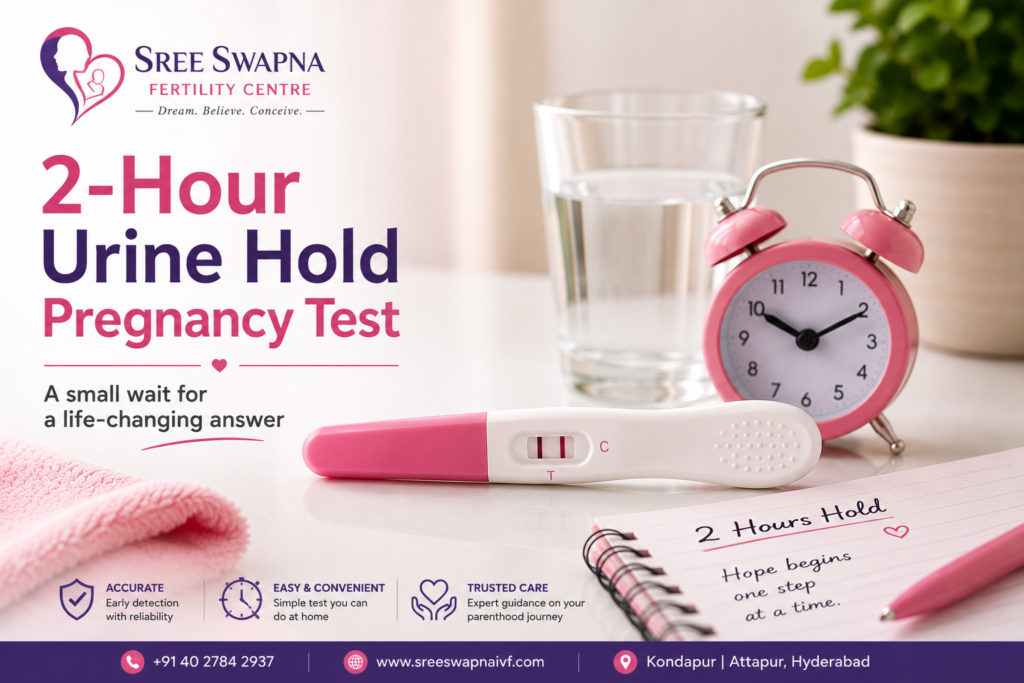
If you’ve spent any time on Instagram or YouTube lately, you’ve probably come across the “2-hour urine hold” trend — the idea that holding your urine for two hours before taking a home pregnancy test gives you a clearer, more reliable result. For anyone trying to conceive, even a slightly more trustworthy line on that little plastic stick feels like a big deal.
But does holding your urine for two hours actually change anything scientifically? Or is this just another well-meaning myth circulating among women trying to conceive?
At Sree Swapna Fertility Centre, we get asked variations of this question almost every week — usually by women in the two-week wait, refreshing their search bar at midnight. So let’s break down what the science actually says about the 2 hour urine hold pregnancy test in India, how it compares to the standard first morning urine approach, and when it’s time to stop testing at home and get a clinical answer instead.
What Is the “2-Hour Urine Hold” Method?
The 2-hour urine hold method involves avoiding urination for at least two hours before taking a home pregnancy test, with the goal of allowing urine to become more concentrated. The theory is simple: a more concentrated urine sample should, in principle, contain a higher concentration of the pregnancy hormone — human chorionic gonadotropin (hCG) — making a faint line easier to detect.
This is a variation of the more established “first morning urine” advice that comes printed on almost every home pregnancy test box.
The Science Behind Urine Concentration and hCG Detection
Home pregnancy tests work by detecting hCG, a hormone produced by the placenta shortly after a fertilised egg implants in the uterus. In early pregnancy, hCG levels are still low, and test strips need enough hormone concentration in the sample to trigger a visible line.
Two factors affect how “concentrated” your urine is:
- How much fluid you’ve had recently. Drinking a lot of water dilutes urine and can lower hCG concentration, occasionally masking a true positive.
- How long urine has been sitting in the bladder. The longer urine collects, the more concentrated it generally becomes — because the kidneys keep filtering out waste products (including hCG) even while you’re not urinating.
This is why the science does support urine concentration mattering for test sensitivity. Where the “2-hour” specificity gets shaky is that there’s no clinical consensus that exactly two hours is a magic number. Longer holds (like first-thing-in-the-morning urine, often 6–8 hours of overnight buildup) are generally more concentrated than a 2-hour daytime hold — which is exactly why manufacturers recommend morning urine for pregnancy test accuracy rather than a specific daytime interval.
Morning Urine vs. 2-Hour Hold: Which Is More Reliable?
| Factor | First Morning Urine | 2-Hour Daytime Hold |
|---|---|---|
| Typical concentration time | 6–8 hours | 2 hours |
| hCG concentration | Highest | Moderate |
| Convenience | Requires testing right on waking | Can be done anytime during the day |
| Manufacturer recommendation | Yes, standard advice on most kits | Not officially specified on most kits |
In short: if you can test first thing in the morning, that remains the gold standard for pregnancy test first morning urine accuracy. The 2-hour hold is a reasonable second option if you’ve missed your morning window or need to retest later in the day, but it isn’t a scientifically superior shortcut — it’s a practical compromise.
Step-by-Step: How to Do a 2-Hour Urine Hold Test Correctly
- Avoid urinating for at least 2 hours before your planned test time.
- Limit fluid intake during this window — don’t overcompensate by drinking excess water, as this dilutes the sample.
- Use a clean, dry container or test directly midstream, following your test kit’s instructions.
- Read the result within the time window specified on the pack (usually 3–5 minutes). Results read after this window can show false evaporation lines.
- Test again in 48 hours if the result is negative but your period still hasn’t arrived, since hCG levels roughly double every 48–72 hours in early pregnancy.
Common Mistakes That Affect Accuracy
- Testing too early. Even a perfectly held urine sample won’t show hCG that isn’t there yet. Testing before your missed period significantly increases the chance of a false negative.
- Overhydrating before the test. This is the single most common reason for a falsely faint or negative line, regardless of hold time.
- Reading results after the recommended window. Evaporation lines can appear and be mistaken for a faint positive.
- Using an expired or improperly stored test kit. Heat and humidity (common in Indian summers) can degrade test strip sensitivity.
- Ignoring medication interference. Certain fertility medications containing hCG (used in ovulation induction or IVF cycles) can cause false positives for up to 10–14 days after the injection.
When a Home Test Isn’t Enough: Why Clinical Confirmation Matters
Home urine tests are a helpful first indicator, but they have real limitations — especially for women who are actively undergoing fertility treatment, have irregular cycles, or have a history of pregnancy loss. A urine test only tells you “yes” or “no.” It can’t tell you how a pregnancy is progressing, whether hCG levels are rising appropriately, or whether the pregnancy is developing in the right location.
This is where Dr. Swapna Naik, Clinical Director and Chief IVF Consultant at Sree Swapna Fertility Centre, and her team step in. With over 15 years of experience in reproductive medicine and having guided more than 5,000 successful pregnancies, Dr. Naik’s approach goes beyond a single test result.
For patients undergoing ovulation induction, IUI, or IVF at either of our Hyderabad centres, a home urine test is never the final word. We rely on quantitative serum beta-hCG blood tests, which measure the exact hormone level in your blood — far more sensitive and precise than any urine strip, and able to confirm pregnancy several days earlier. Follow-up testing 48 hours later helps us track whether hCG levels are rising appropriately, an important early indicator of a healthy, viable pregnancy.
Both our Kondapur (flagship) and Attapur clinics are equipped with in-house diagnostic facilities and a CLIA-certified embryology and diagnostic lab, so patients don’t have to wait anxiously for outside lab reports — results and next steps are handled by the same team guiding your treatment.
If you’ve had a faint or unclear home test result, or you’re managing a fertility treatment cycle and need a definitive answer, we recommend booking a same-week consultation rather than repeatedly testing at home.
Frequently Asked Questions
1. Does holding urine for 2 hours really improve pregnancy test accuracy?
It can help slightly by increasing urine concentration, but the effect is smaller than testing with first morning urine, which has a much longer concentration window.
2. Is first morning urine always more accurate than a 2-hour hold?
Generally yes, because urine has typically been concentrating for 6–8 hours overnight compared to just 2 hours during the day.
3. How many hours should I hold urine before a pregnancy test?
There’s no universally agreed exact number, but longer holds (within reason) tend to produce more concentrated, easier-to-read samples.
4. Can drinking water before the test affect the result?
Yes. Excess fluid dilutes urine and can weaken or mask a faint positive line.
5. How soon after a missed period should I test?
Testing on the day of your missed period, using first morning urine, gives the most reliable result.
6. Can I test before my missed period?
You can, but hCG levels may still be too low to detect, increasing the risk of a false negative.
7. What does a very faint line mean?
A faint line often indicates early pregnancy with lower hCG levels. Retesting after 48 hours with first morning urine usually gives a clearer result.
8. How accurate are home pregnancy tests in general?
Most kits claim over 99% accuracy when used correctly on or after the day of a missed period, though real-world accuracy is often lower due to testing errors.
9. Can fertility medications cause a false positive?
Yes. Injections containing hCG, sometimes used in ovulation induction or IVF cycles, can cause false positives for 10–14 days after administration.
10. Should I test again if I get a negative result but still haven’t gotten my period?
Yes — wait 48 hours and retest using first morning urine, or consult your fertility specialist for a blood test.
11. How long after implantation can hCG be detected in urine?
Typically hCG becomes detectable in urine around 3–4 days after implantation, though this varies between individuals.
12. Is a blood test more accurate than a urine test?
Yes. Quantitative serum beta-hCG blood tests are more sensitive and can detect pregnancy earlier and more precisely than urine tests.
13. Can I use any container to collect urine for the 2-hour hold method?
Use a clean, dry container, or follow your specific test kit’s instructions for midstream collection.
14. Does the brand of pregnancy test matter for accuracy?
Sensitivity varies by brand. Digital tests and higher-sensitivity strips can detect lower hCG concentrations earlier.
15. Can stress or irregular cycles affect when I should test?
Irregular cycles make it harder to know your exact “missed period” date, which is why cycle tracking or a clinical consultation is more reliable for these cases.
16. What if I get different results from two different test brands?
This can happen due to sensitivity differences. A blood test at a clinic is the best way to resolve conflicting results.
17. How long should I wait to read the test result?
Follow the manufacturer’s window, usually 3–5 minutes. Reading later can show inaccurate evaporation lines.
18. Can heat affect pregnancy test accuracy in India’s climate?
Yes, storing test kits in high heat or humidity can degrade the strip and affect reliability. Store kits in a cool, dry place.
19. Is it necessary to see a doctor after a positive home test?
Yes. A clinical visit confirms the pregnancy, checks hCG levels, and helps assess if the pregnancy is progressing normally, especially important if you’re undergoing fertility treatment.
20. Can PCOS or hormonal imbalances affect pregnancy test results?
PCOS doesn’t directly affect hCG detection, but irregular cycles common with PCOS can make timing your test correctly more difficult.
21. What should I do if I’ve been trying to conceive for a while with repeated negative tests?
If you’ve been trying for over a year (or 6 months if over age 35) without success, it’s worth consulting a fertility specialist for a full evaluation rather than relying only on home testing.
22. Does Sree Swapna Fertility Centre offer pregnancy confirmation blood tests?
Yes, both our Kondapur and Attapur centres offer quantitative beta-hCG blood testing as part of routine fertility monitoring and pregnancy confirmation.
Conclusion
The 2-hour urine hold can offer a modest boost in test sensitivity, but it isn’t a scientific guarantee — first morning urine remains the more reliable choice whenever possible, and a single line (or lack of one) is never the complete picture, especially if you’re actively trying to conceive or undergoing fertility treatment. When you need a definitive, clinically accurate answer, a quantitative blood test and the guidance of an experienced fertility specialist matter far more than any home test timing trick.
Get a Definitive Answer, Not Just a Guess
If you’re unsure about a test result, going through the two-week wait, or currently undergoing fertility treatment, Dr. Swapna Naik and the team at Sree Swapna Fertility Centre are here to help you get clarity — quickly and compassionately.
📞 Call: +91 76708 04424 / +91 40 4995 3719 💬 WhatsApp: Message us directly 📧 Email: sreeswapna.fertility@gmail.com 📍 Visit us at: Kondapur (flagship centre) or Attapur, Hyderabad 🌐 Book an appointment: sreeswapnaivf.com/contact-us
