
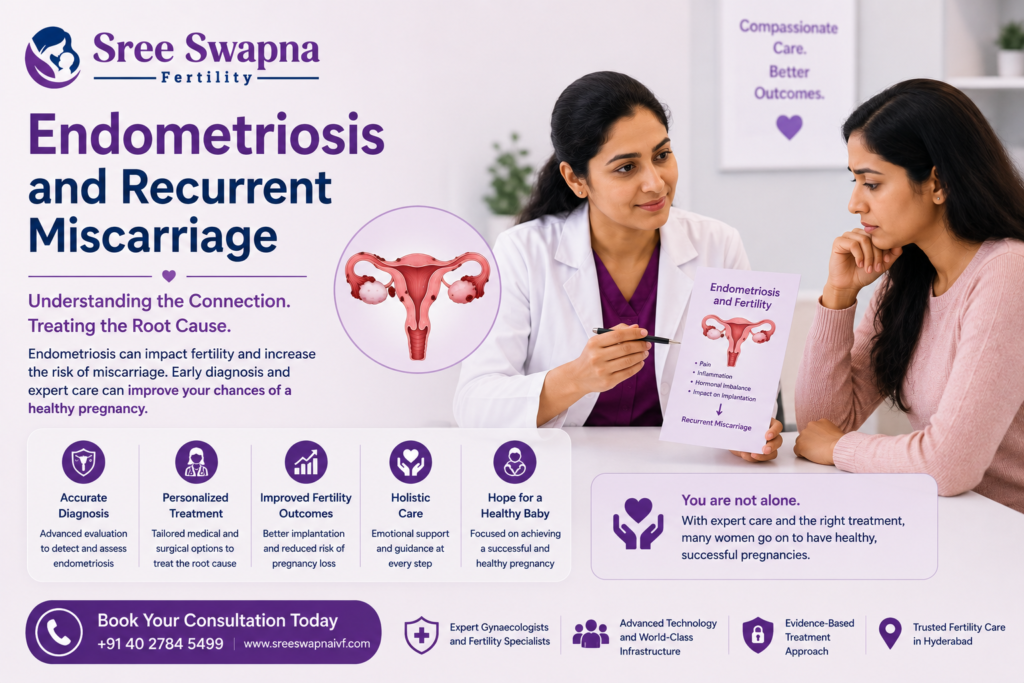
If you have endometriosis and have experienced recurrent miscarriage, you’ve probably wondered if the two are connected. The honest answer: research suggests a real association, but it isn’t a fully settled question — and understanding both sides of the evidence helps you have a more informed conversation with your specialist.
What Does Recurrent Miscarriage Mean?
Recurrent pregnancy loss (RPL) is generally defined as two or more pregnancy losses before 20–24 weeks of gestation. It’s worth knowing that even without any endometriosis, roughly half of RPL cases have no clearly identified cause after standard testing — a reminder that this is a genuinely complex area of reproductive medicine.
What Does the Research Say About Endometriosis and Miscarriage?
Evidence Supporting a Connection
A meta-analysis found that women with endometriosis have a statistically significant higher risk of several pregnancy-related complications, including miscarriage, preterm birth, placenta previa, smaller-than-expected babies, and caesarean delivery.
A large Scottish cohort study compared over 5,000 women with surgically confirmed endometriosis to nearly 9,000 women without the condition, and concluded that endometriosis does predispose women to a higher risk of early pregnancy loss and later pregnancy complications.
Separately, a retrospective study of IVF patients found a higher miscarriage rate following fresh embryo transfer specifically in women with endometriosis.
Evidence Questioning the Strength of the Connection
It’s important to present the full picture honestly: a separate systematic review reached a notably different conclusion, finding that pregnancy complications related to endometriosis are actually rare, and that there isn’t strong evidence the condition has a major detrimental effect on pregnancy outcomes overall.
This genuine disagreement in the research reflects how complex and still-evolving this area of study is.
What Mechanisms Might Explain a Connection?
Researchers have proposed several biologically plausible pathways:
- Chronic inflammation altering endometrial receptivity — a mechanism shared with related conditions like adenomyosis and chronic endometritis, potentially affecting how well the endometrium supports early pregnancy
- Immune system dysfunction — the endometrium plays a genuinely important role in creating immune tolerance toward the developing embryo, and this process may be disrupted by endometriosis-related inflammation
- Pelvic inflammatory effects on the oocyte and embryo — specifically relevant to natural conception, where the egg and early embryo develop within the pelvic environment potentially affected by endometriosis inflammation
An Important, Practical Nuance: Natural Conception vs. IVF
This is genuinely useful to understand: some proposed mechanisms — particularly pelvic inflammation affecting oocyte and embryo development — are specific to natural conception, where the egg and early embryo remain within the body’s pelvic environment. With IVF, fertilisation and early embryo development happen outside the body in a controlled lab environment, potentially bypassing this specific pathway, even though other endometrium-related mechanisms could still apply once the embryo is transferred.
This doesn’t mean IVF eliminates all endometriosis-related miscarriage risk, but it’s a meaningful distinction worth discussing with your specialist if you’re weighing natural conception against assisted reproduction.
What Does This Mean for Your Care?
Given that the evidence is genuinely mixed rather than fully conclusive, here’s what’s practically useful:
- If you have endometriosis and recurrent miscarriage, it’s reasonable to consider endometriosis as one possible contributing factor — but not to assume it’s automatically the sole explanation, especially since roughly half of all RPL cases (with or without endometriosis) remain unexplained even after thorough evaluation
- A comprehensive RPL work-up remains important regardless of your endometriosis diagnosis — including genetic testing, uterine evaluation, hormonal assessment, and blood clotting disorder screening
- Treatment for endometriosis itself (hormonal or surgical) is generally aimed at improving fertility and reducing pain, rather than being a proven, specific treatment for preventing miscarriage — this distinction matters when setting expectations
Should Endometriosis Treatment Be Part of Your Miscarriage Prevention Plan?
This is worth discussing directly with your specialist, since the evidence doesn’t currently support a simple “treat the endometriosis and miscarriage risk resolves” narrative. Any treatment decision should weigh your specific symptoms, fertility goals, and overall RPL evaluation findings together — not treat endometriosis in isolation as the answer to recurrent loss.
Endometriosis and Recurrent Miscarriage Care at Sree Swapna Fertility Centre
As one of the best fertility centers in Hyderabad, we approach recurrent miscarriage with a comprehensive evaluation — considering endometriosis as one possible contributing factor among several, rather than assuming it explains everything.
Dr. Swapna Naik, Clinical Director at Sree Swapna Fertility Centre, holds an MBBS, DGO, DRM, DFM, a Diploma in Reproductive Medicine from Germany, and a Fellowship in Advanced ART, and is a trained laparoscopic surgeon with over 15 years of experience. Our approach to recurrent pregnancy loss includes thorough genetic, hormonal, and structural evaluation, alongside assessment for endometriosis where relevant — giving you an honest, complete picture rather than a single explanation that may not tell the whole story.
Both our Kondapur and Attapur clinics offer the diagnostic facilities needed for a comprehensive recurrent miscarriage evaluation, whether or not endometriosis is part of your history.
Frequently Asked Questions
1. Does endometriosis increase the risk of miscarriage?
Research is genuinely mixed — some large studies show a statistically higher risk, while at least one systematic review found pregnancy complications from endometriosis to be rare.
2. What is considered recurrent pregnancy loss?
Generally, two or more pregnancy losses before 20–24 weeks of gestation.
3. Why might endometriosis affect pregnancy outcomes?
Proposed mechanisms include chronic inflammation altering endometrial receptivity, immune system dysfunction, and effects on the egg and embryo in natural conception.
4. Does IVF reduce the miscarriage risk associated with endometriosis?
Some proposed mechanisms specific to natural conception may be bypassed with IVF, though this doesn’t necessarily eliminate all endometriosis-related risk.
5. What percentage of recurrent miscarriage cases have no identified cause?
Roughly half of RPL cases remain unexplained even after thorough evaluation, regardless of endometriosis status.
6. Should I get an RPL work-up if I have endometriosis and recurrent miscarriage?
Yes, a comprehensive evaluation remains important, since endometriosis shouldn’t be assumed as the sole explanation without ruling out other factors.
7. Does treating endometriosis prevent future miscarriages?
This isn’t well established — endometriosis treatment is generally aimed at symptom relief and improving fertility, not specifically proven to prevent miscarriage.
8. What did the Scottish cohort study find about endometriosis and pregnancy?
It found that endometriosis predisposed women to a higher risk of early pregnancy loss and later pregnancy complications, based on over 5,000 women with surgically confirmed disease.
9. Is there research disagreeing with a strong endometriosis-miscarriage link?
Yes, a systematic review found pregnancy complications related to endometriosis to be rare, with no strong evidence of major detrimental effects overall.
10. Can chronic endometritis also contribute to recurrent miscarriage?
Yes, it’s another condition associated with altered endometrial receptivity and early pregnancy loss, sometimes considered alongside endometriosis in an evaluation.
11. Does adenomyosis share similar mechanisms with endometriosis regarding miscarriage risk?
Yes, chronic inflammation affecting endometrial receptivity is a proposed shared mechanism among endometriosis, adenomyosis, and chronic endometritis.
12. What tests are typically done for recurrent miscarriage?
Genetic testing, uterine imaging, hormonal testing, and blood clotting disorder screening are commonly included in a comprehensive evaluation.
13. Can immune system factors contribute to miscarriage in endometriosis patients?
Yes, immune dysfunction affecting the endometrium’s tolerance toward the embryo is a proposed, actively researched mechanism.
14. Should I choose IVF over natural conception if I have endometriosis and recurrent miscarriage?
This is a decision to discuss with your specialist, weighing your specific evaluation findings, fertility goals, and the nuanced evidence around natural conception versus IVF.
15. Is endometriosis-related miscarriage risk the same for everyone with the condition?
No, individual risk likely varies based on endometriosis severity, location, and other personal factors, alongside the genuinely mixed broader research.
16. Can research on shared genes between endometriosis and RPL help future treatment?
Yes, this is an active area of research aiming to identify biomarkers and potential therapeutic targets, though it’s still developing.
17. Does having endometriosis automatically mean I’ll have a miscarriage?
No, endometriosis doesn’t guarantee a miscarriage will happen — it’s associated with a statistically higher risk in some studies, not a certainty.
18. Is fresh or frozen embryo transfer better for women with endometriosis?
Some research has noted differences in miscarriage rates between fresh and frozen transfer in endometriosis patients, though this should be discussed individually with your specialist.
19. Can lifestyle factors influence miscarriage risk in endometriosis patients?
General reproductive health factors may play a role, though the primary research focus has been on inflammatory and immune mechanisms specific to the condition.
20. Should both endometriosis and other RPL causes be investigated together?
Yes, a comprehensive evaluation considering multiple potential factors together provides a more complete picture than focusing on endometriosis alone.
21. Is this an actively evolving area of medical research?
Yes, genuinely so — new studies continue to explore the mechanisms and treatment implications of the endometriosis-miscarriage relationship.
22. Where can I get a comprehensive recurrent miscarriage evaluation in Hyderabad?
Sree Swapna Fertility Centre, a leading best fertility center in Hyderabad, offers comprehensive recurrent pregnancy loss evaluation at both our Kondapur and Attapur clinics.
Conclusion
The link between endometriosis and recurrent miscarriage is real enough to take seriously, but not settled enough to treat as the automatic explanation for every case. The most useful path forward is a comprehensive evaluation that considers endometriosis as one possible factor among several — giving you an honest, complete picture rather than a single, oversimplified answer.
Get a Comprehensive Evaluation
Dr. Swapna Naik and the team at Sree Swapna Fertility Centre will help you understand the full picture behind your recurrent pregnancy loss.
📞 Call: +91 76708 04424 / +91 40 4995 3719 💬 WhatsApp: Message us directly 📧 Email: sreeswapna.fertility@gmail.com 📍 Visit us at: Kondapur (flagship centre) or Attapur, Hyderabad 🌐 Book an appointment: sreeswapnaivf.com/contact-us
