
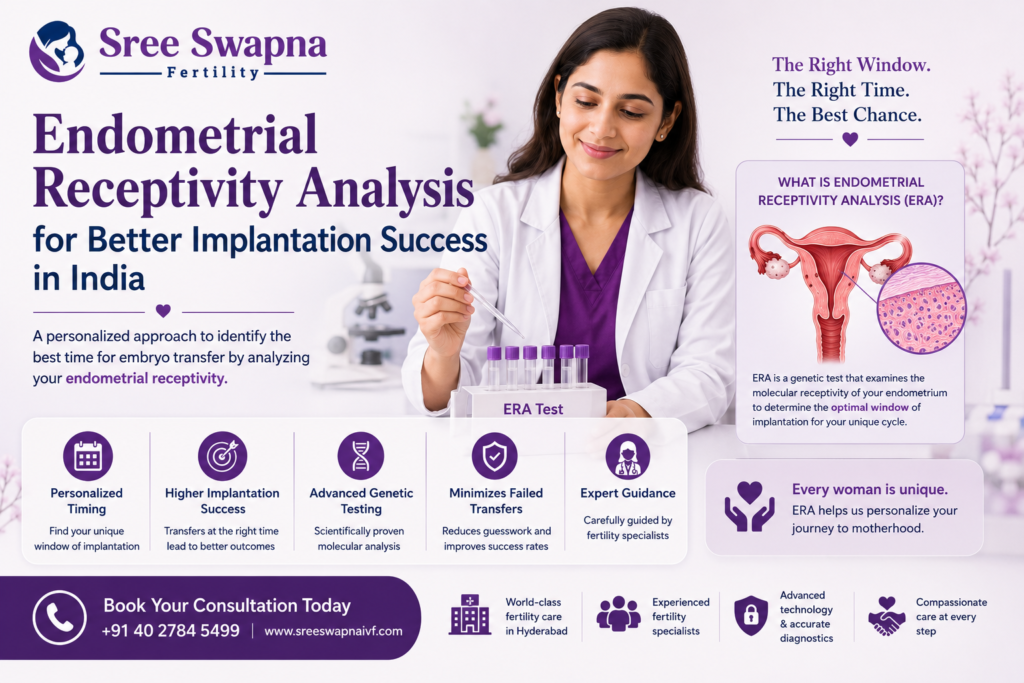
If you’ve experienced failed embryo implantation despite good-quality embryos, you may have come across the ERA test as a possible explanation — and a possible fix. Before you consider it, it’s worth knowing something important: the evidence behind this test has shifted significantly in recent years, and not in the direction its early popularity suggested.
What Is the ERA Test?
The Endometrial Receptivity Analysis (also called the Endometrial Receptivity Array) is a test that analyses the expression of 238 specific genes in a sample of your endometrial tissue, aiming to determine whether your endometrium is:
- Receptive — the optimal time for embryo transfer
- Pre-receptive — suggesting more progesterone exposure time is needed before transfer
- Post-receptive — suggesting less progesterone exposure time would be better
The idea is to identify your personal “window of implantation” (WOI) — the theory being that some women’s biological window doesn’t align with the standard timing used in most IVF protocols, and that personalising your embryo transfer timing (pET) to this window could improve your chances.
How Is the ERA Test Done?
A small endometrial tissue sample is taken via biopsy, typically during a mock (non-transfer) cycle that mimics your actual treatment protocol. This tissue is then analysed for its gene expression profile, and the result guides the recommended timing for your actual embryo transfer in a subsequent cycle.
What Does Current Evidence Actually Show?
This is where honesty matters far more than following the test’s early popularity.
The Major Randomized Trial Found No Benefit
A large, high-quality, double-blind randomized controlled trial — using vitrified, genetically normal (euploid) embryos — found no significant advantage in live birth rates, or any other positive clinical outcome, when embryo transfer timing was guided by ERA results compared to standard timing. Reported live birth rates were statistically similar between groups in multiple analyses of this data.
A Meta-Analysis Confirmed the Pattern
A subsequent meta-analysis reviewing the broader body of research on ERA-guided transfer similarly concluded that it does not confer a significant advantage over standard transfer timing.
A Critical Reanalysis Raised an Even More Serious Concern
Perhaps most striking: a detailed reanalysis of the major randomized trial’s data, published in a peer-reviewed journal, argued that the ERA test failed to accurately identify the window of implantation as intended — and that personalised embryo transfer based on its results may have actually reduced birth rates rather than improved them. The authors explicitly recommended that clinical use of ERA-guided personalised embryo transfer be discontinued outside of a properly controlled research setting with full patient informed consent.
Why Did ERA Become Popular Before This Evidence Existed?
This is a genuinely important pattern to understand: ERA saw rapid, widespread clinical adoption after its introduction, before the large, rigorous randomized trials needed to properly evaluate it had been completed. This isn’t unique to ERA — a similar story played out decades earlier with histological (microscope-based) assessment of endometrial receptivity, which was also widely used before being shown unreliable once properly studied.
Is There Any Population Where ERA Might Still Help?
This is genuinely still being studied. Most of the strong negative evidence above comes from general IVF populations, not specifically women with recurrent implantation failure (RIF) — the group ERA was originally intended to help most. As of current research, a dedicated, adequately powered randomized trial specifically in RIF patients has been harder to find, though at least one such trial is currently registered and underway, with results not yet available.
In other words: for most patients, current evidence doesn’t support ERA-guided transfer timing. For the specific RIF population, the question remains more genuinely open, pending dedicated research — but even here, it’s not something with confirmed proven benefit.
What Does This Mean for You?
If a clinic recommends the ERA test, it’s reasonable to ask directly:
- What specific evidence supports this test for my particular situation?
- Am I part of a population (like RIF) where the evidence is still evolving, or a general population where recent trials have shown no benefit?
- What would change about my treatment plan based on the result, and is that change itself evidence-based?
A good specialist should be able to answer these questions honestly, rather than presenting ERA as a routine, proven solution for implantation difficulties.
What About Cost?
ERA testing typically adds meaningful cost on top of your IVF cycle, given the additional biopsy and specialised laboratory analysis involved. Given the current evidence, it’s worth having a clear, direct conversation about cost versus expected benefit for your specific situation, rather than assuming it’s a routine, worthwhile add-on. Costs vary by clinic and lab, so ask for a specific, itemised estimate if you’re considering it.
Our Approach to Endometrial Receptivity Testing at Sree Swapna Fertility Centre
As one of the best fertility centers in Hyderabad, we believe patients deserve current, honest evidence — not outdated enthusiasm for a test that hasn’t held up under rigorous study.
Dr. Swapna Naik, Clinical Director at Sree Swapna Fertility Centre, holds an MBBS, DGO, DRM, DFM, a Diploma in Reproductive Medicine from Germany, and a Fellowship in Advanced ART, with over 15 years of experience in reproductive medicine. For patients experiencing recurrent implantation failure, our approach involves a comprehensive evaluation — considering embryo quality, uterine structural factors, and other potential contributors — rather than defaulting to any single test, including ERA, as an automatic explanation or fix.
Both our Kondapur and Attapur clinics stay current with evolving reproductive medicine research, and we’re committed to explaining exactly what the evidence does and doesn’t support before recommending any additional testing.
Frequently Asked Questions
1. What is the ERA test?
It’s a test analysing endometrial gene expression to determine whether the uterine lining is in its optimal “window of implantation” for embryo transfer.
2. Does the ERA test improve IVF success rates?
Current strong randomized trial evidence shows no significant improvement in live birth rates for general IVF populations, and one reanalysis suggests it may even reduce success in some cases.
3. Is the ERA test still worth doing for recurrent implantation failure?
This remains a more open question specifically for this population, as dedicated, adequately powered trials in RIF patients are still ongoing, with results not yet fully available.
4. How is the ERA test performed?
Through an endometrial tissue biopsy, typically during a mock cycle that mimics your actual treatment protocol, followed by gene expression analysis.
5. What does a “pre-receptive” or “post-receptive” ERA result mean?
It suggests your endometrium may need more or less progesterone exposure time before transfer, according to the test’s underlying theory.
6. Why did ERA become popular before strong evidence existed?
It saw rapid clinical adoption shortly after introduction, before the large randomized trials needed to properly evaluate its benefit had been completed — a pattern seen with some earlier receptivity tests too.
7. What did the major randomized trial on ERA find?
It found no significant advantage in live birth rates or other clinical outcomes when embryo transfer was timed according to ERA results, compared to standard timing.
8. Did any research suggest ERA could actually be harmful?
Yes, a detailed reanalysis of trial data suggested ERA failed to accurately identify the window of implantation, and that personalised transfer based on it may have reduced birth rates in that trial.
9. Should I ask my doctor why ERA is being recommended?
Yes, it’s a reasonable and important question — ask what specific evidence supports it for your situation, and what would change in your treatment based on the result.
10. Is the ERA test expensive?
It typically adds meaningful cost to an IVF cycle due to the biopsy and specialised analysis involved — ask for a specific, itemised estimate from your clinic.
11. Is ERA testing banned or discontinued anywhere?
No formal ban exists, though some researchers have explicitly recommended discontinuing routine clinical use outside of controlled research settings, based on current evidence.
12. What is the “window of implantation”?
It refers to the specific time period when the endometrium is theoretically most receptive to embryo implantation.
13. Does ERA testing use euploid (genetically normal) embryos in research?
Yes, the major randomized trial specifically used euploid embryos to remove embryo quality as a confounding factor in assessing ERA’s benefit.
14. What other factors should be considered for recurrent implantation failure?
Embryo quality, uterine structural issues, chronic endometritis, and other factors should all be part of a comprehensive evaluation, not just endometrial receptivity timing.
15. Is there an ongoing trial specifically studying ERA for RIF patients?
Yes, at least one registered randomized trial is currently investigating this specific population, though results aren’t yet available.
16. Should I decline ERA testing if my clinic recommends it?
This is a personal decision best made after understanding the current evidence and discussing it directly with your specialist, rather than a decision to make alone.
17. Does a meta-analysis support ERA’s clinical use?
No, a meta-analysis reviewing the broader evidence concluded that ERA-guided transfer doesn’t confer a significant advantage over standard timing.
18. Is this similar to other reproductive medicine tests that were later questioned?
Yes, histological (microscope-based) endometrial receptivity assessment was similarly popular for decades before rigorous studies showed it unreliable.
19. Can ERA results change between cycles?
This is part of the ongoing scientific debate about the test’s reliability, since a stable, accurate result is important for the test’s underlying premise to hold.
20. Does Sree Swapna Fertility Centre recommend ERA testing routinely?
No, we base testing recommendations on current evidence and your specific clinical picture, rather than offering it as a routine add-on.
21. What should I focus on instead if I’m facing recurrent implantation failure?
A comprehensive evaluation covering embryo quality, uterine health, and other potential factors, guided by a specialist who stays current with evolving research.
22. Where can I get an evidence-based evaluation for implantation failure in Hyderabad?
Sree Swapna Fertility Centre, a leading best fertility center in Hyderabad, offers comprehensive, evidence-based evaluation for recurrent implantation failure at both our Kondapur and Attapur clinics.
Conclusion
The ERA test’s story is a genuinely important lesson in reproductive medicine: early promise and rapid adoption don’t always hold up once rigorous randomized trials are completed. Current evidence doesn’t support routine ERA-guided embryo transfer for most patients, though the question remains more open for recurrent implantation failure specifically. The most valuable thing you can do is ask direct questions about the evidence behind any test recommended to you.
Get an Honest, Evidence-Based Fertility Evaluation
Dr. Swapna Naik and the team at Sree Swapna Fertility Centre will explain exactly what current research supports before recommending any additional testing.
📞 Call: +91 76708 04424 / +91 40 4995 3719 💬 WhatsApp: Message us directly 📧 Email: sreeswapna.fertility@gmail.com 📍 Visit us at: Kondapur (flagship centre) or Attapur, Hyderabad 🌐 Book an appointment: sreeswapnaivf.com/contact-us
