
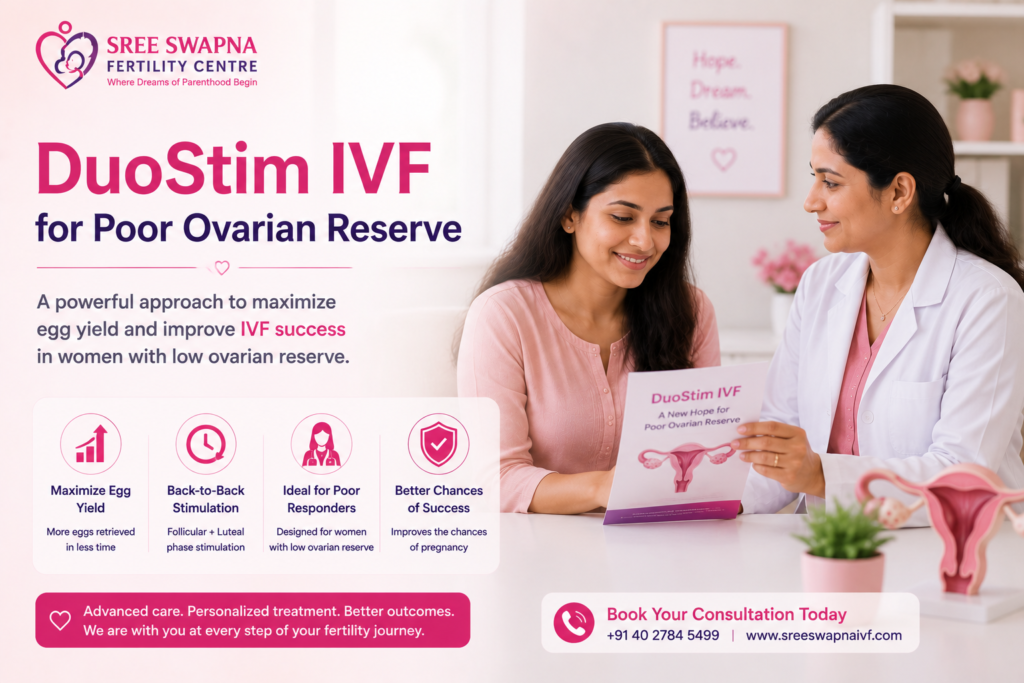
If you’ve been told you’re a “poor ovarian responder” — meaning your ovaries produce fewer eggs than expected during IVF stimulation — time can feel like it’s working against you. Every month spent waiting between cycles is a month your ovarian reserve continues to decline.
DuoStim was developed specifically to address this problem, by fitting two egg retrieval opportunities into the time it would normally take for just one.
What Is DuoStim?
DuoStim (dual or double stimulation) involves performing two ovarian stimulations within the same menstrual cycle — one during the follicular phase (the first half of your cycle), and a second during the luteal phase (shortly after your first egg retrieval, in the same month).
This approach — sometimes also referred to as the “Shanghai protocol,” reflecting its origins — was made possible by an important scientific discovery: follicles don’t only develop and become recruitable during the follicular phase. Multiple “waves” of follicle development can occur within a single ovarian cycle, meaning the luteal phase holds real, usable potential that traditional IVF protocols simply weren’t designed to capture.
Why Was DuoStim Developed for Poor Ovarian Responders?
Poor ovarian response affects roughly 9–24% of women undergoing IVF, and despite various stimulation protocol adjustments over the years, outcomes for this group have historically remained difficult to improve. DuoStim emerged as a genuinely different approach: rather than trying to coax more eggs out of a single stimulation, it captures two separate opportunities within one cycle.
What Does the Research Actually Show?
This is where DuoStim’s evidence becomes genuinely compelling:
- Luteal phase stimulation often yields more oocytes than the initial follicular phase stimulation in the same patient
- Egg competence is comparable between the two phases — fertilisation rates, blastocyst formation rates, and euploidy (chromosomally normal) rates were found to be similar in a multicentre study
- The real impact shows up in cumulative results: in one multicentre study of poor prognosis patients, the proportion of patients obtaining at least one chromosomally normal (euploid) blastocyst rose from 42.3% after follicular phase stimulation alone to 65.5% once luteal phase stimulation was added — a genuinely meaningful increase in a patient population where every additional viable embryo matters
Does DuoStim Guarantee Better Pregnancy Outcomes?
It’s important to be honest here: DuoStim’s clearest advantage is time efficiency — maximising the number of oocytes and embryos obtained within the shortest possible window, which matters enormously for poor responders and for time-sensitive situations like fertility preservation before cancer treatment.
However, at least one study comparing DuoStim to two separate, consecutive mild stimulation cycles (spread across two months) found that while DuoStim produced fewer frozen embryos in older poor-responder patients specifically, pregnancy outcomes were not significantly different between the two approaches. This suggests DuoStim’s core value is compressing your timeline, rather than a guaranteed increase in your overall chance of pregnancy compared to spacing stimulations across separate cycles — though for many patients, that time savings is itself a significant, practical benefit.
Who Might DuoStim Be Recommended For?
- Women with low AMH or a low antral follicle count, indicating reduced ovarian reserve
- Poor responders to a previous standard IVF stimulation cycle
- Women needing urgent fertility preservation, such as before starting cancer treatment, where waiting for a second natural cycle isn’t a realistic option
- Patients undergoing PGT-A (embryo genetic testing) cycles, where accumulating enough tested, euploid embryos in the shortest time is a priority
What Does the DuoStim Process Involve?
- Follicular phase stimulation: Ovarian stimulation medication begins early in your cycle, followed by egg retrieval
- Luteal phase stimulation: A second round of stimulation begins shortly after the first retrieval, within the same cycle, followed by a second egg retrieval
- Fertilisation and embryo development: Eggs from both retrievals are fertilised (typically via ICSI, given the smaller egg numbers often involved) and cultured
- Genetic testing (if applicable): Embryos may undergo PGT-A testing to identify chromosomally normal embryos before transfer
- Embryo transfer: Since DuoStim involves back-to-back stimulation, embryo transfer is typically done in a later, separate frozen embryo transfer cycle, once your body has had time to recover
Does Trigger Medication Choice Matter?
Yes — research suggests that using a GnRH agonist or recombinant hCG as the trigger medication, rather than urinary hCG, is associated with better quality embryos at both the follicular and luteal phase stages. This is a detail worth discussing with your specialist as part of your specific protocol.
DuoStim IVF at Sree Swapna Fertility Centre
As one of the best fertility centers in Hyderabad for complex fertility cases, we consider DuoStim specifically for patients where time and egg yield genuinely matter — not as a routine, one-size-fits-all protocol.
Dr. Swapna Naik, Clinical Director at Sree Swapna Fertility Centre, holds an MBBS, DGO, DRM, DFM, a Diploma in Reproductive Medicine from Germany, and a Fellowship in Advanced ART, alongside training as a laparoscopic surgeon, with over 15 years of experience in reproductive medicine. Her approach to poor ovarian response and low AMH cases includes a thorough discussion of protocol options — including whether DuoStim, sequential mild stimulation cycles, or another approach best fits your specific timeline and ovarian reserve profile.
Both our Kondapur and Attapur clinics offer the diagnostic evaluation, monitoring, and embryology support needed for DuoStim cycles, including access to PGT-A testing when appropriate.
Frequently Asked Questions
1. What is DuoStim in IVF?
It’s a technique involving two ovarian stimulations and egg retrievals within the same menstrual cycle — one in the follicular phase, one in the luteal phase.
2. Who is DuoStim typically recommended for?
Primarily poor ovarian responders, women with low AMH, and patients needing urgent fertility preservation, such as before cancer treatment.
3. Does the luteal phase actually produce usable eggs?
Yes, research has shown follicles can develop and respond to stimulation during the luteal phase, sometimes yielding more oocytes than the follicular phase in the same patient.
4. Is egg quality different between the two stimulation phases?
Research suggests egg competence — fertilisation, blastocyst formation, and euploidy rates — is generally comparable between follicular and luteal phase stimulation.
5. Does DuoStim guarantee a higher pregnancy rate than doing two separate cycles?
Not necessarily — one study found no significant difference in pregnancy outcomes compared to two consecutive mild stimulation cycles, though DuoStim compresses the timeline significantly.
6. What is the main advantage of DuoStim?
Its main advantage is time efficiency — maximising the number of eggs and embryos obtained within a single month, rather than waiting across multiple cycles.
7. Is DuoStim also called the Shanghai protocol?
Yes, this name reflects its origins, and it’s used somewhat interchangeably with DuoStim in the literature.
8. How common is poor ovarian response in IVF patients?
It’s estimated to affect roughly 9–24% of women undergoing IVF.
9. Does DuoStim increase the chance of getting at least one healthy embryo?
Research from a multicentre study found the rate of obtaining at least one euploid blastocyst rose significantly when luteal phase stimulation was added to follicular phase stimulation.
10. Is ICSI typically used with DuoStim?
Yes, since egg numbers can be limited in poor responders, ICSI is commonly used to maximise fertilisation chances.
11. Does trigger medication choice affect DuoStim outcomes?
Yes, research suggests GnRH agonist or recombinant hCG triggers may yield better quality embryos than urinary hCG in both stimulation phases.
12. Is embryo transfer done immediately after DuoStim retrievals?
Typically no — embryo transfer is usually done in a separate, later frozen embryo transfer cycle, allowing the body time to recover.
13. Can DuoStim be used for fertility preservation before cancer treatment?
Yes, its time-efficient nature makes it particularly useful when starting cancer treatment promptly is a priority.
14. Is DuoStim suitable for women with normal ovarian reserve?
It’s primarily studied and used for poor ovarian responders and time-sensitive cases, rather than routine use in women with normal reserve.
15. How is DuoStim different from a standard IVF cycle?
Standard IVF typically involves one stimulation and retrieval per cycle, while DuoStim performs two within the same cycle.
16. Does age affect how well DuoStim works?
Some research suggests older poor-responder patients may see somewhat different embryo yield patterns compared to younger patients, so individual assessment matters.
17. Is DuoStim more expensive than standard IVF?
It can involve additional monitoring and medication costs due to the two stimulation phases — discuss specific cost implications with your clinic.
18. Can PGT-A testing be combined with DuoStim?
Yes, DuoStim is often used alongside PGT-A to accumulate enough tested, chromosomally normal embryos in the shortest possible time.
19. How soon after the first retrieval does luteal phase stimulation begin?
It typically begins shortly after the first retrieval, within the same menstrual cycle, though exact timing depends on your individual monitoring.
20. Is DuoStim considered an experimental technique?
No, it’s a well-studied approach with a substantial and growing body of clinical research, particularly for poor ovarian responders.
21. Should I ask my specialist if DuoStim is right for me?
Yes, it’s a reasonable question if you’ve been identified as a poor responder or have low AMH — your specialist can assess whether it fits your specific situation.
22. Where can I access DuoStim IVF treatment in Hyderabad?
Sree Swapna Fertility Centre, a leading best fertility center in Hyderabad, offers DuoStim protocols for appropriate candidates at both our Kondapur and Attapur clinics.
Conclusion
DuoStim offers a genuinely valuable option for poor ovarian responders and women with low AMH — not by guaranteeing a higher overall pregnancy rate, but by compressing the time needed to gather eggs and embryos, which matters enormously when ovarian reserve or treatment timing is a pressing concern. The right protocol for you depends on your specific reserve, age, and timeline, and is worth a detailed conversation with your specialist.
Discuss Whether DuoStim Is Right for You
Dr. Swapna Naik and the team at Sree Swapna Fertility Centre can help determine whether DuoStim or another protocol best fits your ovarian reserve and treatment timeline.
📞 Call: +91 76708 04424 / +91 40 4995 3719 💬 WhatsApp: Message us directly 📧 Email: sreeswapna.fertility@gmail.com 📍 Visit us at: Kondapur (flagship centre) or Attapur, Hyderabad 🌐 Book an appointment: sreeswapnaivf.com/contact-us
