
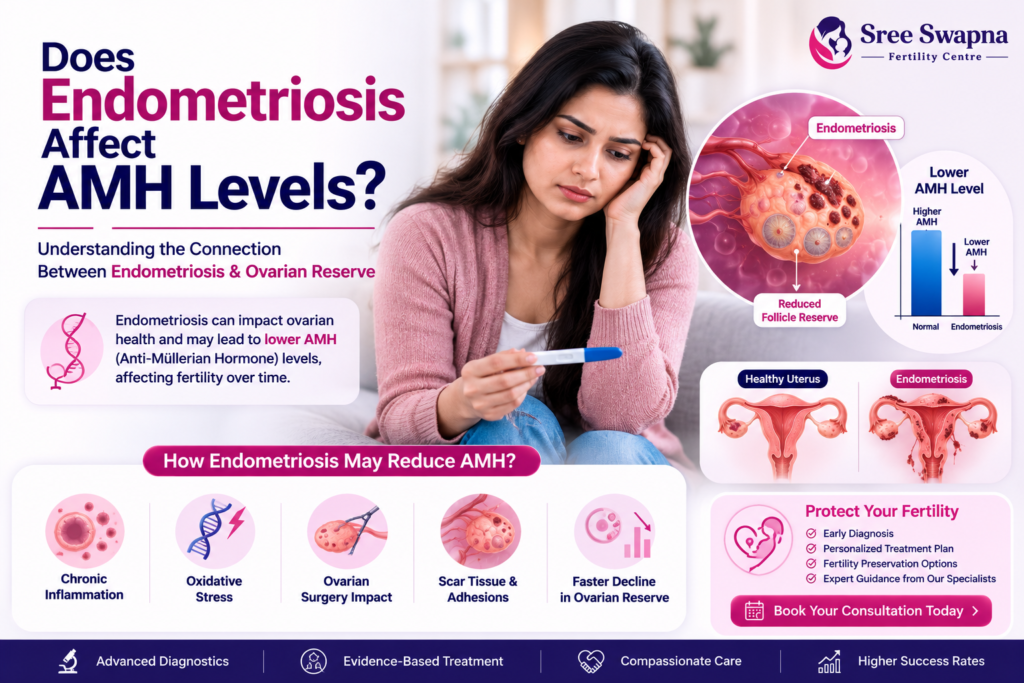
If you have endometriosis — particularly an ovarian endometrioma (chocolate cyst) — and you’ve had your AMH tested, you might be looking at a number lower than expected for your age. This is a genuinely well-documented pattern, and understanding why can help you make more informed decisions about treatment timing.
Yes, Endometriosis Is Linked to Lower AMH — Even Before Surgery
Multiple studies have found that women with ovarian endometriomas have measurably lower AMH levels compared to women of similar age without the condition. One notable study tracking AMH over six months found it declined by a median of 26.4% in women with untreated endometriomas, compared to just 7.4% in women without the condition — suggesting the endometrioma itself accelerates the natural decline in ovarian reserve, independent of any surgery.
This appears to happen through a combination of local inflammation, oxidative stress, and gradual damage to the surrounding healthy ovarian tissue that houses your egg-containing follicles.
Then Surgery Adds Another Layer
This is the part that surprises many patients: cystectomy (surgical removal of an endometrioma) typically causes an additional, often substantial drop in AMH — on top of whatever decline the endometrioma itself has already caused.
Research findings vary somewhat by study, but the pattern is consistent:
- Unilateral cystectomy: Roughly a 30% additional decline in AMH is commonly reported
- Bilateral cystectomy: Declines of up to 44% or more have been reported, with some studies showing even steeper initial drops that partially recover over the following months
One study following patients for a full year found AMH declining from a median of 3.77 ng/mL before surgery to around 1.60–1.72 ng/mL afterward — a sustained decline of over 40%, even a year later.
Why Does Surgery Cause This?
It’s not because surgeons are careless — it’s an unavoidable trade-off of the procedure itself:
- Removing the cyst wall inevitably takes some healthy ovarian cortex with it, since endometrioma tissue is often intimately attached to surrounding normal tissue
- Thermal coagulation (cautery) used to control bleeding during surgery can damage nearby healthy follicles
- Disrupted blood supply, particularly when the mesosalpinx (tissue connecting the ovary to the fallopian tube) is involved or adhesions need to be released, can further affect ovarian tissue health
What Makes the Decline Worse?
Research has identified several factors associated with a steeper AMH drop after surgery:
- Bilateral endometriomas (both ovaries affected) consistently show a larger decline than unilateral cases
- Larger cyst size — declines are notably steeper for cysts over 7cm
- Lower AMH levels before surgery — women who already have reduced ovarian reserve tend to see a larger proportional impact
- Involved mesosalpinx or significant adhesions, which can compromise the ovary’s blood supply during and after surgery
Does Surgical Technique Make a Difference?
Yes, genuinely. Research comparing different surgical approaches has found:
- Cystectomy (complete excision) has the lowest recurrence rate, but causes the greatest AMH decline
- Ablation (vaporisation) of the cyst lining tends to preserve more ovarian reserve, but is associated with a higher recurrence rate
- Combined techniques (partial cystectomy plus ablation of the remaining cyst wall) have shown a middle-ground effect — less AMH decline than full cystectomy, without the recurrence rates seen with ablation alone
This is a genuine trade-off, not an easy choice, and it’s worth discussing directly with your surgeon: are you prioritising the lowest recurrence risk, or preserving as much ovarian reserve as possible? The right answer depends on your age, fertility timeline, and how symptomatic the cyst is.
Can AMH Recover After Surgery?
Some studies show partial recovery over the following months, particularly in women with intact blood supply to the ovary and smaller, unilateral cysts. However, in many cases — particularly bilateral surgery, larger cysts, or when the mesosalpinx was involved — the decline tends to persist rather than fully reverse.
What This Means for Your Fertility Planning
If you have an endometrioma and are considering both your symptoms and future fertility, this research points to a few practical takeaways:
- Surgery isn’t automatically the first or only option — if the cyst is small, causing minimal symptoms, and you’re not in urgent need of treatment, monitoring or hormonal management may be reasonable, particularly if preserving ovarian reserve is a priority
- If surgery is needed, discuss technique with your surgeon — cystectomy, ablation, or a combined approach each carry different trade-offs
- If fertility is a near-term goal, some specialists may discuss egg freezing before surgery, particularly for bilateral endometriomas or larger cysts, to preserve options regardless of how surgery affects your ovarian reserve afterward
Endometriosis and AMH Care at Sree Swapna Fertility Centre
Dr. Swapna Naik, Clinical Director at Sree Swapna Fertility Centre, is a trained laparoscopic surgeon with over 15 years of experience, and factors ovarian reserve preservation directly into surgical planning for endometriomas — not treating every cyst with the same default technique.
Both our Kondapur and Attapur clinics offer AMH testing and detailed ultrasound evaluation, allowing us to have an honest, informed conversation about your specific situation — cyst size, laterality, symptoms, and fertility timeline — before recommending a surgical approach, or discussing whether surgery is the right next step at all.
Frequently Asked Questions
1. Does having an endometrioma lower AMH even without surgery?
Yes, research shows AMH tends to decline faster in women with untreated endometriomas compared to women without the condition.
2. How much does cystectomy typically lower AMH?
Studies commonly report roughly a 30% additional decline after unilateral cystectomy, and up to 44% or more after bilateral cystectomy.
3. Why does removing an endometrioma affect healthy ovarian tissue?
The cyst wall is often closely attached to surrounding healthy tissue, so some normal ovarian cortex containing follicles is inevitably removed or affected during surgery.
4. Does AMH recover after endometrioma surgery?
Some recovery is possible, particularly with smaller, unilateral cysts and intact blood supply, but the decline often persists, especially after bilateral surgery.
5. Is bilateral endometrioma surgery worse for ovarian reserve than unilateral?
Yes, bilateral cystectomy is consistently associated with a larger AMH decline than unilateral surgery in research studies.
6. Does cyst size affect how much AMH drops after surgery?
Yes, larger cysts, particularly over 7cm, are associated with a steeper decline in AMH after surgery.
7. Is ablation better than cystectomy for preserving ovarian reserve?
Ablation is generally associated with less AMH decline than cystectomy, but comes with a higher risk of cyst recurrence — a genuine trade-off to discuss with your surgeon.
8. What is a combined surgical technique for endometriomas?
It involves partial cystectomy along with ablation of the remaining cyst wall, aiming to balance lower recurrence risk with less impact on ovarian reserve.
9. Should I get my AMH tested before endometrioma surgery?
Yes, baseline AMH testing can help inform surgical planning and give you and your doctor a clearer picture of your starting ovarian reserve.
10. Does every woman with endometriosis have low AMH?
Not necessarily — the association is more consistently shown with ovarian endometriomas specifically, rather than all forms or severities of endometriosis.
11. Can I avoid surgery to protect my ovarian reserve?
In some cases, if the cyst is small and symptoms are manageable, monitoring or hormonal treatment may be a reasonable alternative to surgery — this is worth discussing with your specialist.
12. Does the surgeon’s experience affect how much AMH declines after surgery?
Surgical technique and care in preserving healthy tissue can influence outcomes, so experience with endometrioma-specific surgery is a reasonable factor to consider.
13. Should I consider egg freezing before endometrioma surgery?
This is worth discussing with your specialist, particularly for bilateral endometriomas, larger cysts, or if you’re not planning pregnancy in the near term but want to preserve options.
14. Does a lower AMH after surgery mean I can’t get pregnant?
No, AMH reflects ovarian reserve (egg quantity), not a guarantee of infertility — many women with lower AMH after surgery still conceive naturally or with fertility treatment.
15. How soon after surgery should AMH be retested?
This varies by clinical protocol, but testing at intervals like 1, 3, 6, and 12 months has been used in research to track recovery patterns.
16. Does having a smaller endometrioma mean surgery will have less impact on AMH?
Generally, smaller cysts are associated with a less significant AMH decline compared to larger ones, though individual factors still matter.
17. Can adhesions affect AMH decline after surgery?
Yes, involvement of the mesosalpinx or significant adhesions, which can affect the ovary’s blood supply, has been linked to a greater and more persistent AMH decline.
18. Is AMH the only factor in deciding on endometrioma surgery?
No, symptoms, cyst size, risk of malignancy, and personal fertility goals all factor into this decision alongside AMH considerations.
19. Does repeat endometrioma surgery cause more ovarian reserve damage?
Yes, repeated surgery on the same ovary is generally associated with a cumulative additional impact on ovarian reserve, which is an important consideration for recurrent cases.
20. Can hormonal treatment help avoid the need for repeat surgery?
In some cases, postoperative hormonal treatment may help reduce recurrence risk, potentially avoiding the need for repeat surgery and its additional impact on ovarian reserve.
21. Should I discuss surgical technique options with my surgeon beforehand?
Yes, it’s a reasonable and important conversation — ask about cystectomy versus ablation versus combined techniques and how each might apply to your specific case.
22. Where can I get AMH testing and endometrioma evaluation in Hyderabad?
Sree Swapna Fertility Centre offers AMH testing and detailed ultrasound evaluation for endometriomas at both our Kondapur and Attapur clinics.
Conclusion
Endometriosis, and particularly ovarian endometriomas, genuinely can lower AMH — both from the condition itself and, further, from the surgery often used to treat it. This isn’t a reason to avoid necessary treatment, but it is a reason to have an honest, detailed conversation with your specialist about surgical technique, timing, and whether fertility preservation should be part of your plan.
Discuss Your Ovarian Reserve and Treatment Options
Dr. Swapna Naik and the team at Sree Swapna Fertility Centre can help you weigh symptom relief against ovarian reserve preservation for your specific situation.
📞 Call: +91 76708 04424 / +91 40 4995 3719 💬 WhatsApp: Message us directly 📧 Email: sreeswapna.fertility@gmail.com 📍 Visit us at: Kondapur (flagship centre) or Attapur, Hyderabad 🌐 Book an appointment: sreeswapnaivf.com/contact-us
