
If you or someone you love has just heard the words “endometrial cancer,” the first question is almost always the same: how fast is this moving?
The honest, direct answer: it depends — on the type of endometrial cancer, its grade, and increasingly, its molecular profile. This isn’t a dodge; it’s genuinely the most accurate answer current medicine can give. Let’s break down what actually determines the answer for a specific diagnosis.
The Reassuring Part First
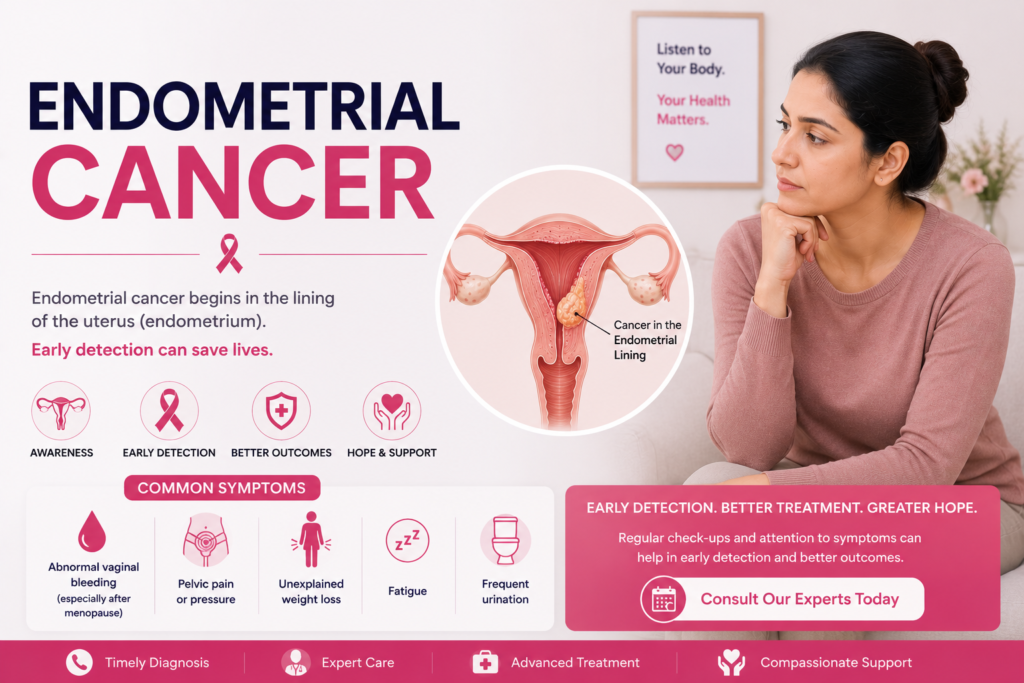
Endometrial cancer is one of the more frequently caught-early cancers, largely because it tends to announce itself. Abnormal bleeding — especially bleeding after menopause — is the most common early symptom, and it typically prompts women to see a doctor relatively quickly. Because of this, a large majority of endometrial cancer cases are diagnosed at an early stage, when the disease is still confined to the uterus.
Early-stage, low-grade endometrioid endometrial cancer (the most common type) is generally considered a comparatively slower-growing cancer, and outcomes at this stage are often favourable, with published survival rates in the high 80s to high 90s percentage range at 3 and 5 years for early-stage, lower-grade disease.
But Not All Endometrial Cancer Behaves the Same Way
This is where “it depends” becomes genuinely important, not just a hedge.
Type and Grade Matter
- Low-grade, endometrioid tumours (the most common type) tend to grow and spread more slowly
- High-grade, aggressive histological subtypes — including serous carcinoma, clear cell carcinoma, and carcinosarcoma — behave much more aggressively, and can spread more quickly, even when caught at a similar stage
Molecular Classification Now Changes the Picture Significantly
Since 2023, the official staging system for endometrial cancer has started incorporating molecular subtyping — genetic characteristics of the tumour — because it turns out to predict behaviour more precisely than the older, purely anatomical staging system:
- POLE-mutated tumours carry an excellent prognosis — close to 100% survival in some studies, even when found at a more advanced stage
- p53-abnormal tumours carry the least favourable prognosis among the molecular subtypes, and are associated with more aggressive behaviour
- Mismatch repair-deficient (MMRd) and “no specific molecular profile” (NSMP) tumours generally fall in between
This is a genuinely significant shift: two women with the “same stage” diagnosis under older classification systems can now be understood to have meaningfully different outlooks, once their tumour’s molecular profile is known.
How Does Endometrial Cancer Actually Spread?
When it does spread, endometrial cancer typically follows a fairly predictable path:
- Direct extension — growing deeper into the muscular wall of the uterus (myometrium), and potentially into the cervix
- Lymphatic spread — travelling to nearby lymph nodes in the pelvis, and later, nodes near the aorta
- Peritoneal spread — in some cases, particularly aggressive types, spreading across the lining of the abdominal cavity
- Distant spread — in more advanced disease, reaching further organs such as the lungs, liver, or bone
The depth of invasion into the myometrium, and the presence of cancer cells within lymphatic or blood vessels (called lymphovascular space invasion, or LVSI), are both important factors your pathology report will note, since they influence both staging and prognosis.
Why Early Symptoms Matter So Much Here
Because abnormal uterine bleeding — particularly any bleeding after menopause — is often the very first sign, taking it seriously and getting it evaluated promptly is one of the most meaningful things a woman can do for her own outcome. This isn’t about causing alarm over every irregular period; it’s about not dismissing a genuinely important warning sign, especially postmenopausally, when any bleeding is considered abnormal until proven otherwise.
What Determines Your Actual Prognosis
If you or a loved one has received a diagnosis, prognosis is generally shaped by:
- Stage at diagnosis (how far it has spread)
- Grade (how abnormal the cells look, and how quickly they’re likely to grow)
- Histological subtype (endometrioid vs. more aggressive types like serous or clear cell)
- Molecular subtype, where available
- Lymphovascular space invasion, noted on pathology review
- Depth of myometrial invasion
A gynaecologic oncologist will interpret all of these factors together to determine both staging and the recommended treatment plan.
Where This Fits Into Our Care
We want to be transparent about our role here. Diagnosis, staging surgery, and treatment (including chemotherapy and radiation) for confirmed endometrial cancer require a gynaecologic oncologist and a specialised cancer care team — this is standard, appropriate care, not a referral we make reluctantly.
What general gynaecology, including our practice, contributes is often the first step: recognising abnormal bleeding as a symptom worth investigating, performing initial evaluation through transvaginal ultrasound (checking endometrial thickness) and endometrial biopsy, and coordinating a prompt referral to gynaecologic oncology when findings raise concern.
Endometrial Health Evaluation at Sree Swapna Fertility Centre
Dr. Swapna Naik, Clinical Director at Sree Swapna Fertility Centre, brings over 15 years of experience in gynaecology, and takes abnormal uterine bleeding seriously as a symptom warranting prompt evaluation — particularly in postmenopausal women, or in the presence of known risk factors like obesity, PCOS, or a family history of Lynch syndrome.
Both our Kondapur and Attapur clinics offer in-house transvaginal ultrasound and endometrial biopsy, allowing timely initial evaluation, with rapid referral coordination to gynaecologic oncology whenever findings suggest malignancy.
Frequently Asked Questions
1. Does endometrial cancer spread quickly?
It depends on the type, grade, and molecular subtype — low-grade endometrioid tumours tend to grow more slowly, while aggressive histological or molecular subtypes can spread more quickly.
2. What is the most common early symptom of endometrial cancer?
Abnormal uterine bleeding, especially bleeding after menopause, is the most common early symptom.
3. Is endometrial cancer usually caught early?
Yes, a large majority of cases are diagnosed at an early stage, largely because abnormal bleeding prompts relatively quick evaluation.
4. What does “molecular subtype” mean for endometrial cancer prognosis?
It refers to specific genetic characteristics of the tumour that have been shown to predict behaviour and outcomes more precisely than older staging methods alone.
5. Which molecular subtype has the best prognosis?
POLE-mutated tumours generally carry an excellent prognosis, even at more advanced stages.
6. Which molecular subtype has the worst prognosis?
p53-abnormal tumours are generally associated with the least favourable prognosis among the molecular subtypes.
7. How does endometrial cancer typically spread if untreated?
It can extend directly into the uterine muscle wall and cervix, spread through lymphatic channels to nearby lymph nodes, and in more advanced cases, reach distant organs.
8. What is lymphovascular space invasion (LVSI)?
It refers to cancer cells found within lymphatic or blood vessels on pathology review, an important factor in staging and prognosis.
9. Does Sree Swapna Fertility Centre treat endometrial cancer directly?
No, diagnosis confirmation and treatment require a gynaecologic oncologist. We provide initial evaluation, including ultrasound and biopsy, and coordinate referral when needed.
10. What are the risk factors for endometrial cancer?
Risk factors include obesity, PCOS, unopposed oestrogen exposure, diabetes, and a family history of Lynch syndrome, among others.
11. Is postmenopausal bleeding always a sign of cancer?
No, but it’s considered abnormal until proven otherwise and should always be evaluated promptly by a doctor.
12. How is endometrial cancer initially diagnosed?
Typically through transvaginal ultrasound to assess endometrial thickness, followed by an endometrial biopsy if findings raise concern.
13. What is the difference between endometrioid and non-endometrioid endometrial cancer?
Endometrioid is the more common, generally slower-growing type, while non-endometrioid subtypes like serous or clear cell carcinoma tend to behave more aggressively.
14. Can endometrial cancer be treated while preserving the uterus?
In very select, early-stage, low-grade cases in women who strongly wish to preserve fertility, this may be discussed with a gynaecologic oncologist, though it’s not appropriate for every case.
15. Does grade affect how quickly endometrial cancer spreads?
Yes, higher-grade tumours generally show more aggressive behaviour and a greater tendency to spread compared to lower-grade tumours.
16. What changed in the 2023 FIGO staging update for endometrial cancer?
It incorporated molecular classification alongside traditional anatomical staging, improving the accuracy of prognosis prediction.
17. Is endometrial cancer more common in postmenopausal women?
Yes, it’s more frequently diagnosed in postmenopausal women, though it can occur in younger women as well.
18. Can endometrial cancer spread to the ovaries?
Yes, in some cases, particularly with more advanced or aggressive disease, spread to the ovaries can occur.
19. What survival rates are associated with early-stage endometrial cancer?
Published studies report survival rates in the high 80s to high 90s percentage range at 3 and 5 years for early-stage, lower-grade endometrioid disease, though individual outcomes vary.
20. Should every case of abnormal bleeding be evaluated for endometrial cancer?
Any abnormal or postmenopausal bleeding should be evaluated by a doctor, though most cases have benign causes — evaluation is about ruling out serious causes, not assuming the worst.
21. Can family history affect endometrial cancer risk?
Yes, a family history of Lynch syndrome significantly increases endometrial cancer risk and may warrant additional screening discussions with your doctor.
22. Where can I get initial evaluation for abnormal uterine bleeding in Hyderabad?
Sree Swapna Fertility Centre offers transvaginal ultrasound and endometrial biopsy evaluation at both our Kondapur and Attapur clinics, with prompt referral to gynaecologic oncology when needed.
Conclusion
Whether endometrial cancer spreads quickly genuinely depends on its type, grade, and increasingly, its molecular profile — not a single universal answer. What matters most practically is taking abnormal bleeding seriously and getting it evaluated promptly, since early detection remains one of the most meaningful factors in a favourable outcome.
Concerned About Abnormal Bleeding?
Dr. Swapna Naik and the team at Sree Swapna Fertility Centre can provide prompt evaluation and coordinate specialist care when needed.
📞 Call: +91 76708 04424 / +91 40 4995 3719 💬 WhatsApp: Message us directly 📧 Email: sreeswapna.fertility@gmail.com 📍 Visit us at: Kondapur (flagship centre) or Attapur, Hyderabad 🌐 Book an appointment: sreeswapnaivf.com/contact-us
