
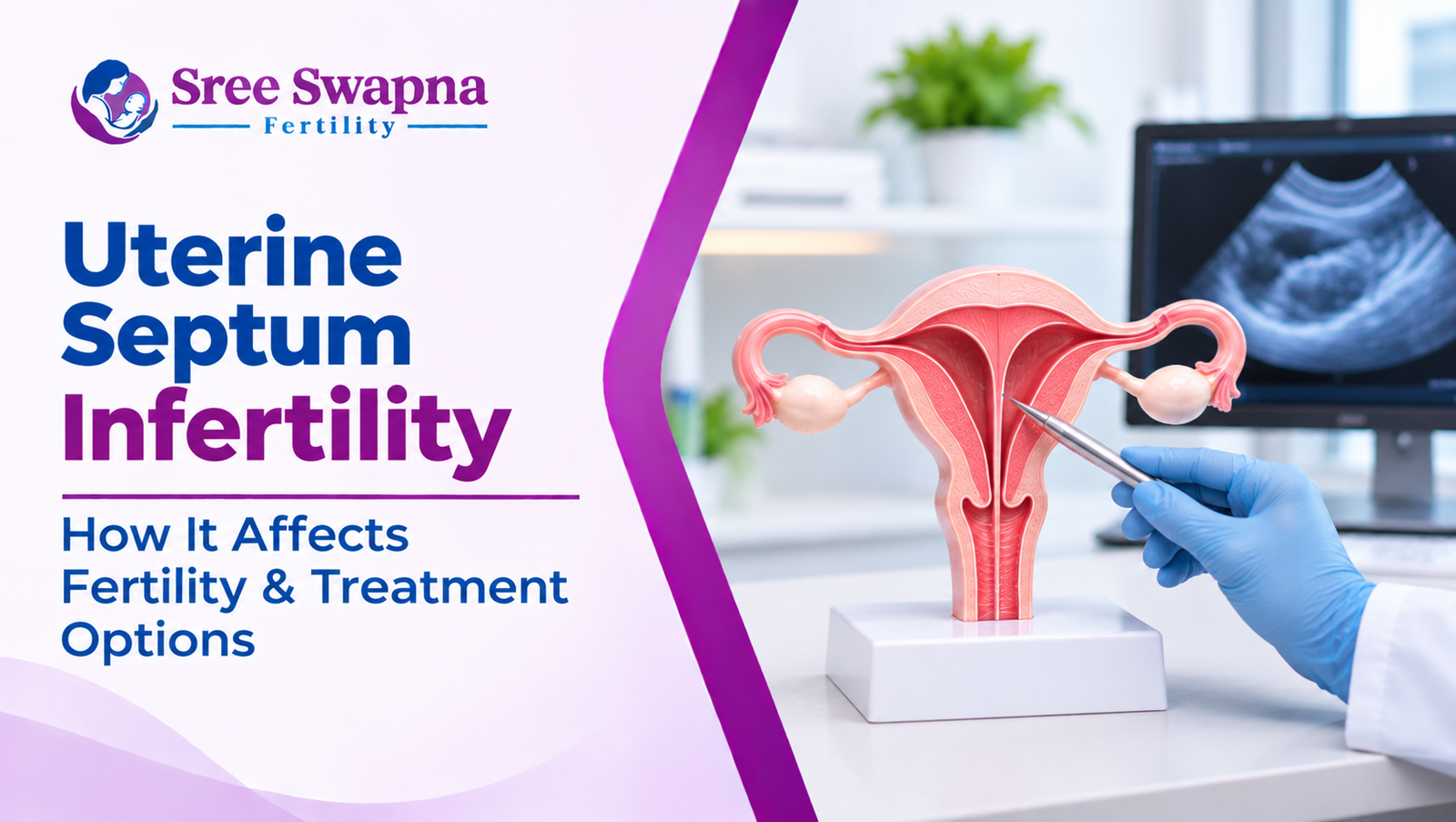
Uterine Septum and Infertility: Diagnosis & Treatment
Being told that you have a septate uterus can raise immediate questions about conception, miscarriage and surgery. A careful diagnosis matters because different uterine shapes need different management, and finding a septum does not automatically mean it explains every reproductive difficulty.
Quick Answer
A uterine septum is a congenital partition within the uterine cavity. It is associated with miscarriage and certain pregnancy complications, but evidence linking it directly to infertility is insufficient. ASRM recommends 3D transvaginal ultrasound, with or without saline infusion, as the first-line noninvasive diagnostic test. Surgery is an individual decision, not an automatic requirement.
What Is a Uterine Septum?
A septate uterus is a developmental difference present from birth. During formation of the reproductive tract, tissue that would normally be resorbed remains within the uterine cavity.
The partition may extend partway into the cavity or be more complete. It is not a growth caused by trying to conceive, a hormone imbalance or a previous embryo transfer.
The appearance must be interpreted using an appropriate classification system. A report describing a slight indentation is not, by itself, enough to decide that treatment is needed.
How Is a Septum Different from Other Findings?
| Finding | Main distinction | Why it matters |
|---|---|---|
| Septate uterus | A developmental partition inside the cavity, assessed together with the outer uterine contour. | Selected patients may discuss hysteroscopic septum incision after counselling. |
| Bicornuate uterus | A different developmental configuration involving the external shape of the uterus. | It should not be treated as a septum simply because the cavity appears divided. |
| Arcuate configuration | Usually considered a clinically insignificant normal variant rather than a true septum. | Accurate classification helps avoid unnecessary intervention. |
| Intrauterine adhesions | Acquired scar tissue, rather than a congenital partition. | History, treatment and follow-up differ. |
If the cavity has changed after a uterine procedure, our guide to Asherman syndrome and intrauterine adhesions explains an acquired condition that should not be confused with a congenital septum.
Can a Uterine Septum Cause Infertility?
ASRM’s 2024 guideline states that evidence is insufficient to conclude whether a septate uterus is associated with infertility. Many studies include people already attending fertility clinics, which can make cause and effect difficult to separate.
Therefore, a septum should not automatically be labelled the sole reason for difficulty conceiving. Ovulation, semen findings, tubal factors, age and other relevant issues still require appropriate assessment.
What About Miscarriage and Pregnancy Complications?
The evidence is different here. A septate uterus is associated with miscarriage and adverse obstetric outcomes, including preterm birth and an abnormal position of the baby before birth.
An association does not mean that every pregnancy will be affected or that the septum caused a particular loss. Counselling should address the individual’s complete reproductive history.
The ASRM guideline on uterine septum clearly separates the uncertain infertility association from the evidence on miscarriage and obstetric risks.
Does a Uterine Septum Cause Symptoms?
Often there are no specific symptoms. The finding may appear during an infertility evaluation, investigation of pregnancy losses or imaging for another reason.
Pain or abnormal bleeding should not automatically be attributed to a septum. Other causes may need assessment, and an incidental imaging finding does not establish a treatment indication.
How Is a Septate Uterus Diagnosed?
Accurate classification requires assessment of both the internal cavity and the external uterine contour. ASRM recommends 3D transvaginal ultrasound, with or without saline infusion, as the first-line noninvasive tool.
| Investigation | Role | Important limitation |
|---|---|---|
| 3D transvaginal ultrasound | First-line noninvasive assessment of cavity and uterine shape. | Accurate interpretation depends on appropriate imaging and experience. |
| Saline infusion with ultrasound | Can help outline the cavity in selected assessments. | Use depends on the diagnostic question and clinical circumstances. |
| HSG | Can suggest a divided cavity and assess apparent tubal patency. | Does not reliably distinguish septate from bicornuate uterus by itself. |
| Hysteroscopy | Direct view of the uterine cavity; used for treatment when appropriate. | Does not by itself show the external uterine contour. |
| MRI | May help in selected complex or uncertain anatomical assessments. | Not automatically the first investigation for every suspected septum. |
Our HSG vs hysteroscopy comparison explains why the tests answer different questions. Neither should be assumed to replace imaging of the outer uterine contour.
What If Two Reports Give Different Diagnoses?
Ask for review by a clinician experienced in uterine anomalies. Differences can arise from the imaging method, image quality, classification system or interpretation. Confirming the diagnosis is more important than rushing into surgery.
Does Every Uterine Septum Need Surgery?
No. The discussion should distinguish recurrent miscarriage, infertility and a finding in someone who has not yet attempted conception.
| Situation | Evidence-based discussion |
|---|---|
| Septum with recurrent miscarriage | ASRM recommends offering hysteroscopic incision within a shared decision-making approach. Benefits, limitations and risks need explanation. |
| Infertility or fertility treatment | Incision may be offered after counselling that it may or may not increase live birth. A universal benefit is not established. |
| No previous attempt at conception | Evidence is insufficient to recommend routine prophylactic septum surgery. |
Why Is the Evidence Not a Simple Yes or No?
Many studies are observational, use different definitions or compare pregnancy outcomes before and after surgery without an adequate untreated comparison group. A small randomised trial did not demonstrate an improvement in live birth.
These limitations are why shared decision-making matters. A study showing fewer miscarriages does not automatically establish a live-birth benefit for every patient.
Should Size Alone Decide?
No. ASRM advises against using septum characteristics such as size or shape to determine its impact on reproductive outcomes. Measurements help establish anatomy and diagnosis, but a “small” or “large” label should not by itself dictate a fertility prognosis or surgery.
What Is Hysteroscopic Septum Incision?
When chosen, the procedure divides the septal tissue under hysteroscopic visualisation to create a more unified cavity. The hysteroscope passes through the cervix; the exact technique and anaesthesia are planned according to the case.
The clinic’s hysteroscopy service page introduces direct cavity examination. Ask what the planned operation involves, rather than assuming diagnostic hysteroscopy and operative treatment are the same.
What Risks Should Be Discussed?
Consent should cover bleeding, infection, uterine perforation, procedure-related fluid complications, adhesion formation and incomplete correction. Rare pregnancy-related complications have also been reported after septum surgery.
The team should explain how it confirms the anatomy, limits injury and decides when the procedure is complete. No operation can guarantee pregnancy or eliminate every future obstetric risk.
Are Oestrogen, Balloons or an IUD Always Needed Afterwards?
No. ASRM finds insufficient evidence to recommend routine oral oestrogen, intrauterine balloons or IUDs solely to prevent adhesions after septum resection. A selected indication should be explained; do not self-start postoperative medication.
When Can Fertility Treatment Resume?
ASRM states that patients may generally proceed with fertility treatment 1–2 months after septum resection, based on limited evidence. This is not permission to schedule treatment yourself. Healing, procedural findings and your clinician’s instructions determine the individual plan.
After Surgery: Follow Your Discharge Advice
Obtain written guidance on medication, bleeding, activity, intercourse and follow-up. Severe or worsening pain, heavy bleeding, fever or feeling acutely unwell needs prompt medical assessment rather than an online callback request.
How Does a Septum Affect IVF Planning?
IVF does not remove a septum or automatically establish a need for surgery. The team should confirm the diagnosis and consider the history before deciding whether to operate, proceed without surgery or seek another opinion.
The discussion should explain the expected benefit, evidence uncertainty, procedural risk and any delay to treatment. It should not promise improved implantation or live birth simply because the cavity looks different afterwards.
What If There Have Been Repeated Pregnancy Losses?
A septum may be relevant, but should not replace a broader evidence-based review. The ASRM 2026 recurrent-pregnancy-loss guidance supports uterine assessment and individualised counselling about treatment of relevant findings.
What About Pregnancy After Treatment?
Tell the obstetric team about the original uterine diagnosis and any operation, and provide the operative report if available. Monitoring and delivery planning should reflect your history and the pregnancy findings.
ASRM describes uterine rupture after septum resection as rare, with limited reporting. This should be discussed proportionately, without presenting either surgery or an untreated septum as risk-free.
Questions for Your Consultation
- Has a true septum been confirmed using appropriate imaging?
- Were the internal and external uterine contours assessed?
- Which classification system is being used?
- Is the main concern conception, miscarriage or pregnancy risk?
- What benefit is reasonably expected from surgery in my case?
- What are the alternatives and procedural risks?
- Will postoperative treatment or follow-up imaging be needed?
- When can we safely resume attempts or fertility treatment?
Frequently Asked Questions
Can pregnancy happen naturally with a septate uterus?
Yes. A septum does not mean conception is impossible. Its association with pregnancy loss and some obstetric risks should be discussed individually.
Is a uterine septum the same as Asherman syndrome?
No. A septum is a congenital developmental finding. Asherman syndrome involves acquired intrauterine scar tissue associated with symptoms or reproductive problems.
Can hysteroscopy alone distinguish septate from bicornuate uterus?
Not reliably. Hysteroscopy views the cavity but does not define the external uterine contour. Appropriate imaging is essential.
Is 3D ultrasound usually the first test?
ASRM recommends 3D transvaginal ultrasound, with or without saline infusion, as the first-line noninvasive tool for uterine shape assessment.
Does septum surgery guarantee a baby?
No. ASRM supports offering surgery for recurrent miscarriage through shared decision-making. In infertility, patients should be counselled that live birth may or may not improve.
Should an incidental septum be removed before trying?
Not automatically. Evidence is insufficient to recommend routine surgery in people who have not yet attempted conception. Confirm the diagnosis and discuss the individual circumstances.
Is lifestyle change a treatment for the septum itself?
No. General health measures can support pregnancy preparation but do not remove a congenital uterine partition.
Do I need IVF because a septum was found?
No. Whether IVF is appropriate is a separate fertility decision. Neither IVF nor septum surgery is automatically required by the imaging finding alone.
Conclusion
A suspected uterine septum should first be accurately classified. The next decision depends on the reproductive history and what treatment is expected to achieve. Clear counselling distinguishes miscarriage risk from uncertain infertility causation and explains the benefits and limitations of surgery without promising an outcome.

About the specialist
Dr. Swapna Naik
Founder & Medical Director
Sree Swapna Fertility Centre
Her clinic profile describes fertility services including IVF, IUI, ovulation induction and fertility preservation.
Read Dr. Swapna Naik’s professional profile .
Request an appointmentAbout This Health Information
Purpose and evidence
This guide provides general education, not an individual imaging interpretation or surgical recommendation. Professional sources are linked in the discussion and listed below.
Publisher and commercial context
Sree Swapna Fertility Centre publishes this article and offers fertility services. Appointment and service links lead to the clinic’s own pages. No treatment guarantees pregnancy or live birth.
Questions and corrections
Use the contact page to report a possible error. Include the article title and relevant passage. Do not post private scans or medical information in public comments.
Medical Sources
General educational information only. Confirm the diagnosis and treatment options with a qualified clinician. Do not start hormones or schedule treatment based on this article. The callback form is not an emergency service.
FERTILITY HELPLINE
Contact the Clinic
Appointment and fertility consultation enquiries.
Not an emergency service. Do not send sensitive medical information through this panel.
