
Egg Quality and Age: What Fertility Tests Can and Cannot Predict
“How is my egg quality?” is an understandable question after an AMH test, an ultrasound or an unsuccessful treatment cycle. However, fertility tests measure different things. A result that helps estimate egg numbers does not directly reveal whether an individual egg can lead to a baby.
Quick Answer
Egg quality refers broadly to an egg’s potential, after fertilisation, to contribute to a live birth. Age is an important population-level predictor, particularly of chromosome-related risk. AMH and AFC mainly estimate ovarian reserve and stimulation response. There is no routine blood test that directly measures the quality of every egg remaining in the ovaries.
What Does “Egg Quality” Mean?
Egg quality is not a single laboratory score. It describes the egg’s biological potential to mature, fertilise and support embryo development that may ultimately lead to a live birth. Chromosome competence is an important part of that potential, but not its only aspect.
Pregnancy also depends on sperm contribution, embryo development, uterine factors and other clinical circumstances. A failure at one stage does not automatically prove that every egg is of poor quality.
Egg Quantity and Egg Quality Are Different
Ovarian reserve describes the remaining quantity of oocytes. Egg quality concerns reproductive potential. ASRM explicitly separates these concepts in its guidance on ovarian-reserve testing .
How Does Age Affect Egg Quality?
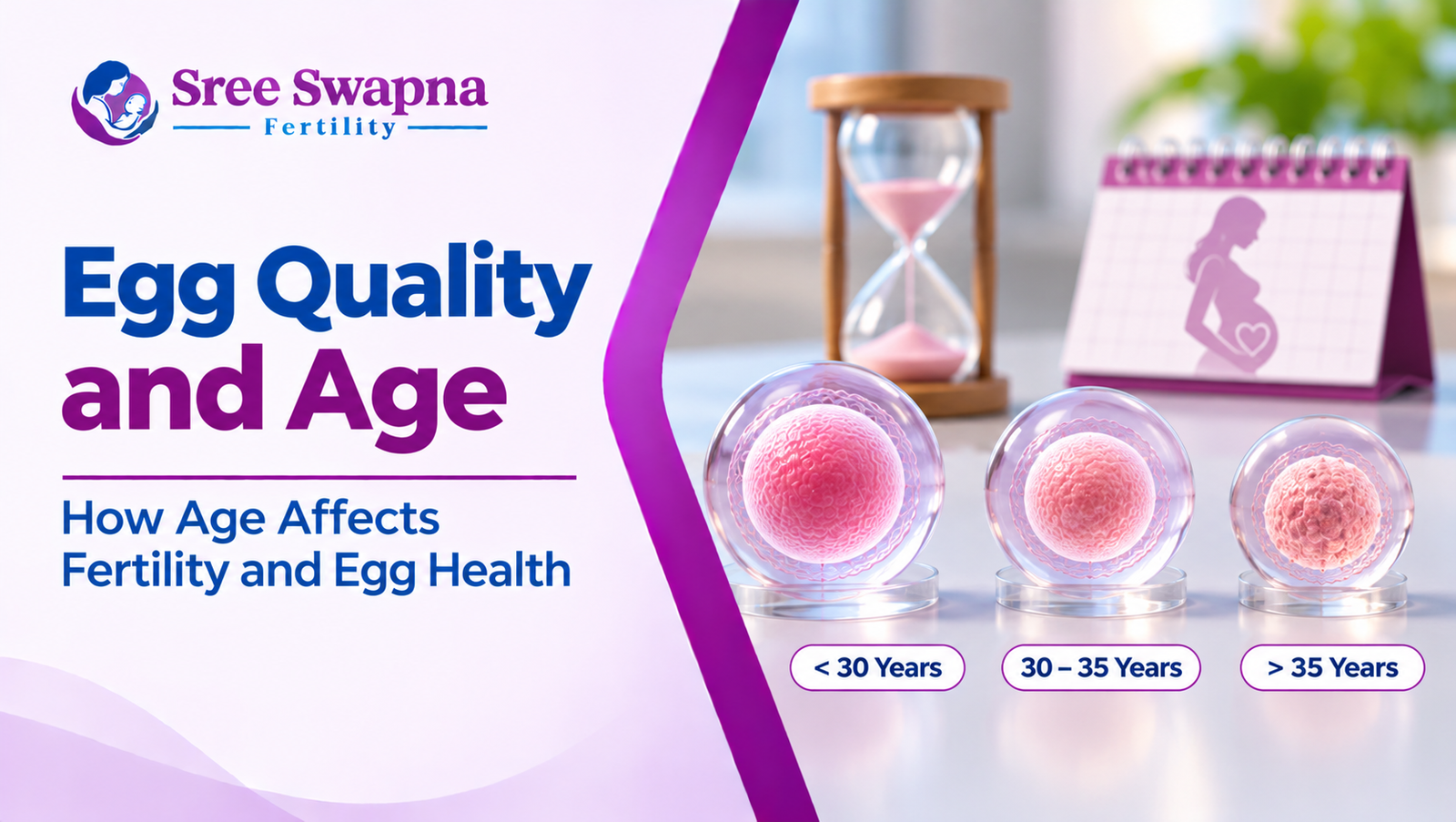
As reproductive age increases, egg numbers decrease and the remaining eggs are more likely to have chromosome abnormalities. On average, this contributes to lower fertility and a higher miscarriage risk.
Age 35 is not a sudden biological switch. Changes occur over time and vary between individuals. The decline generally becomes faster through the mid-30s and later, which makes timely planning important.
The ACOG guide to fertility and pregnancy with age explains these average changes. It does not mean that all eggs at a particular age have the same chromosome status.
Does Age Predict My Exact Outcome?
No. Age helps estimate probabilities across groups, but it is not an individual egg test. People of the same age can have different medical histories, ovarian responses and pregnancy outcomes.
Can Regular Periods Confirm Good Egg Quality?
No. Regular cycles can continue while age-related reproductive changes occur. Symptoms, menstrual flow and home ovulation tests cannot directly determine egg chromosome status.
What Can Fertility Tests Actually Tell You?
| Assessment | Main use | Important limitation |
|---|---|---|
| AMH | Estimates ovarian reserve and likely response to stimulation. | Does not directly measure egg quality or chromosome status. |
| AFC | Counts visible small antral follicles on ultrasound to estimate reserve. | Does not count every remaining egg or establish the quality of each egg. |
| FSH and estradiol | May provide additional information about ovarian function in selected settings. | Not direct egg-quality tests; timing and context affect interpretation. |
| Follicle measurements | Help monitor development and plan treatment timing. | Do not reveal egg chromosome status or guarantee maturity. |
| IVF laboratory observations | Describe collected eggs, maturity, fertilisation and embryo development. | Reflect multiple egg, sperm, laboratory and clinical influences. |
ASRM finds that AMH and AFC predict quantitative outcomes, such as egg yield, better than they independently predict qualitative outcomes such as live birth. Neither should become a stand-alone fertility verdict.
Our AFC vs AMH comparison explains reserve assessment. For interpreting a result against age-related context, read AMH levels by age .
Does Low AMH Mean Poor Egg Quality?
Not necessarily. A younger person may have reduced ovarian reserve while retaining the age-related reproductive characteristics expected of a younger egg population. Low reserve can still matter because fewer eggs may be obtained from stimulation.
Conversely, a high AMH does not eliminate age-related chromosome risk or rule out tubal, sperm or other fertility factors.
Our guide to low AMH vs egg quality examines this specific test-result concern. The present article focuses more broadly on age, biological potential and the limits of available assessments.
Can AMH Predict Natural Pregnancy?
Not reliably as a stand-alone test. ASRM advises against using ovarian-reserve markers as general fertility screening in people with untested fertility. A reassuring result is not permission to delay pregnancy indefinitely.
What Can IVF Reveal About Eggs?
IVF provides information that is not available from a blood test alone: how the ovaries respond, how many eggs are collected, maturity where assessed, fertilisation and subsequent embryo development.
These observations inform counselling, but they do not isolate egg quality perfectly. Sperm factors, insemination technique, laboratory conditions and chance also influence the process.
Are Mature Eggs Automatically Good-Quality Eggs?
No. Maturity describes a developmental stage. It does not guarantee normal chromosomes, successful fertilisation, a blastocyst or a live birth.
Does One Unsuccessful Cycle Prove All Remaining Eggs Are Poor?
No. An individual cycle provides useful information but is not a direct test of every egg remaining in the ovaries. Review the stage at which attrition occurred and whether the findings suggest a change in strategy.
The IVF treatment overview explains the treatment sequence. For practical decisions beyond age 35, read IVF after 35 and treatment planning .
Can Embryo Grading or PGT-A Measure Egg Quality?
Embryo Appearance
Morphology grading describes embryo appearance and development. It is not a chromosome test and cannot establish the quality of the original egg by itself.
Embryo Chromosome Screening
PGT-A assesses chromosome copy-number patterns in cells biopsied from an embryo after fertilisation. It does not directly test an unfertilised egg or measure every aspect of embryo health.
PGT-A does not repair an embryo, make eggs younger or guarantee a baby. ASRM’s 2024 committee opinion states that routine screening of all IVF patients has not demonstrated a universal benefit.
Our PGT-A in IVF guide explains result categories, biopsy limitations and why per-transfer outcomes differ from overall treatment outcomes.
Can Egg Quality Be Improved?
Supporting general health is worthwhile, but it should not be confused with reversing reproductive ageing. No routine treatment can guarantee that a person’s remaining eggs will become chromosomally normal or biologically younger.
Pre-pregnancy care can address smoking, alcohol, medications, nutrition, vaccinations and relevant medical conditions. Ask a clinician about folic acid and other preparation appropriate to your circumstances.
What About Diet and Supplements?
A balanced diet supports health. However, no specific food or supplement should be marketed as a guaranteed treatment for age-related egg chromosome abnormalities.
Ask whether any claimed benefit concerns a laboratory marker, the number of eggs retrieved, pregnancy or live birth. These outcomes are not interchangeable, and evidence in one patient group may not apply to another.
Be Cautious with “Ovarian Rejuvenation” Claims
A change in AMH, menstrual bleeding or a scan measurement does not establish that the egg pool has been rebuilt or egg quality restored. Ask for evidence of meaningful reproductive benefit, potential risks, study oversight and alternatives before considering experimental add-ons.
How Should Age and Test Results Guide Planning?
Begin with the decision you need to make: trying now, investigating infertility, choosing treatment or considering future family building. Testing is most useful when it helps answer that question.
- Consider exact age and reproductive goals, not just an AMH category.
- Assess other fertility factors rather than attributing every difficulty to eggs.
- Use previous treatment response when available, without treating one cycle as a complete prognosis.
- Agree on a review point before spending months on interventions with uncertain benefit.
What If Pregnancy Will Be Delayed?
Egg or embryo freezing may be discussed after individual counselling. Age at egg collection is important to later egg-related reproductive potential, while the number of stored eggs and other treatment factors also matter.
Freezing is not an insurance policy or a guarantee of live birth. ASRM advises that planned freezing decisions should be based on reproductive plans and age, rather than using an ovarian-reserve test alone to promote treatment.
The clinic’s fertility preservation information introduces available approaches. Ask about realistic outcomes, possible retrievals, storage, future treatment and costs.
When Should You Seek Evaluation?
Seek advice earlier when there is a known fertility concern, absent or persistently irregular periods, previous ovarian surgery or treatment that may affect reproductive function. Do not wait for symptoms that supposedly reveal egg quality.
ACOG recommends fertility assessment after 6 months of trying for people older than 35 and recommends evaluation before trying when older than 40. Your clinician can advise on the appropriate timeline for your situation.
Questions for Your Consultation
- Is this result measuring quantity, response or something else?
- What does my exact age add to the interpretation?
- Are other fertility factors being assessed?
- What can previous IVF results reasonably tell us?
- Would further testing change the plan?
- What benefit is expected from a proposed add-on?
- How important is timing for my reproductive goals?
- When will we reassess the plan?
Frequently Asked Questions
Can a blood test measure egg quality?
No routine blood test directly measures the quality or chromosome status of the eggs remaining in the ovaries.
Does high AMH guarantee good-quality eggs?
No. AMH primarily estimates ovarian reserve and stimulation response. It does not remove age-related chromosome risk or assess all fertility factors.
Can low AMH coexist with reproductive potential?
Yes. Low reserve can mean fewer eggs available from stimulation, without proving that every egg has poor developmental potential. Age and other findings matter.
Does fertility suddenly change on the 35th birthday?
No. Reproductive changes occur over time. Age-based counselling thresholds support timely assessment; they are not sudden biological switches.
Do regular periods prove normal egg quality?
No. Regular cycles can coexist with age-related reproductive changes. Bleeding patterns cannot directly establish egg chromosome status.
Does IVF make eggs younger?
No. IVF allows eggs to be collected and fertilised in the laboratory. It does not reverse the biological age of those eggs.
Does a euploid PGT-A result prove the original egg was perfect?
No. PGT-A evaluates embryo biopsy material within the assay’s scope. It is not a complete assessment of the egg or future baby’s health.
Should low AMH alone rule out IVF?
No. ASRM states that even extremely low AMH should not by itself be used to refuse IVF treatment. Counselling should address expected response and the whole clinical picture.
Conclusion
Age, ovarian reserve and egg quality are related, but they are not interchangeable. The useful question is not whether one result is “good” or “bad,” but how it changes a realistic plan for your circumstances. Clear counselling should explain uncertainty without offering false reassurance or unnecessary fear.

About the specialist
Dr. Swapna Naik
Founder & Medical Director
Sree Swapna Fertility Centre
Her clinic profile describes fertility services including IVF, IUI, ovulation induction and fertility preservation.
Read Dr. Swapna Naik’s professional profile .
Request an appointmentAbout This Health Information
Purpose and evidence
This guide provides general education, not a personal fertility prediction. Professional sources are linked in the discussion and listed below.
Publisher and commercial context
Sree Swapna Fertility Centre publishes this article and offers fertility services. Appointment and service links lead to the clinic’s own pages. No test or treatment guarantees conception or live birth.
Questions and corrections
Use the contact page to report a possible error. Include the article title and relevant passage. Do not post private medical results in public comments.
Medical Sources
General educational information only. Do not start supplements or change fertility treatment based on this article. Seek an individual assessment. The callback form is not an emergency service.
FERTILITY HELPLINE
Contact the Clinic
Appointment and fertility consultation enquiries.
Not an emergency service. Do not send sensitive medical information through this panel.
