
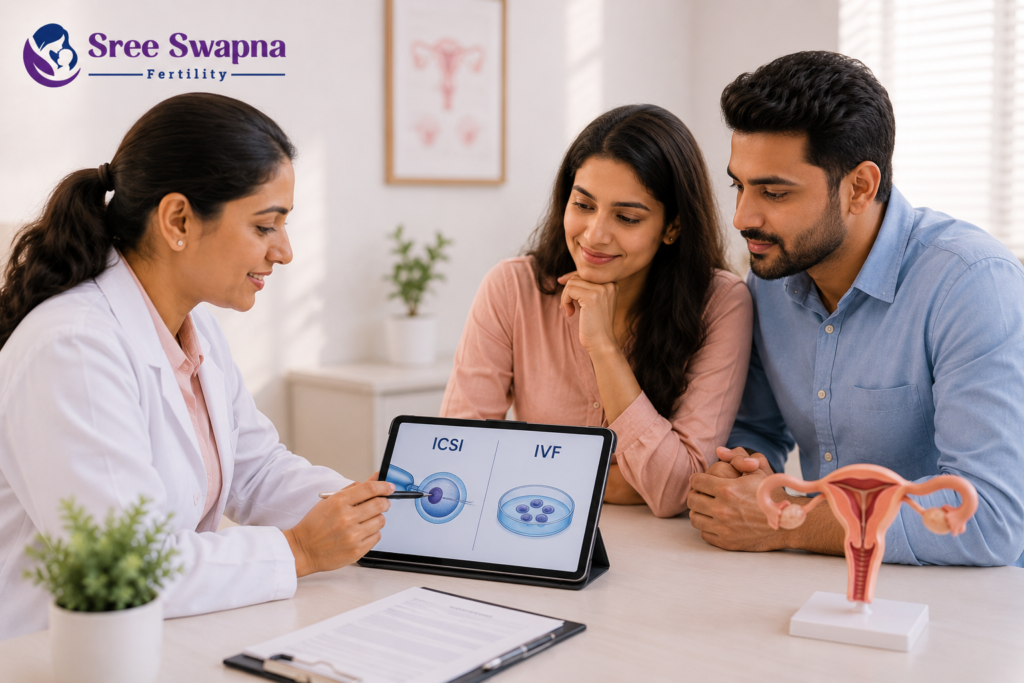
IVF and ICSI are often mentioned together, but they are not two completely separate fertility pathways. IVF is the overall treatment process in which eggs are collected and fertilised in a laboratory. ICSI is one method of fertilisation used within an IVF cycle.
The key difference is how sperm fertilises the egg in the laboratory.
Conventional IVF
In conventional IVF, prepared sperm and eggs are placed together in a culture environment. Fertilisation depends on a sperm reaching and penetrating the egg.
For related treatment information, explore ICSI treatment and IVF treatment. These resources provide additional context for the treatment choices discussed in this guide.
ICSI
In ICSI, an embryologist selects a sperm and injects it directly into a mature egg using specialised laboratory equipment.
The stages before and after fertilisation—ovarian stimulation, egg retrieval, embryo culture and embryo transfer—are broadly part of the same IVF treatment pathway.
When Is ICSI Commonly Used?
ICSI may be recommended for:
- very low sperm count
- poor sperm motility
- selected severe morphology problems
- surgically retrieved sperm
- previous poor or failed fertilisation
- other specific laboratory or clinical indications
Professional guidance published in 2026 also notes that ICSI is increasingly used beyond male-factor infertility and that benefit should not be assumed when semen parameters are normal.
Does ICSI Improve IVF Success?
ICSI is designed to improve the chance that fertilisation can occur when sperm cannot reliably fertilise the egg on its own. That does not mean it automatically improves implantation, pregnancy or live birth for every patient.
For additional context, review does ICSI improve IVF success rates?. You can also explore male infertility treatment to understand related options before discussing the next step with your fertility team.
Once fertilisation has occurred, outcome still depends on egg quality, embryo development, age, uterine factors and other clinical variables.
Is ICSI More Expensive Than Conventional IVF?
ICSI usually adds laboratory work and specialised embryology to an IVF cycle, so it may increase the treatment cost. Patients should ask whether ICSI is included in an IVF package or charged separately.
Are There Risks?
Not every injected egg survives or fertilises. ICSI also cannot correct all genetic or biological causes of male infertility. In some male-factor conditions, further evaluation or genetic counselling may be appropriate.
IVF vs ICSI: Which One Should You Choose?
This is not usually a patient-choice question based only on preference. The embryology and fertility team should recommend the fertilisation method based on semen parameters, treatment history, sperm source, egg number, prior fertilisation and the overall clinical picture.
Questions to Ask Your Clinic
- Why are you recommending ICSI in my case?
- What problem is ICSI expected to solve?
- What happens if conventional IVF is used instead?
- Is ICSI cost included in my package?
- How does the clinic report fertilisation rates?
- Is additional male-factor testing needed?
For a related explanation that can help you understand the next stage, see ICSI procedure.
Frequently Asked Questions
1. Is ICSI different from IVF?
ICSI is a fertilisation technique used within an IVF cycle. In conventional IVF, eggs and sperm are placed together in the laboratory; in ICSI, an embryologist injects a single sperm into a mature egg.
2. When is ICSI commonly recommended?
ICSI is commonly considered for significant male-factor infertility, very low sperm numbers, surgically retrieved sperm, or certain prior fertilisation problems.
3. Is ICSI better than conventional IVF for everyone?
No. ICSI may solve a specific fertilisation problem, but routine use when there is no clear indication does not automatically improve pregnancy or live-birth outcomes.
4. Does ICSI increase fertilisation rates?
ICSI can improve the chance of fertilisation in cases where sperm are unlikely to fertilise an egg conventionally, but it cannot guarantee fertilisation of every injected egg.
5. Does ICSI improve embryo quality?
Not necessarily. ICSI changes how sperm enters the egg; embryo development still depends on egg quality, sperm factors, genetics, and laboratory conditions.
6. Does ICSI improve implantation rates?
ICSI itself is not primarily an implantation treatment. Implantation depends on embryo competence, uterine factors, transfer conditions, and other clinical variables.
7. Is egg retrieval different in ICSI and IVF?
No. Ovarian stimulation and egg retrieval are generally the same. The main difference occurs in the laboratory during fertilisation.
8. Is embryo transfer different after ICSI?
Usually not. Once embryos have developed, transfer or freezing is managed similarly to conventional IVF based on the clinical plan.
9. Can ICSI be used with normal sperm?
It can be, but the reason should be discussed. Current evidence does not support automatic ICSI for all non-male-factor IVF cycles.
10. Is ICSI used after previous fertilisation failure?
It may be considered after total or very low fertilisation in a previous conventional IVF cycle, depending on the suspected cause.
11. Is ICSI used with frozen sperm?
It may be, especially when sperm numbers or motility are limited, but the decision depends on specimen quality and the treatment plan.
12. Is ICSI used with surgically retrieved sperm?
Yes, ICSI is commonly used when sperm are obtained through surgical retrieval because the number and motility of available sperm can be limited.
13. Can ICSI be combined with PGT?
Yes. ICSI may be used in cycles that also involve preimplantation genetic testing, but whether ICSI is necessary should still be based on clinical and laboratory considerations.
14. Does ICSI reduce miscarriage risk?
ICSI is not a treatment for most causes of miscarriage. Miscarriage risk is influenced by age, embryo genetics, uterine factors, and other health conditions.
15. Are the medications different for ICSI?
The ovarian stimulation medications are usually similar because ICSI is a laboratory fertilisation method, not a separate stimulation treatment.
16. Does ICSI cost more than conventional IVF?
Often there is an additional laboratory fee for ICSI. Exact pricing and package inclusions vary by clinic and should be confirmed before treatment.
17. Does ICSI guarantee a normal embryo?
No. ICSI assists fertilisation but does not guarantee normal chromosomes, healthy embryo development, implantation, or live birth.
18. Are there risks specific to ICSI?
ICSI requires egg handling and micromanipulation. Overall risks should be discussed with the fertility team, including the underlying male-factor condition and any relevant genetic evaluation.
19. How does the doctor decide between IVF and ICSI?
The decision considers semen analysis, sperm source, previous fertilisation history, egg number, diagnosis, and laboratory judgement.
20. Can we switch from conventional IVF to ICSI after retrieval?
Treatment plans are usually made before fertilisation. Rescue approaches have limitations, so the lab strategy should be discussed in advance whenever possible.
21. What should I ask before agreeing to ICSI?
Ask why ICSI is recommended in your case, what problem it is expected to solve, whether conventional IVF is a reasonable alternative, and what additional cost or testing is involved.
Next Step
Discuss whether conventional IVF or IVF with ICSI fits your diagnosis at Sree Swapna Fertility Centre.
Medical References
- https://www.asrm.org/practice-guidance/practice-committee-documents/intracytoplasmic-sperm-injection-for-nonmale-factor-indications-a-committee-opinion-2026/
- https://www.hfea.gov.uk/treatments/explore-all-treatments/intracytoplasmic-sperm-injection-icsi/
Important: This article is for general educational information and is not a substitute for individualized medical advice.
