
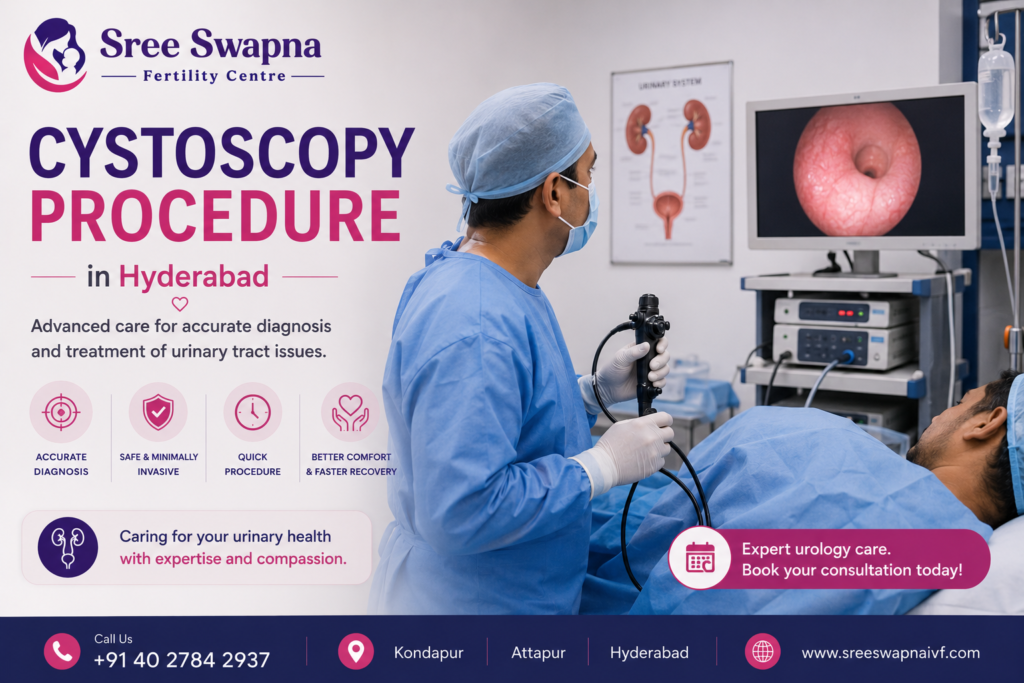
Being told you need a cystoscopy can sound more intimidating than it actually is. It’s a well-established, generally quick procedure that gives doctors a direct look inside your bladder — something imaging alone often can’t fully provide.
This guide explains what a cystoscopy actually involves, the different types, what to expect during recovery, and where it fits into gynaecological care specifically.
What Is a Cystoscopy?
A cystoscopy is a procedure where a thin, tube-like instrument called a cystoscope — fitted with a light and camera — is passed through the urethra into the bladder, allowing direct visualisation of the bladder lining and urethra.
It’s used to investigate symptoms like blood in the urine, recurrent urinary infections, or to examine the bladder more closely when imaging has raised a specific question.
Types of Cystoscopy
1. Flexible Cystoscopy
Uses a thin, bendable scope and is typically done under local anaesthesia as an outpatient procedure. It’s generally more comfortable and is often the first choice for straightforward diagnostic evaluation.
2. Rigid Cystoscopy
Uses a firmer, straight scope, allowing better access for certain procedures like tissue biopsy or treatment of specific bladder findings. This is usually done under local, spinal, or general anaesthesia, depending on what’s being done during the procedure.
Why Might a Cystoscopy Be Recommended?
- Blood in the urine (haematuria), to identify the source
- Recurrent urinary tract infections, to check for underlying causes
- Unexplained bladder pain or urinary symptoms
- Evaluation of suspected bladder lesions or growths
- Intraoperative use during certain gynaecological or pelvic surgeries, to directly visualise the bladder and protect it during the procedure
What Happens During the Procedure?
- Preparation: You may be asked to empty your bladder beforehand, and local anaesthetic gel is often applied
- Insertion: The cystoscope is gently passed through the urethra into the bladder
- Examination: Sterile fluid is used to gently fill the bladder, allowing a clearer view of the bladder walls
- Additional steps, if needed: Tissue samples (biopsy) can be taken, or certain minor treatments performed, during the same procedure
- Completion: The scope is removed, and the fluid drains out
A purely diagnostic cystoscopy typically takes just 5–15 minutes. If additional treatment is performed at the same time, it may take longer.
What Does Recovery Look Like?
- Mild burning during urination for a day or two is common and generally resolves on its own
- Slightly blood-tinged urine immediately afterward is normal, though it should improve quickly
- Increased fluid intake is often recommended to help flush the bladder gently
- Most people resume normal activities the same day or the next day, especially after a flexible cystoscopy under local anaesthesia
- Recovery from a rigid cystoscopy done under general or spinal anaesthesia may take slightly longer, depending on what was done during the procedure
When to Contact Your Doctor After a Cystoscopy
- Fever or chills
- Heavy bleeding, rather than mild pink-tinged urine
- Inability to urinate
- Severe or worsening pain
These aren’t common, but they’re worth flagging to your doctor promptly if they occur.
Cystoscopy in Gynaecological Care: Where It Fits at Sree Swapna Fertility Centre
It’s worth being clear about where cystoscopy fits into our practice specifically. General cystoscopy for conditions like bladder tumours, kidney stones, or unrelated urological complaints is typically the domain of a urologist.
Where cystoscopy becomes directly relevant to our work is in gynaecological contexts — particularly evaluating suspected bladder endometriosis, and as a precautionary, intraoperative step during certain pelvic surgeries to protect the bladder and confirm its integrity.
Dr. Swapna Naik, Clinical Director at Sree Swapna Fertility Centre, is a trained laparoscopic surgeon with over 15 years of experience, and uses cystoscopy as part of a broader diagnostic and surgical approach when bladder involvement is suspected in endometriosis or during complex pelvic procedures. For general urological cystoscopy unrelated to gynaecological concerns, we’ll help coordinate a referral to the right urology specialist.
Frequently Asked Questions
1. What is a cystoscopy?
It’s a procedure where a thin scope with a camera is passed through the urethra to directly examine the inside of the bladder.
2. Is a cystoscopy painful?
Most people experience mild discomfort rather than significant pain, especially with a flexible cystoscopy done under local anaesthesia.
3. What is the difference between flexible and rigid cystoscopy?
Flexible cystoscopy uses a bendable scope and is generally more comfortable for diagnostic purposes, while rigid cystoscopy allows better access for certain treatments or biopsies.
4. How long does a cystoscopy take?
A purely diagnostic cystoscopy typically takes about 5–15 minutes, though additional treatment during the same procedure can extend this.
5. What anaesthesia is used for a cystoscopy?
Flexible cystoscopy is often done under local anaesthesia, while rigid cystoscopy may use local, spinal, or general anaesthesia depending on the specific procedure.
6. Is it normal to see blood in urine after a cystoscopy?
Yes, mild, pink-tinged urine is common immediately afterward and should improve quickly. Heavy bleeding should be reported to your doctor.
7. How long does recovery take after a cystoscopy?
Most people resume normal activities within a day, especially after a flexible cystoscopy, though this varies based on the specific procedure performed.
8. Why would a cystoscopy be used in gynaecological care?
It’s used to evaluate suspected bladder endometriosis, or as a precautionary step during certain pelvic surgeries to protect and check the bladder.
9. Does Sree Swapna Fertility Centre perform general urological cystoscopy?
Our use of cystoscopy is specifically within gynaecological contexts. For general urological cystoscopy unrelated to gynaecological concerns, we’ll help coordinate a referral to a urologist.
10. Can a biopsy be taken during a cystoscopy?
Yes, tissue samples can be taken during the procedure if a suspicious area is identified.
11. What symptoms might lead to a cystoscopy recommendation?
Blood in the urine, recurrent urinary tract infections, unexplained bladder pain, or suspected bladder lesions are common reasons.
12. Is fasting required before a cystoscopy?
This depends on the type of anaesthesia used — flexible cystoscopy under local anaesthesia usually doesn’t require fasting, while general anaesthesia procedures typically do.
13. Can cystoscopy help diagnose bladder endometriosis?
Yes, it allows direct visualisation of the bladder wall and, combined with biopsy, can help confirm suspected bladder endometriosis.
14. What should I avoid after a cystoscopy?
Strenuous activity is generally discouraged for a short period after the procedure, especially if additional treatment was performed. Your doctor will give specific guidance.
15. Is cystoscopy a major surgery?
No, diagnostic cystoscopy is a minor procedure, though it can be combined with more involved treatment steps depending on findings.
16. How soon can I return to work after a cystoscopy?
Many people return to normal activities, including work, the same day or the next day, particularly after a flexible cystoscopy.
17. Can cystoscopy detect bladder cancer?
Yes, it’s a key tool for evaluating suspicious bladder lesions, though further testing like biopsy is typically needed to confirm a diagnosis.
18. Is cystoscopy used during hysterectomy or other pelvic surgeries?
Yes, it’s sometimes used intraoperatively to check bladder integrity and reduce the risk of injury during certain pelvic procedures.
19. Does cystoscopy require a hospital stay?
Diagnostic cystoscopy is typically an outpatient procedure and usually doesn’t require an overnight stay.
20. Can I drive myself home after a cystoscopy?
If done under local anaesthesia, yes, in most cases. If general or spinal anaesthesia was used, you’ll need someone to drive you home.
21. Are there risks associated with cystoscopy?
As with any procedure involving the urinary tract, there’s a small risk of infection or bleeding, though serious complications are uncommon.
22. Where can I get a gynaecological cystoscopy evaluation in Hyderabad?
Sree Swapna Fertility Centre offers cystoscopy as part of gynaecological evaluation, particularly for suspected bladder endometriosis, at both our Kondapur and Attapur clinics.
Conclusion
A cystoscopy is a well-established, generally quick procedure that gives doctors valuable direct information about your bladder. Whether it’s being used to investigate symptoms or as part of gynaecological surgical planning, understanding what to expect can make the experience far less daunting.
Have Questions About a Recommended Cystoscopy?
Dr. Swapna Naik and the team at Sree Swapna Fertility Centre can explain how cystoscopy fits into your specific gynaecological evaluation or treatment plan.
📞 Call: +91 76708 04424 / +91 40 4995 3719 💬 WhatsApp: Message us directly 📧 Email: sreeswapna.fertility@gmail.com 📍 Visit us at: Kondapur (flagship centre) or Attapur, Hyderabad 🌐 Book an appointment: sreeswapnaivf.com/contact-us
