
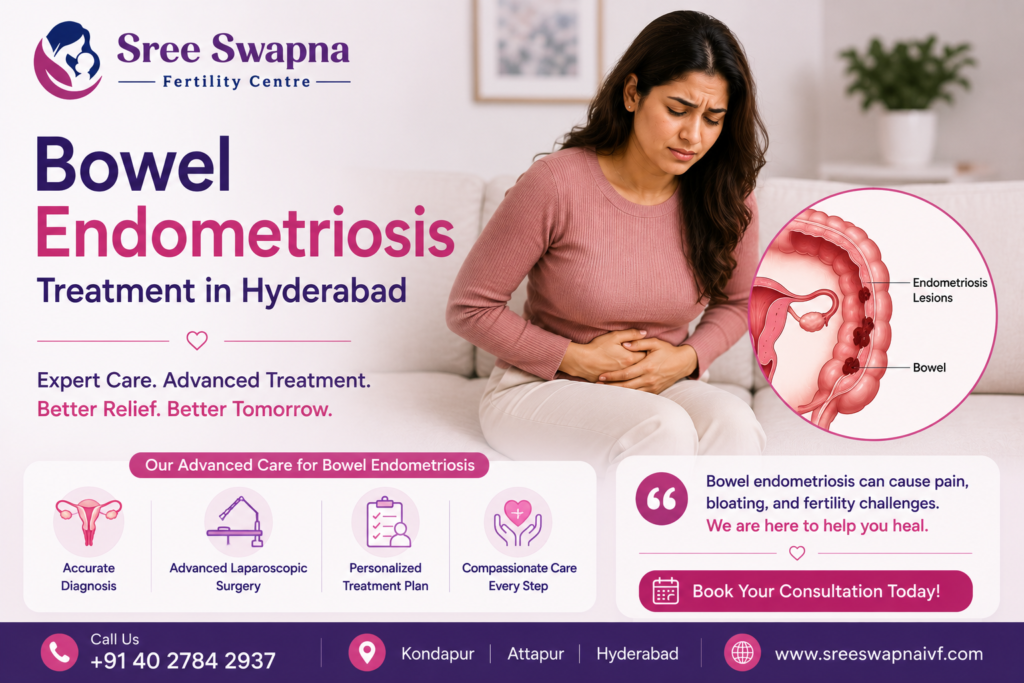
Painful bowel movements that flare up specifically around your period aren’t a typical digestive issue. If this pattern sounds familiar, bowel endometriosis may be the reason — even if you’ve already been told it’s IBS.
This condition is frequently misdiagnosed for years, simply because its symptoms overlap so closely with common gastrointestinal disorders. This guide explains what bowel endometriosis is, how it’s different from IBS, and what treatment looks like in Hyderabad.
What Is Bowel Endometriosis?
Bowel endometriosis happens when endometrial-like tissue — similar to the lining of the uterus — grows on the surface of, or sometimes into, the intestines. It most commonly affects the rectosigmoid colon (the lower part of the large intestine, closest to the rectum).
Like endometriosis elsewhere in the body, this misplaced tissue still responds to your monthly hormonal cycle, causing inflammation, pain, and sometimes bleeding tied specifically to your period.
Bowel Endometriosis vs. IBS: What’s the Difference?
This is the single most important distinction, since the two are frequently confused.
| Feature | IBS | Bowel Endometriosis |
|---|---|---|
| Pain pattern | Random, throughout the month | Intensifies specifically around your period |
| Bowel movement pain | Variable | Often significantly worse during menstruation |
| Rectal bleeding | Uncommon | Can occur, tied to cycle |
| Response to standard IBS treatment | Usually improves | Often doesn’t fully resolve |
If your “IBS” symptoms have a clear monthly pattern tied to your cycle, it’s worth raising bowel endometriosis as a possibility with your doctor.
Common Symptoms of Bowel Endometriosis
- Painful bowel movements (dyschezia), especially during your period
- Constipation or diarrhoea, often worsening cyclically
- Bloating and abdominal cramping
- Rectal bleeding during menstruation
- Nausea around your period
- Deep pelvic pain, alongside typical endometriosis symptoms like painful periods
How Is Bowel Endometriosis Diagnosed?
Diagnosis can be genuinely challenging, and many women go through extensive gastrointestinal work-ups before the correct diagnosis is reached.
- Pelvic Exam with Ultrasound: A rectovaginal exam combined with transvaginal ultrasound can help identify tenderness and suspicious areas
- MRI: Provides a more detailed picture of deep infiltrating disease and helps guide surgical planning
- Colonoscopy: Often has limited value here — since most bowel endometriosis lesions sit on the outside of the bowel wall, a colonoscopy (which examines the inside) frequently misses them entirely, unless the disease has progressed to involve the inner lining
- Surgery: Remains the only definitive way to confirm a bowel endometriosis diagnosis with certainty, through direct visualisation and tissue sampling
This is exactly why a normal colonoscopy doesn’t rule out bowel endometriosis — a common source of diagnostic delay.
Treatment Options for Bowel Endometriosis
Medical (Hormonal) Treatment
- Combined hormonal contraceptives (pills or patches), to reduce tissue growth and manage symptoms
- Progestin-only therapy, including the hormonal IUD
- GnRH agonists, to temporarily suppress hormone production and shrink the affected tissue
Medical management can meaningfully improve symptoms for many women. However, research shows a significant proportion of patients eventually move to surgery within about a year, due to persistent symptoms despite hormonal treatment.
Surgical Treatment
The right surgical approach depends on how deep and extensive the disease is:
- Shave Excision: For superficial disease — the lesion is carefully shaved off the bowel surface without cutting into the bowel itself. Usually a same-day procedure.
- Disc Resection: For a small, localised area of deeper involvement — a small portion of the bowel wall is removed and stitched closed.
- Segmental Resection: For more extensive or deeply infiltrating disease — a larger section of bowel is removed, and the two ends are rejoined. In rare cases, a temporary colostomy may be needed during healing.
Surgery is typically performed laparoscopically, allowing for smaller incisions and generally faster recovery compared to open surgery.
Why an Accurate Diagnosis Matters Before Treatment
Because bowel endometriosis can closely mimic IBS, colitis, or other digestive conditions, getting the diagnosis right — rather than continuing to treat it as a purely gastrointestinal issue — is the most important step. A specialist experienced in deep infiltrating endometriosis will know to look beyond a normal colonoscopy result when your symptom pattern points toward a cyclic cause.
Bowel Endometriosis Treatment at Sree Swapna Fertility Centre
Bowel endometriosis requires a specialist comfortable with both gynaecological diagnosis and precise laparoscopic surgical technique.
Dr. Swapna Naik, Clinical Director at Sree Swapna Fertility Centre, is a trained laparoscopic surgeon with over 15 years of experience in reproductive medicine. Her approach starts with a thorough evaluation — including pelvic exam, transvaginal ultrasound, and further imaging where needed — to properly assess whether your symptoms point toward bowel involvement.
Both our Kondapur and Attapur clinics offer in-house diagnostic facilities, so if your digestive symptoms follow a clear monthly pattern and haven’t responded to standard IBS management, we can investigate the possibility of endometriosis properly, rather than continuing the same treatment cycle.
Frequently Asked Questions
1. What is bowel endometriosis?
It’s a condition where endometrial-like tissue grows on or into the intestines, most commonly the rectosigmoid colon, causing cyclic digestive symptoms.
2. How is bowel endometriosis different from IBS?
Bowel endometriosis symptoms typically intensify specifically around your period, while IBS symptoms tend to occur randomly throughout the month.
3. Can a colonoscopy diagnose bowel endometriosis?
Often not — most lesions sit on the outside of the bowel wall, which a colonoscopy (examining the inside) may not detect.
4. What are the main symptoms of bowel endometriosis?
Painful bowel movements, constipation or diarrhoea, bloating, and rectal bleeding, especially during menstruation.
5. Is surgery the only way to diagnose bowel endometriosis?
Surgery with tissue sampling is currently the only definitive way to confirm the diagnosis, though imaging and exams can strongly suggest it beforehand.
6. Can bowel endometriosis be treated without surgery?
Yes, hormonal treatment can improve symptoms for many women, though some eventually need surgery if symptoms persist.
7. What is shave excision surgery?
A technique for superficial bowel endometriosis where the lesion is carefully removed from the bowel surface without cutting into the bowel itself.
8. What is segmental bowel resection?
A surgical procedure for extensive disease where a portion of the bowel is removed and the remaining ends are rejoined.
9. Does bowel endometriosis surgery always require a colostomy?
No, a temporary colostomy is only needed in rare, more extensive cases, not for most surgical procedures.
10. Can bowel endometriosis affect fertility?
As a form of endometriosis, it’s often associated with broader pelvic disease, which can be linked to fertility challenges in some cases.
11. What imaging is used to diagnose bowel endometriosis?
Transvaginal ultrasound and MRI are commonly used, alongside a detailed pelvic and rectovaginal exam.
12. How long can bowel endometriosis go undiagnosed?
It’s not uncommon for women to go years without a correct diagnosis, since symptoms are frequently mistaken for IBS or other digestive conditions.
13. Is bowel endometriosis surgery performed laparoscopically?
Yes, in most cases, allowing for smaller incisions and generally quicker recovery than open surgery.
14. Can hormonal treatment shrink bowel endometriosis lesions?
Yes, in some cases, though it manages symptoms rather than permanently eliminating the tissue.
15. What percentage of patients eventually need surgery despite medical treatment?
Research indicates a significant proportion of patients move to surgery within about a year due to persistent symptoms, though individual outcomes vary.
16. Can bowel endometriosis cause infertility?
It can be part of broader endometriosis affecting fertility, though the specific impact varies by individual case.
17. Does bowel endometriosis always cause rectal bleeding?
No, not all patients experience rectal bleeding — symptoms vary widely between individuals.
18. Is recovery from bowel resection surgery lengthy?
Recovery varies by procedure type and extent of surgery; your surgeon will explain expected recovery time for your specific case.
19. Can bowel endometriosis come back after treatment?
As with endometriosis elsewhere, recurrence is possible, and ongoing monitoring is generally recommended.
20. Should I see a gynaecologist or a gastroenterologist for suspected bowel endometriosis?
Ideally a specialist experienced in both areas, or coordinated care between a gynaecologist and gastroenterologist.
21. What should I do if my “IBS” symptoms seem tied to my period?
Raise this specific pattern with your doctor and ask about evaluation for bowel endometriosis, rather than continuing standard IBS treatment alone.
22. Where can I get bowel endometriosis evaluated in Hyderabad?
Sree Swapna Fertility Centre offers diagnostic evaluation and laparoscopic surgical treatment for bowel endometriosis at both our Kondapur and Attapur clinics.
Conclusion
If your digestive symptoms follow your menstrual cycle rather than appearing randomly, it’s worth considering bowel endometriosis — even if you’ve been told it’s IBS before. With the right diagnostic approach and a specialist experienced in deep infiltrating endometriosis, both symptom relief and long-term treatment are genuinely achievable.
Get Your Symptoms Properly Evaluated
If your digestive symptoms seem to follow a monthly pattern, Dr. Swapna Naik and the team at Sree Swapna Fertility Centre can help identify what’s really going on.
📞 Call: +91 76708 04424 / +91 40 4995 3719 💬 WhatsApp: Message us directly 📧 Email: sreeswapna.fertility@gmail.com 📍 Visit us at: Kondapur (flagship centre) or Attapur, Hyderabad 🌐 Book an appointment: sreeswapnaivf.com/contact-us
