
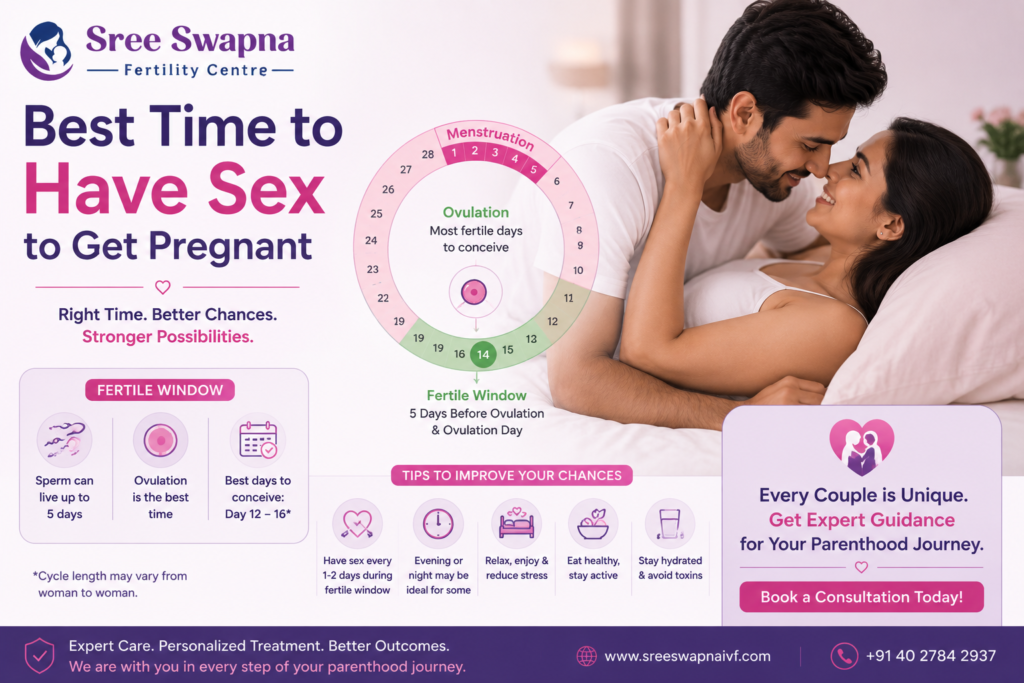
Timing matters more than most people realise when trying to conceive.
Out of your entire menstrual cycle, there are really only about 6 days when sex can actually lead to pregnancy. Miss this window, and even perfectly healthy sperm and eggs won’t meet.
This guide explains exactly when your fertile window happens, how to track it, and what to do if timing alone isn’t working.
What Is the Fertile Window?
The fertile window is the span of days in your cycle when pregnancy is possible. It includes:
- The 5 days before ovulation
- The day of ovulation itself
This window exists because sperm can survive inside the female reproductive tract for up to 5 days, while an egg survives for only about 24 hours after release. Timing intercourse within this window gives sperm the best chance of being present when the egg is released.
When Does Ovulation Happen?
For a typical 28-day cycle, ovulation usually happens around day 14, counting from the first day of your period.
But here’s the catch: most women don’t have a perfectly regular 28-day cycle. Research shows real ovulation timing varies significantly between individuals — and even from month to month in the same woman.
This is why relying on a fixed “day 14” rule for everyone can lead you to miss your actual fertile window.
What’s the Single Best Day to Have Sex?
Research shows conception chances aren’t equal across the fertile window. They typically look like this:
- 5–3 days before ovulation: Lower chance, around 5–10%
- 2–1 days before ovulation: Highest chance, around 20–30%
- Day of ovulation: Moderate chance, dropping off quickly
- After ovulation: Chance drops close to zero
This means the 1–2 days right before ovulation are typically your best window — but predicting that exact day in advance is genuinely difficult, even with tracking tools.
How to Track Your Fertile Window
1. Calendar / Cycle Tracking
Track your cycle length over a few months to estimate your typical ovulation timing. This works best for women with regular cycles.
2. Ovulation Predictor Kits (OPKs)
These test urine for a surge in luteinising hormone (LH), which happens 24–36 hours before ovulation — giving you a short, more precise heads-up.
3. Basal Body Temperature (BBT)
Your body temperature rises slightly after ovulation. Tracking this daily can help confirm ovulation happened, though it tells you after the fact rather than predicting ahead.
4. Cervical Mucus Changes
Around ovulation, cervical mucus typically becomes clearer, stretchier, and more slippery — a natural sign your body is approaching peak fertility.
Do I Really Need to Time It Perfectly?
Not necessarily. Because predicting the exact day of ovulation is genuinely difficult — even with tracking — many fertility organisations recommend a simpler approach: having intercourse every 1–2 days throughout your cycle, rather than trying to hit one “perfect” day.
This approach naturally covers your fertile window without the stress of precise timing, and research supports it as an effective strategy for couples trying to conceive.
When Should You See a Fertility Specialist?
Timing intercourse correctly helps, but it isn’t the full picture. Consider seeing a specialist if:
- You’re under 35 and haven’t conceived after 12 months of regular, unprotected intercourse
- You’re 35 or older and haven’t conceived after 6 months
- You have irregular or absent periods, making ovulation timing hard to predict
- You have a known condition like PCOS, endometriosis, or a prior pelvic surgery
- Your partner has a known or suspected sperm-related issue
Trying to time things perfectly for many months without success can be exhausting — and sometimes the issue isn’t timing at all, but something a specialist evaluation can identify.
Getting Support at Sree Swapna Fertility Centre
If you’ve been tracking your cycle carefully and timing intercourse correctly without success, it may be time for a proper fertility evaluation.
At Sree Swapna Fertility Centre, our clinical director, Dr. Swapna Naik (MBBS, MS in Obstetrics & Gynaecology, Fellowship in Reproductive Medicine & IVF), brings over 15 years of experience and has guided more than 5,000 successful pregnancies — including many couples who came to us after months of careful timing without results.
Both our Kondapur and Attapur clinics offer in-house diagnostic facilities, including ultrasound-based ovulation tracking and hormonal testing, to identify exactly what might be affecting your chances — rather than continuing to guess at timing alone.
Frequently Asked Questions
1. What is the fertile window?
It’s the span of days in your cycle when pregnancy is possible — the 5 days before ovulation, plus the day of ovulation itself.
2. What day does ovulation usually happen?
In a typical 28-day cycle, ovulation usually happens around day 14, though this varies significantly between individuals.
3. What is the single best day to have sex to get pregnant?
Research suggests the 1–2 days right before ovulation offer the highest chance of conception.
4. How long does sperm survive inside the body?
Sperm can survive in the female reproductive tract for up to 5 days.
5. How long does an egg survive after ovulation?
An egg survives for approximately 24 hours after release.
6. Do I need to have sex every day to get pregnant?
No, having intercourse every 1–2 days throughout your cycle is generally considered an effective, less stressful approach than trying to hit one exact day.
7. Can ovulation predictor kits help pinpoint the best day?
Yes, OPKs detect a hormone surge that typically occurs 24–36 hours before ovulation, giving a useful advance signal.
8. Does basal body temperature tracking predict ovulation in advance?
Not exactly — BBT confirms that ovulation has already happened, rather than predicting it beforehand.
9. Can irregular periods make timing harder?
Yes, irregular cycles make ovulation timing much less predictable, and tracking tools may be less reliable.
10. Is day 14 always the day of ovulation?
No, day 14 is a general average for a 28-day cycle, but actual ovulation timing varies widely between women and even cycle to cycle.
11. What does cervical mucus tell me about ovulation?
Around ovulation, mucus typically becomes clearer, stretchier, and more slippery — a natural fertility sign.
12. How soon after sex can I take a pregnancy test?
It’s generally recommended to wait until your missed period, about two weeks after ovulation, for an accurate result.
13. Can stress affect ovulation timing?
Yes, significant stress can sometimes affect cycle regularity and ovulation timing in some women.
14. Does age affect the fertile window itself?
Age doesn’t change the fertile window mechanics, but it can affect overall egg quality and quantity, which influences conception chances.
15. How many months of trying is considered “normal” before seeking help?
Generally 12 months for women under 35, or 6 months for women 35 and older.
16. Can PCOS make ovulation timing unpredictable?
Yes, PCOS often causes irregular or absent ovulation, making natural timing much harder to predict.
17. Is it possible to ovulate more than once in a cycle?
It’s rare, but some women can release more than one egg around the same time, which is part of why multiple pregnancies sometimes occur.
18. Does having sex too often reduce sperm quality?
Sperm quality can be slightly affected by very frequent ejaculation, but daily or every-other-day intercourse during the fertile window is generally not a concern for most men.
19. Can a fertility app accurately predict my ovulation day?
Apps can help estimate a general range, but research shows even the most refined tracking methods have real limitations, especially for irregular cycles.
20. What tests can a fertility specialist do to check ovulation?
Blood hormone tests and ultrasound-based follicle tracking can directly confirm whether and when ovulation is occurring.
21. Should both partners get evaluated if conception isn’t happening?
Yes, fertility evaluation typically involves both partners, since male factors contribute to roughly half of infertility cases.
22. Where can I get a fertility evaluation in Hyderabad?
Sree Swapna Fertility Centre offers comprehensive fertility evaluations, including ovulation tracking, at both our Kondapur and Attapur clinics.
Conclusion
Understanding your fertile window can meaningfully improve your chances of conceiving naturally — but perfect timing isn’t always the missing piece. If you’ve been trying for several months without success, a proper fertility evaluation can identify what timing alone can’t fix.
Ready for a Fertility Evaluation?
If timing hasn’t worked after several months of trying, Dr. Swapna Naik and the team at Sree Swapna Fertility Centre are here to help identify what’s really going on.
📞 Call: +91 76708 04424 / +91 40 4995 3719 💬 WhatsApp: Message us directly 📧 Email: sreeswapna.fertility@gmail.com 📍 Visit us at: Kondapur (flagship centre) or Attapur, Hyderabad 🌐 Book an appointment: sreeswapnaivf.com/contact-us
