
For many women, period pain is treated as something to simply push through — a monthly inconvenience managed with a hot water bag and a painkiller. But when the pain becomes severe enough to interfere with work, sleep, or daily life, and gets worse rather than better over the years, it’s worth asking whether something more specific is going on.
Adenomyosis is one of the most commonly overlooked causes of severe, worsening period pain. It’s a condition that often goes undiagnosed for years, simply because “bad periods” are so normalised that women rarely think to ask if there’s an underlying medical explanation.
This article walks through what adenomyosis is, how to recognise it, and what treatment options are available — including where to get an accurate diagnosis if you’re based in Kondapur, Hyderabad, or nearby areas.
What Is Adenomyosis?
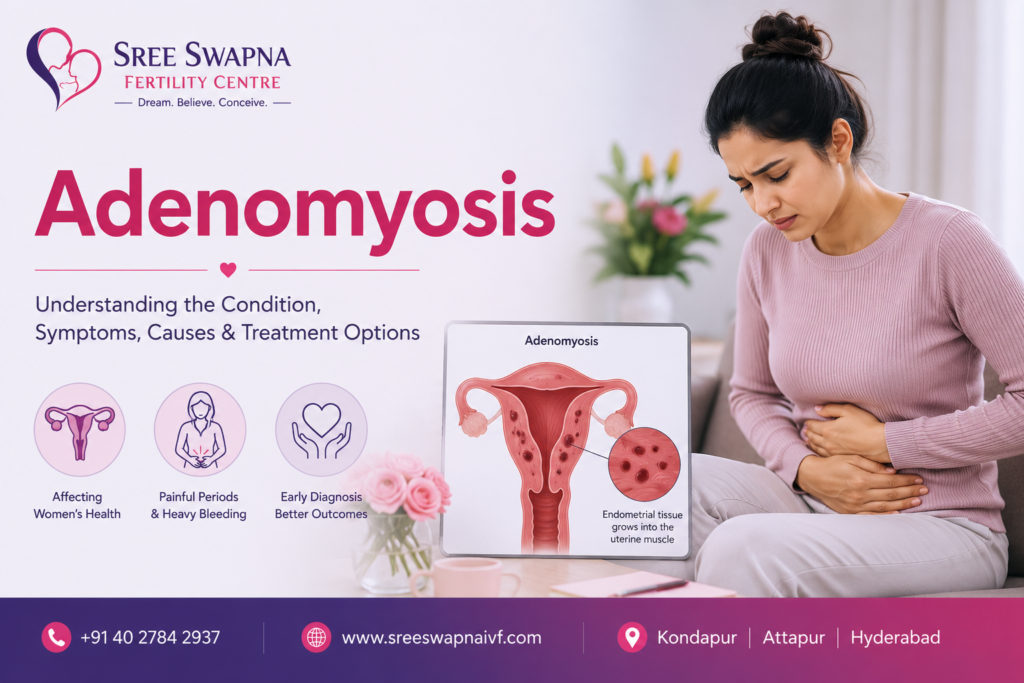
Adenomyosis occurs when tissue similar to the lining of the uterus (the endometrium) grows into the muscular wall of the uterus (the myometrium) instead of staying confined to the uterine cavity. Each month, this misplaced tissue continues to respond to hormonal changes just like normal endometrial tissue — thickening, breaking down, and bleeding — but because it’s trapped inside the muscle wall, it has nowhere to go.
This trapped bleeding and inflammation is what leads to an enlarged, tender uterus and, in many cases, significantly more painful and heavier periods than before.
Adenomyosis is sometimes confused with endometriosis, but the two are distinct conditions. Endometriosis involves endometrial-like tissue growing outside the uterus — on the ovaries, fallopian tubes, or pelvic lining. Adenomyosis, by contrast, stays within the uterus itself, embedded in its muscular wall.
Why Does Adenomyosis Cause Painful Periods?
Several mechanisms contribute to the pain associated with adenomyosis:
- Trapped menstrual blood within the muscle wall causes localised pressure and inflammation
- Uterine wall thickening stretches surrounding tissue and nerve endings
- Increased uterine contractions, as the uterus tries to expel the trapped tissue, similar to labour-like cramping
- Chronic inflammation in the affected area, which sensitises pain receptors over time
This combination often explains why adenomyosis-related period pain tends to be described as deep, cramping, and progressively worse — rather than the milder, more predictable pain many women experience with typical periods.
Common Symptoms of Adenomyosis
- Severe menstrual cramps (dysmenorrhea) that worsen over months or years
- Heavy menstrual bleeding, sometimes with clots
- Periods that last longer than usual
- Chronic pelvic pain, not limited to menstruation
- A feeling of pressure or bloating in the lower abdomen
- Pain during intercourse
- In some cases, no noticeable symptoms at all — adenomyosis can be found incidentally during a scan for other reasons
If you’re experiencing several of these symptoms together, especially if the pain has been getting progressively worse, it’s worth getting evaluated rather than assuming it’s “just how your periods are.”
What Causes Adenomyosis?
The exact cause of adenomyosis isn’t fully understood, but several factors are associated with a higher likelihood of developing it:
- Prior uterine surgery, including C-sections, fibroid removal, or D&C procedures, which may disrupt the natural barrier between the endometrium and myometrium
- Childbirth, particularly multiple pregnancies
- Age, as adenomyosis is most commonly diagnosed in women in their 30s and 40s, though it can occur earlier
- Hormonal factors, since the condition is oestrogen-dependent and tends to improve after menopause
How Is Adenomyosis Diagnosed?
- Transvaginal Ultrasound: The first-line diagnostic tool, which can identify uterine wall thickening and other characteristic changes
- MRI: Used when a more detailed picture is needed, or to help distinguish adenomyosis from fibroids, which can present with overlapping symptoms
- Pelvic Examination: A gynaecologist may note an enlarged, tender uterus during a routine exam, prompting further imaging
A proper diagnosis usually requires more than symptom description alone — imaging is essential to confirm adenomyosis and rule out other conditions like fibroids or endometriosis, which can present similarly.
Treatment Options for Adenomyosis-Related Period Pain
Treatment is chosen based on the severity of symptoms, your age, and whether you’re currently trying to conceive.
For Symptom Management
- Pain relief medication, such as NSAIDs, to manage cramping during periods
- Hormonal therapy, including birth control pills, hormonal IUDs, or other hormone-regulating treatments, which can reduce bleeding and pain by limiting the hormonal stimulation of the misplaced tissue
For More Severe or Persistent Cases
- GnRH agonist therapy, which temporarily suppresses hormone production to shrink adenomyosis tissue and reduce symptoms
- Uterine artery embolisation, a less invasive procedure that reduces blood supply to the affected area in some cases
- Surgical options, including removal of localised adenomyoma tissue where feasible, or in cases where fertility preservation isn’t a priority, a hysterectomy may be discussed as a definitive treatment
If You’re Trying to Conceive
Adenomyosis can affect fertility and IVF outcomes in some cases, so if you’re planning pregnancy, treatment should be coordinated with a fertility specialist rather than approached purely as pain management. The right protocol often differs depending on whether the primary goal is symptom relief or preparing the uterus for conception.
It’s important to know that no single treatment works identically for everyone — what helps one woman manage her symptoms may not be the right approach for another, depending on severity and future fertility plans.
Getting an Accurate Diagnosis in Kondapur, Hyderabad
If you’ve been dealing with worsening period pain and suspect it might be more than “normal,” getting a proper evaluation is the first step — and where you go for that evaluation matters.
At Sree Swapna Fertility Centre’s Kondapur clinic, our flagship centre is equipped with in-house transvaginal ultrasound and diagnostic facilities, allowing for same-visit imaging rather than being referred elsewhere and waiting for results. Our clinical director, Dr. Swapna Naik (MBBS, MS in Obstetrics & Gynaecology, Fellowship in Reproductive Medicine & IVF), brings over 15 years of experience in gynaecology and reproductive medicine, and has guided more than 5,000 successful pregnancies — giving her deep familiarity with how conditions like adenomyosis present and progress in real patients.
Whether your primary concern is managing painful periods or you’re also thinking about future fertility, our team takes time to understand your specific situation before recommending a treatment path — rather than defaulting to a one-size-fits-all approach. The Kondapur clinic is easily accessible from Gachibowli, Madhapur, HITEC City, Miyapur, and Kukatpally, and is open Monday to Saturday, 9:00 AM to 7:00 PM, with Sunday consultations available by appointment.
Frequently Asked Questions
1. Is adenomyosis the same as endometriosis?
No. Adenomyosis involves endometrial-like tissue growing within the uterine muscle wall, while endometriosis involves similar tissue growing outside the uterus.
2. Can adenomyosis be cured completely?
There’s no guaranteed cure short of hysterectomy, but symptoms can often be effectively managed with hormonal therapy, other medical treatments, or in some cases, targeted surgery.
3. At what age does adenomyosis typically occur?
It’s most commonly diagnosed in women in their 30s and 40s, though it can occur at other ages too.
4. Does adenomyosis go away after menopause?
Since adenomyosis is hormone-dependent, symptoms typically improve significantly or resolve after menopause, when oestrogen levels drop.
5. Can adenomyosis affect fertility?
Yes, adenomyosis can affect fertility and IVF outcomes in some patients, though the extent varies based on severity and individual factors.
6. How is adenomyosis different from fibroids?
Fibroids are distinct, usually well-defined muscular growths in or on the uterus, while adenomyosis involves diffuse tissue changes within the uterine wall itself. Imaging can help distinguish between the two.
7. Is heavy bleeding always a sign of adenomyosis?
Not necessarily — heavy bleeding has multiple possible causes, including fibroids and hormonal imbalances, which is why proper diagnostic imaging is important.
8. Can a pelvic exam alone diagnose adenomyosis?
A pelvic exam can suggest adenomyosis if the uterus feels enlarged or tender, but imaging like ultrasound or MRI is needed for confirmation.
9. What painkillers are typically recommended for adenomyosis pain?
NSAIDs are commonly used for symptom management, though the right medication and dosage should be discussed with your doctor based on your health history.
10. Can birth control pills help with adenomyosis symptoms?
Yes, hormonal birth control is often used to reduce bleeding and pain by limiting hormonal stimulation of the affected tissue.
11. Is surgery always necessary for adenomyosis?
No, many women manage symptoms successfully with medication or hormonal therapy without needing surgery.
12. What is a hysterectomy, and when is it considered for adenomyosis?
A hysterectomy is the surgical removal of the uterus. It’s considered a definitive treatment for severe adenomyosis, typically in women who have completed childbearing or aren’t planning future pregnancy.
13. Can adenomyosis come back after treatment?
Non-surgical treatments manage symptoms rather than eliminate the underlying tissue, so symptoms can return if hormonal treatment is stopped. Hysterectomy is the only treatment that removes the condition entirely.
14. Does adenomyosis increase the risk of other health problems?
Adenomyosis itself is not cancerous, but persistent heavy bleeding can sometimes lead to anaemia if left unmanaged, which is another reason to seek treatment.
15. Can lifestyle changes help manage adenomyosis symptoms?
While lifestyle changes alone won’t resolve adenomyosis, some women find that heat therapy, anti-inflammatory diets, and regular exercise help manage pain alongside medical treatment.
16. How long does it take to get a diagnosis?
With in-house ultrasound facilities, a preliminary diagnosis can often be made in a single visit, though further imaging like MRI may be recommended in some cases.
17. Is adenomyosis common in India?
Adenomyosis is increasingly recognised in Indian gynaecological practice, though it has historically been under-diagnosed due to normalisation of period pain.
18. Can adenomyosis cause pain outside of periods?
Yes, some women experience chronic pelvic pain throughout the month, not just during menstruation.
19. Should I see a gynaecologist or a fertility specialist for adenomyosis?
If you’re not currently trying to conceive, a gynaecologist can manage symptoms. If fertility is a concern, a specialist who handles both gynaecology and reproductive medicine — like at Sree Swapna Fertility Centre — can address both aspects together.
20. Can adenomyosis be mistaken for other conditions?
Yes, its symptoms overlap with fibroids, endometriosis, and even some pelvic infections, which is why accurate imaging-based diagnosis is essential.
21. Does Sree Swapna Fertility Centre treat adenomyosis at the Kondapur clinic?
Yes, our Kondapur clinic offers diagnostic evaluation and treatment planning for adenomyosis, whether your primary concern is pain management or future fertility.
22. What should I bring to my first appointment for suspected adenomyosis?
It helps to bring a record of your period patterns (cycle length, bleeding duration, pain severity) and any previous scan reports, if available, though these aren’t mandatory for your first visit.
Conclusion
Severe, worsening period pain is never something you have to simply accept as normal. Adenomyosis is a real, diagnosable, and manageable condition — and getting an accurate diagnosis is the first step toward relief, whether your goal is pain management, planning a pregnancy, or both. The sooner it’s identified, the more treatment options are typically available to you.
Book a Consultation at Our Kondapur Clinic
If period pain has been affecting your daily life, don’t wait it out. Dr. Swapna Naik and the team at Sree Swapna Fertility Centre, Kondapur, are here to help you get answers and a treatment plan that fits your needs.
📞 Call: +91 76708 04424 / +91 40 4995 3719 💬 WhatsApp: Message us directly 📧 Email: sreeswapna.fertility@gmail.com 📍 Visit us at: 2nd Floor, GT/5, 1-51/192, Masjid Banda Rd, above Ratnadeep Building, Kondapur, Hyderabad – 500084 🌐 Book an appointment: sreeswapnaivf.com/contact-us
