
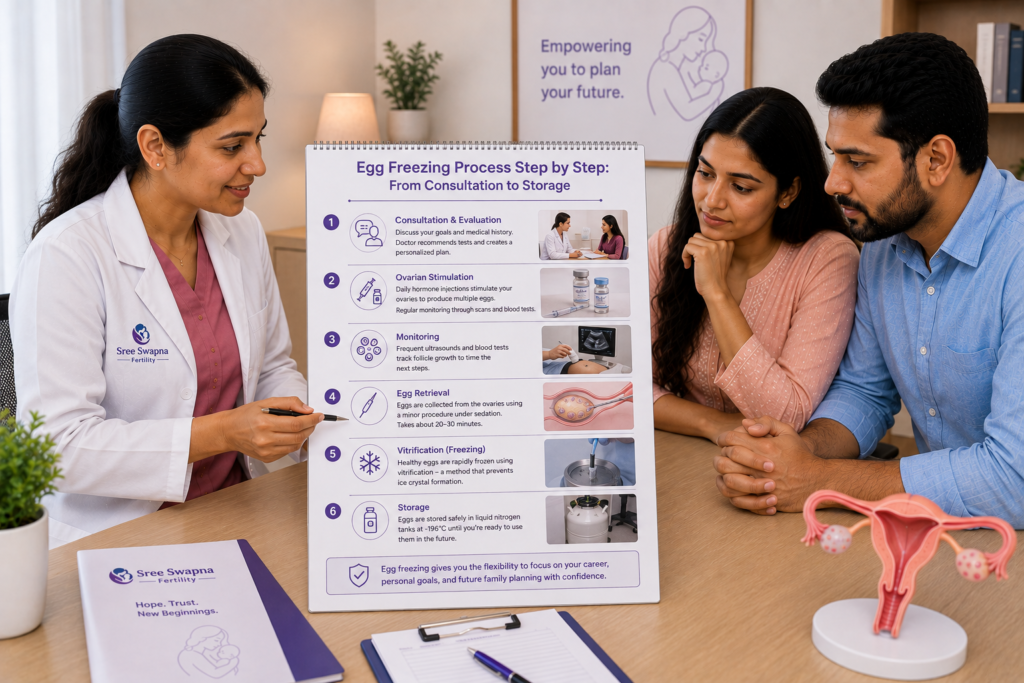
The egg freezing process, or oocyte cryopreservation, usually takes place over several stages: consultation, ovarian stimulation, monitoring, trigger, egg retrieval, laboratory assessment, vitrification and storage.
The exact timeline and medicine doses are individualised, so this guide should be used to understand the pathway rather than to self-manage treatment.
For related treatment information, explore fertility preservation and what is egg freezing. These resources provide additional context for the treatment choices discussed in this guide.
Step 1: Fertility Consultation
The specialist reviews reproductive history, current age, medical conditions, medicines and reasons for considering fertility preservation. This is also the time to discuss realistic expectations and whether egg freezing is the most appropriate option.
Step 2: Ovarian Reserve and Pre-Treatment Tests
Tests may include ultrasound and ovarian reserve assessment. Other blood tests or screening may be required depending on clinic protocol and medical history.
Step 3: Ovarian Stimulation
Daily fertility medicines are commonly used for several days to encourage multiple follicles to develop. The dose is tailored to ovarian reserve and response.
Step 4: Monitoring
Ultrasound scans and sometimes blood tests are used to monitor follicle growth. The treatment team may adjust medication based on response.
Step 5: Trigger for Final Maturation
When follicles reach the appropriate stage, a trigger medicine is given. Egg retrieval is carefully timed after the trigger.
Step 6: Egg Retrieval
Eggs are collected from ovarian follicles using an ultrasound-guided procedure. Sedation or anaesthesia is generally used according to clinic protocol.
For additional context, review egg freezing cost in India. You can also explore Dr. Swapna Naik to understand related options before discussing the next step with your fertility team.
Most people go home the same day after observation, but recovery instructions should be followed.
Step 7: Laboratory Assessment
The laboratory identifies the retrieved eggs and assesses maturity. Not every retrieved egg will be mature or suitable for freezing.
Step 8: Vitrification
Suitable mature eggs are cryopreserved, commonly using vitrification, and placed into secure storage.
Step 9: Storage and Future Planning
The clinic records and stores the eggs under its cryostorage protocol. Patients should understand storage duration, renewal fees, consent requirements and what happens if contact details change.
What Happens When the Eggs Are Used Later?
When the patient is ready, stored eggs are warmed. Eggs that survive warming may be fertilised, commonly using ICSI, followed by embryo culture and embryo transfer if suitable embryos develop.
Side Effects and Risks
Temporary bloating, injection-site discomfort, mood changes or pelvic heaviness can occur during stimulation. Egg retrieval has procedural risks, and ovarian stimulation can rarely lead to ovarian hyperstimulation syndrome. Your clinic should explain warning signs and provide contact instructions.
If you would like advice based on your reports, age, diagnosis and treatment history, book a consultation for an individual fertility assessment.
Frequently Asked Questions
1. What is the first step in the egg-freezing process?
The process starts with a fertility consultation, medical history, ovarian-reserve assessment, and discussion of goals, risks, likely egg yield, and costs.
2. What tests are done before egg freezing?
Common assessments include ultrasound for antral follicle count, AMH or other hormone tests, infection screening, and pre-procedure blood work.
3. When do stimulation injections start?
They usually begin early in the menstrual cycle or according to a clinic-specific protocol.
4. How long are stimulation injections taken?
Stimulation commonly lasts around 8 to 12 days, but the duration varies with ovarian response.
5. How is ovarian response monitored?
Clinics use transvaginal ultrasound and sometimes blood hormone tests to monitor follicle growth and adjust medication.
6. What is the trigger injection?
A trigger medication is given when follicles are ready to complete final egg maturation before retrieval.
7. When is egg retrieval done after the trigger?
Retrieval is carefully timed after the trigger, usually about a day and a half later according to clinic protocol.
8. How are eggs collected?
Under ultrasound guidance, a needle passes through the vaginal wall to aspirate fluid from ovarian follicles while the patient receives sedation or anaesthesia.
9. How long does egg retrieval take?
The procedure is often completed within a short outpatient visit, though exact time depends on the number of follicles and clinical circumstances.
10. What happens immediately after retrieval?
The embryology team identifies eggs in the follicular fluid and assesses which are mature enough for cryopreservation.
11. Are all retrieved eggs frozen?
No. Only eggs meeting the laboratory’s maturity and quality criteria are usually vitrified.
12. How are eggs vitrified?
Mature eggs are exposed to cryoprotectants and rapidly cooled so they can be stored at very low temperatures while minimising ice-crystal formation.
13. Where are frozen eggs stored?
They are stored in secure cryogenic tanks in the fertility laboratory under identification, monitoring, and consent procedures.
14. How long can eggs be stored?
They can remain cryopreserved for years under appropriate conditions, subject to law, clinic policy, consent renewal, and storage fees.
15. What recovery is needed after egg retrieval?
Mild cramping, bloating, or spotting can occur. Most patients return to light activity quickly, but should follow clinic-specific instructions.
16. When should I seek medical help after retrieval?
Contact the clinic urgently for severe pain, heavy bleeding, breathing difficulty, marked abdominal swelling, persistent vomiting, fainting, fever, or other concerning symptoms.
17. Can the process be repeated?
Yes. Some patients undergo more than one stimulation cycle to reach a personally meaningful number of mature frozen eggs.
18. How are frozen eggs used in the future?
The eggs are warmed, assessed for survival, usually fertilised by ICSI, cultured as embryos, and suitable embryo(s) may be transferred.
19. Do all frozen eggs survive warming?
No. Vitrification has improved survival, but some eggs may not survive warming or continue through fertilisation and embryo development.
20. Does age at thawing matter as much as age at freezing?
The age of the egg is effectively the age at which it was frozen, but the patient’s later pregnancy health and uterine factors still matter.
21. What should I confirm before starting the egg-freezing process?
Confirm expected egg yield, medication plan, retrieval risks, laboratory vitrification method, storage policy, total current and future costs, and what happens if more than one cycle is needed.
Next Step
Book an egg-freezing consultation at Sree Swapna Fertility Centre to discuss your personal timeline and options.
Medical References
Important: This article is for general educational information and is not a substitute for individualized medical advice.
