
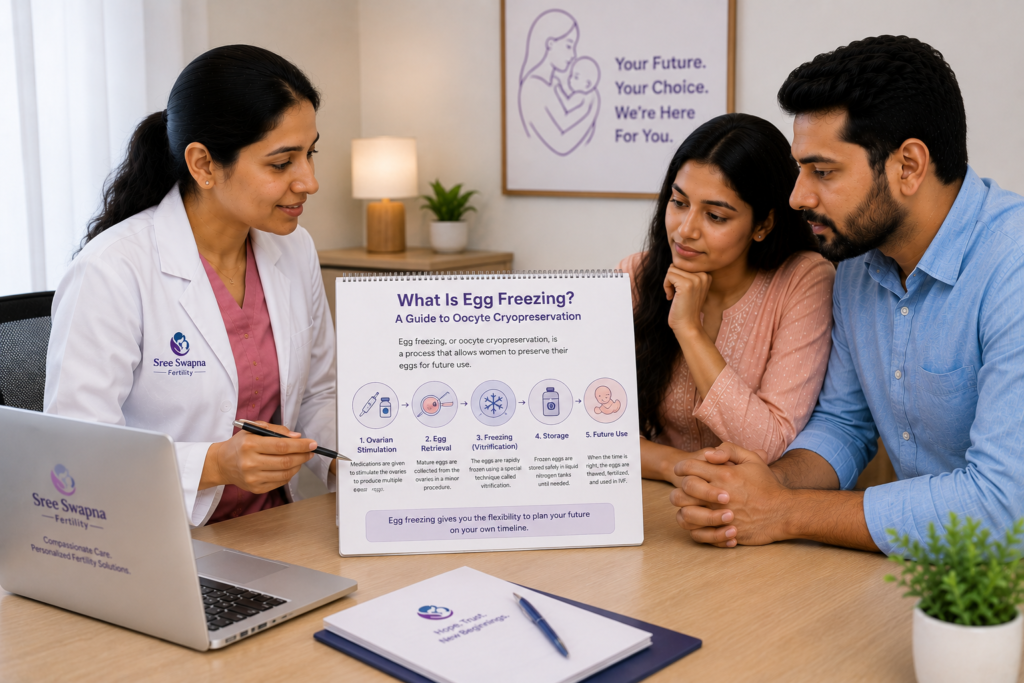
Egg freezing, medically known as oocyte cryopreservation, is a fertility-preservation technique in which eggs are collected from the ovaries, frozen and stored for possible use in the future.
It may be considered for personal reasons, before certain medical treatments that could affect fertility, or when a person wants to preserve reproductive options. It does not guarantee a future pregnancy, and success depends on factors including age at freezing, number of eggs stored and future reproductive health.
For related treatment information, explore fertility preservation and egg freezing process. These resources provide additional context for the treatment choices discussed in this guide.
How Does Egg Freezing Work?
The process is similar to the first part of an IVF cycle. The ovaries are stimulated with medicines, follicle growth is monitored, eggs are retrieved, and mature eggs suitable for preservation are frozen in the laboratory.
Unlike standard IVF, the eggs are not fertilised before freezing.
Why Do People Freeze Eggs?
Common reasons include:
- delaying pregnancy for personal circumstances
- preserving fertility before chemotherapy, radiation or other medical treatment
- risk of reduced ovarian function from a medical condition or surgery
- personal fertility planning after counselling
The decision should be based on medical information and personal goals rather than pressure from age-based marketing.
What Is Vitrification?
Vitrification is a rapid cryopreservation method widely used for freezing eggs and embryos. It aims to reduce ice-crystal formation that can damage cells during freezing.
Does Egg Freezing Stop the Biological Clock?
It preserves the age of the eggs at the time they are frozen, but it does not stop ageing of the person or guarantee future pregnancy. Pregnancy at a later age can still carry age-related maternal health risks even if younger eggs are used.
For additional context, review egg freezing cost in India. You can also explore Dr. Swapna Naik to understand related options before discussing the next step with your fertility team.
What Happens When You Want to Use the Eggs?
Frozen eggs are warmed in the laboratory. Surviving eggs are then fertilised, commonly using ICSI, and resulting embryos are cultured. A suitable embryo may later be transferred to the uterus.
Not every frozen egg survives warming, fertilises, develops into an embryo or leads to a live birth. This is why counselling should focus on probabilities, not guarantees.
When Is the Best Age to Freeze Eggs?
In general, younger age at freezing is associated with better egg quality, but there is no universal “perfect age.” The decision should consider current age, ovarian reserve, family-building goals, medical history, finances and how likely the person is to use the eggs.
What Tests Are Done Before Egg Freezing?
A fertility specialist may assess medical history, ovarian reserve, ultrasound findings and general health. Infectious-disease screening and other tests may also be part of the treatment process.
If you would like advice based on your reports, age, diagnosis and treatment history, book a consultation for an individual fertility assessment.
Frequently Asked Questions
1. What is egg freezing?
Egg freezing, or oocyte cryopreservation, is a fertility-preservation process in which mature eggs are collected, frozen, and stored for possible future use.
2. Why do people freeze eggs?
Reasons include delaying parenthood, upcoming medical treatment that may harm fertility, risk of reduced ovarian function, or personal reproductive planning.
3. How are eggs frozen?
Modern programs commonly use vitrification, a rapid-cooling technique designed to minimise ice-crystal formation.
4. Does egg freezing stop the biological clock?
It preserves eggs at the age they were frozen, but it does not stop ageing or guarantee future pregnancy.
5. Is egg freezing a guarantee of having a baby later?
No. Future success depends on age at freezing, number and quality of eggs, survival after warming, fertilisation, embryo development, and uterine health.
6. At what age should someone consider egg freezing?
Outcomes are generally better when eggs are frozen younger, but the decision should consider age, ovarian reserve, family goals, medical history, and willingness to undergo treatment.
7. Does AMH tell me whether I should freeze eggs?
AMH helps estimate ovarian reserve and likely egg yield, but it does not measure egg quality or guarantee future live birth.
8. How many eggs should I freeze?
There is no number that guarantees a baby. The target is individualized based on age, expected mature egg yield, and desired family size.
9. How long can eggs remain frozen?
Cryopreserved eggs can remain stored for years when maintained under proper laboratory conditions, subject to local law, consent, and clinic policy.
10. Does freezing damage eggs?
Vitrification has improved egg survival, but not every egg survives warming or proceeds to fertilisation and embryo development.
11. How are frozen eggs used later?
Eggs are warmed, assessed for survival, typically fertilised with ICSI, cultured as embryos, and suitable embryo(s) may be transferred.
12. Do frozen eggs need ICSI?
ICSI is commonly used after egg warming because the freezing and warming process affects the egg’s outer layers and laboratory practice typically favours direct sperm injection.
13. Is egg freezing painful?
The process includes hormone injections and an egg-retrieval procedure. Most patients experience temporary bloating, injection-site discomfort, and short-term procedural discomfort.
14. How long does egg freezing take?
One stimulation and retrieval cycle usually takes around two weeks after treatment starts, though consultation and pre-treatment testing add time.
15. Can egg freezing affect future fertility?
Egg retrieval does not appear to use up future eggs beyond those recruited in that treatment cycle, but the underlying age-related fertility decline continues.
16. Can women with PCOS freeze eggs?
Yes, but stimulation may require careful individualization because ovarian response can be high and the risk of ovarian hyperstimulation may need extra management.
17. Can women with low AMH freeze eggs?
Yes, but fewer eggs may be retrieved per cycle, so expectations and the possible need for more than one cycle should be discussed.
18. Is egg freezing the same as embryo freezing?
No. Egg freezing stores unfertilised oocytes, while embryo freezing stores eggs that have already been fertilised and developed into embryos.
19. What are the risks of egg freezing?
Risks mainly relate to ovarian stimulation and egg retrieval, including ovarian hyperstimulation, bleeding, infection, and procedure-related complications, though serious events are uncommon.
20. How much does egg freezing cost?
Cost depends on medicines, monitoring, retrieval, vitrification, storage duration, and future warming and IVF treatment. Request an itemised estimate.
21. What should I ask at an egg-freezing consultation?
Ask about ovarian reserve, expected egg yield, age-related success limits, risks, number of cycles, laboratory methods, storage policies, costs, and how frozen eggs are used later.
Next Step
For personalised fertility-preservation counselling, speak with Sree Swapna Fertility Centre in Hyderabad.
Medical References
- https://www.asrm.org/practice-guidance/ethics-opinions/planned-oocyte-cryopreservation/
- https://www.asrm.org/practice-guidance/practice-committee-documents/fertility-preservation-in-patients-with-medical-indications-a-committee-opinion-2026/
Important: This article is for general educational information and is not a substitute for individualized medical advice.
