
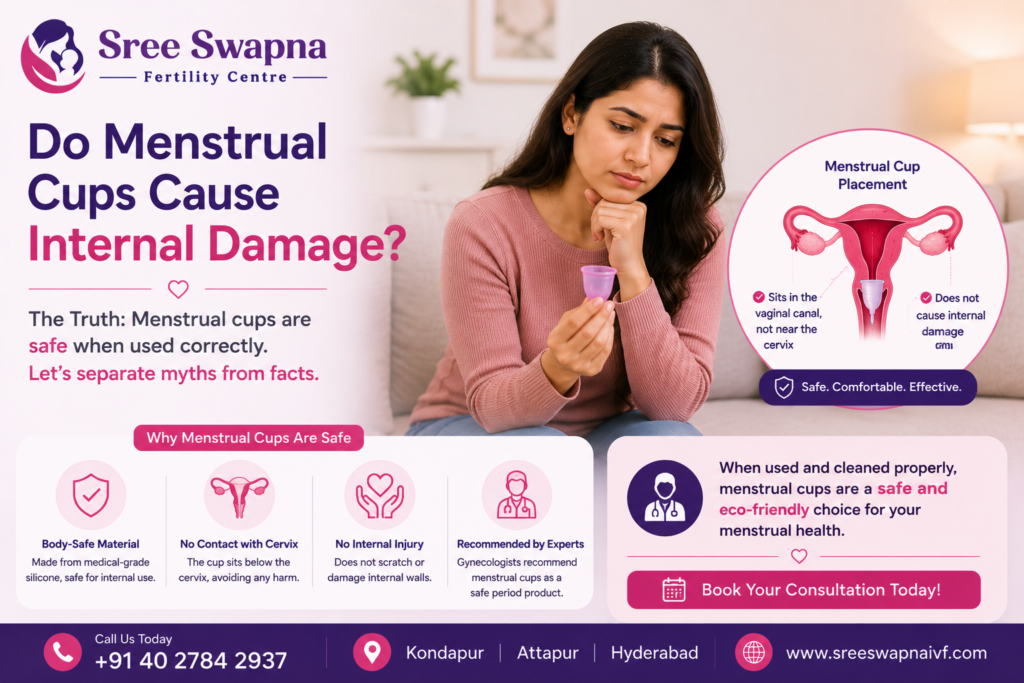
Menstrual cups have become genuinely popular — but so have the worries around them. “Can it get lost inside me?” “Will it damage my cervix?” “Is it safe if I’m not married?”
Let’s separate the real risks from the myths, based on actual research rather than internet rumours.
The Short Answer
For most women, menstrual cups are safe when used correctly. A large review of 43 studies covering over 3,000 participants concluded that menstrual cups are a safe way to manage periods, with no more risk than tampons or pads — and in some cases, a lower infection risk than tampons.
That said, there are a few genuine considerations worth knowing, especially around technique and specific situations like IUD use.
Myth: “The Cup Can Get Lost Inside My Body”
This is one of the most common fears, and it’s simply not possible. The cervix acts as a natural barrier — a menstrual cup cannot travel past it into your uterus or anywhere else in your body. It stays in the vaginal canal, exactly where it’s meant to be.
Myth: “Using a Cup Will Affect My Virginity or Break My Hymen”
The hymen is a thin, flexible tissue that naturally has some opening, and its structure varies significantly between individuals — it isn’t a reliable indicator of anything, including virginity. Using a menstrual cup, like a tampon, may or may not affect the hymen depending on individual anatomy, but this has no medical bearing on virginity as a concept. Comfort with insertion is a personal choice, not a medical restriction.
Myth: “Menstrual Cups Cause Internal Injury”
There’s no evidence that properly used menstrual cups cause damage to internal organs or structures. The vaginal canal is naturally elastic and designed to accommodate significant flexibility — including childbirth. A correctly sized, properly inserted cup sitting in the vaginal canal doesn’t pose a structural risk to your body.
What Are the Real Risks to Know?
While the core safety data is reassuring, a few genuine considerations do exist:
1. Incorrect Insertion or Removal Technique
Forcing the cup in without proper folding, or removing it without first breaking the suction seal, can cause discomfort or minor irritation to the vaginal walls. This isn’t “damage” in a serious sense, but it’s avoidable with the right technique.
2. Wrong Cup Size or Firmness
Using a cup that’s too large, too rigid, or not suited to your anatomy can cause pressure or discomfort over time. Choosing the right size, often based on age, childbirth history, and flow, matters more than people realise.
3. IUD Displacement (For IUD Users)
This is the most genuinely debated area in current research. Some studies have found a possible association between menstrual cup use and IUD displacement or expulsion, particularly linked to the suction effect created when removing the cup, or accidentally pulling the IUD strings during removal. Other guidance bodies have stated there’s no clear increased risk. The evidence remains mixed and evolving.
If you use an IUD and also use a menstrual cup:
- Always break the suction seal before removing the cup (pinch the base, don’t just pull)
- Avoid pulling directly on the cup’s stem in a way that could catch the IUD strings
- If you notice pain, unusual symptoms, or your IUD feels different after cup removal, get it checked with an ultrasound
4. Toxic Shock Syndrome (Rare)
Toxic shock syndrome (TSS) is a very rare but serious condition linked to internal period products. Current evidence suggests menstrual cups carry a lower risk than tampons, though the risk isn’t zero. Cleaning your cup properly between uses and following the recommended wearing time (usually up to 8–12 hours) reduces this risk further.
How to Use a Menstrual Cup Safely
- Wash your hands before insertion and removal
- Fold the cup correctly before inserting, following manufacturer instructions
- Always break the suction seal by pinching the base before removing
- Empty, rinse, and reinsert every 8–12 hours
- Sterilise the cup (typically by boiling) between cycles
- Choose the right size based on your age, childbirth history, and flow
When Should You See a Doctor?
- Persistent pain or discomfort with cup use, even after trying different sizes or techniques
- Unusual discharge, odour, or signs of infection
- If you use an IUD and notice any changes in symptoms after starting cup use
- Difficulty removing the cup, or the cup feels stuck
Getting Guidance at Sree Swapna Fertility Centre
Questions about menstrual products, IUDs, and reproductive health are a normal, healthy part of taking care of yourself — and deserve real answers, not internet myths.
Dr. Swapna Naik, Clinical Director at Sree Swapna Fertility Centre, brings over 15 years of experience in gynaecology and reproductive medicine. If you have questions about menstrual cup use alongside an IUD, or any concerns about your reproductive health, our team at Kondapur or Attapur is here to give you clear, evidence-based guidance.
Frequently Asked Questions
1. Can a menstrual cup get lost inside my body?
No, the cervix acts as a natural barrier, so a menstrual cup cannot travel past it into the uterus or elsewhere in the body.
2. Do menstrual cups cause internal damage?
No, there’s no evidence that properly used menstrual cups cause damage to internal organs or structures.
3. Are menstrual cups safe for unmarried or virgin women to use?
Yes, using a menstrual cup has no medical bearing on virginity, and comfort with insertion is simply a personal choice.
4. Can menstrual cups affect the hymen?
The hymen’s structure varies naturally between individuals and isn’t a reliable indicator of anything. Cup use may or may not affect it depending on individual anatomy, similar to tampon use.
5. Are menstrual cups safer than tampons?
Research suggests menstrual cups carry no more risk than tampons or pads, and in some studies, a lower infection risk than tampons.
6. Can a menstrual cup dislodge an IUD?
This is genuinely debated in current research — some studies suggest a possible association, particularly from suction during removal, while other guidance states no clear increased risk.
7. How can I safely use a menstrual cup with an IUD?
Always break the suction seal before removing the cup, avoid pulling directly on the stem, and get checked if you notice any unusual symptoms afterward.
8. Can menstrual cups cause toxic shock syndrome (TSS)?
TSS risk with menstrual cups is considered lower than with tampons, though not zero. Proper cleaning and following recommended wearing times reduces this risk.
9. How often should I empty a menstrual cup?
Typically every 8–12 hours, depending on your flow and the cup’s capacity.
10. What size menstrual cup should I use?
This depends on factors like your age, childbirth history, and flow — a specialist or product guide can help you choose appropriately.
11. Can using the wrong cup size cause problems?
Yes, an ill-fitting or overly rigid cup can cause discomfort or pressure over time, so proper sizing matters.
12. Is it normal to feel discomfort when first using a menstrual cup?
Some initial adjustment is common, but persistent pain or discomfort suggests you may need a different size or technique, or a check-up.
13. How should I clean a menstrual cup?
Rinse it with water between uses during your cycle, and sterilise it (commonly by boiling) between menstrual cycles.
14. Can menstrual cups cause vaginal infections?
Research hasn’t shown an increased infection risk compared to other period products, and in some studies, cups showed a lower infection risk.
15. Is it difficult to remove a menstrual cup?
It can take practice initially, but breaking the suction seal first makes removal significantly easier and more comfortable.
16. Can menstrual cups be used by women who haven’t given birth?
Yes, cups are generally safe and appropriate for use regardless of childbirth history, though sizing recommendations may differ.
17. What should I do if my menstrual cup feels stuck?
Stay calm, relax your muscles, and try breaking the seal by inserting a clean finger alongside the cup. If it remains difficult, seek medical assistance.
18. Can I use a menstrual cup overnight?
Yes, as long as you don’t exceed the recommended wearing time, typically up to 8–12 hours.
19. Do menstrual cups affect fertility?
No, there’s no evidence that menstrual cup use affects fertility.
20. Should I stop using a menstrual cup if I have an IUD?
Not necessarily, but it’s worth discussing with your doctor and using careful removal technique, given the ongoing research in this area.
21. Can menstrual cups cause allergic reactions?
Rarely, if someone has a specific silicone or latex sensitivity, depending on the cup’s material. Choosing a medical-grade silicone cup can help avoid this.
22. Where can I get personalised guidance on menstrual cup use in Hyderabad?
Sree Swapna Fertility Centre offers gynaecological consultations at both our Kondapur and Attapur clinics for any questions about menstrual products and reproductive health.
Conclusion
Menstrual cups are, for most women, a safe and effective period product — the fear of “internal damage” doesn’t hold up against the evidence. The genuine considerations worth knowing are proper technique, correct sizing, and extra care if you use an IUD. When in doubt, a quick conversation with your gynaecologist is always more reliable than internet rumours.
Have Questions About Reproductive Health?
Dr. Swapna Naik and the team at Sree Swapna Fertility Centre are here to answer your questions with clear, evidence-based guidance.
📞 Call: +91 76708 04424 / +91 40 4995 3719 💬 WhatsApp: Message us directly 📧 Email: sreeswapna.fertility@gmail.com 📍 Visit us at: Kondapur (flagship centre) or Attapur, Hyderabad 🌐 Book an appointment: sreeswapnaivf.com/contact-us
