
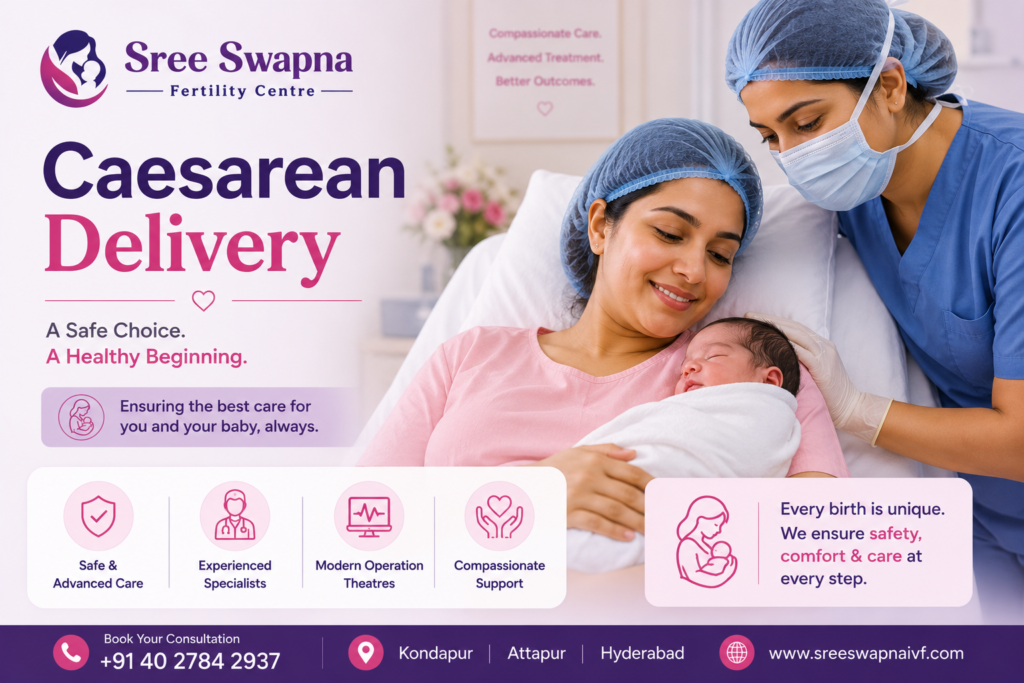
Whether you’re planning ahead or your doctor has just mentioned it as a possibility, understanding caesarean delivery in advance can make the experience far less overwhelming.
A caesarean delivery (C-section) is a common, well-established surgical procedure — but it’s still surgery, and knowing what to expect helps you feel more prepared, not more anxious.
This guide covers why a C-section might be recommended, what the procedure actually involves, and what recovery typically looks like.
What Is a Caesarean Delivery?
A caesarean delivery is a surgical procedure where a baby is delivered through an incision made in the mother’s abdomen and uterus, rather than through vaginal birth.
It can be planned in advance (elective) or performed urgently during labour if complications arise.
Why Might a C-Section Be Recommended?
Maternal Reasons
- A prior caesarean delivery, depending on the type of uterine incision used previously
- Pelvic shape or size making vaginal delivery difficult (cephalopelvic disproportion)
- Certain infections, such as active genital herpes, which can be transmitted during vaginal delivery
- Significant cardiac or pulmonary conditions
- Prior major uterine surgery, including certain fibroid removals
Placental or Uterine Reasons
- Placenta previa — when the placenta covers the cervix
- Placental abruption — when the placenta separates from the uterine wall before delivery
- A prior classical (vertical) uterine incision, which carries a higher risk of rupture in future labour
Fetal Reasons
- Non-reassuring fetal heart rate patterns during labour
- Umbilical cord prolapse
- Breech or other abnormal baby positioning
- Multiple pregnancy (twins or more), in certain positions or circumstances
- Failed attempt at operative vaginal delivery (forceps or vacuum)
Is a C-Section Always Medically Necessary?
Not always — and this is worth understanding. The World Health Organization has stated that caesarean sections should be performed only when medically necessary, since there’s no additional benefit to maternal or newborn health once a population’s C-section rate rises above a certain threshold.
This doesn’t mean C-sections aren’t important — for many women, they’re the safest, and sometimes only, way to deliver safely. It simply means the decision should be based on genuine medical need or informed maternal choice, discussed clearly with your doctor, rather than convenience alone.
What Happens During a Caesarean Delivery?
- Anaesthesia: Most C-sections use a spinal block, allowing the mother to remain awake during delivery. General anaesthesia is used less often, typically in specific emergency situations.
- Preparation: A urinary catheter is placed, and the abdomen is cleaned with antiseptic.
- Incision: A horizontal incision is usually made in the lower abdomen and uterus.
- Delivery: The baby is delivered, the umbilical cord is clamped and cut, and the placenta is removed.
- Closure: The uterine and abdominal incisions are closed with stitches.
The entire procedure typically takes around 45 minutes to an hour.
What Does Recovery Look Like?
Recovery from a C-section generally takes longer than vaginal delivery, since it involves healing from major abdominal surgery.
- Hospital stay: Typically a few days, depending on your individual recovery and hospital protocol
- Pain management: Medication is provided to manage post-surgical discomfort
- Mobility: Gentle movement is usually encouraged early on to support circulation and healing
- Wound care: Keeping the incision clean and monitoring for signs of infection is important
- Activity restrictions: Avoiding heavy lifting and strenuous activity for several weeks, as advised by your doctor
Full recovery timelines vary between individuals, so following your specific doctor’s guidance matters more than general timelines you might read online.
Can I Have a Vaginal Birth After a C-Section (VBAC)?
For some women, a vaginal birth after a previous caesarean (VBAC) is possible in a future pregnancy, depending on factors like the type of uterine incision used previously and your specific obstetric history. This is a decision to discuss in detail with your doctor well before your next delivery.
Understanding the Risks
Like any major surgery, C-sections carry some risks, including infection, bleeding, and a longer recovery period compared to vaginal birth. For future pregnancies, multiple caesarean deliveries can also increase the risk of certain placental complications. This isn’t meant to cause worry — it’s simply why the decision to proceed with a C-section, when not medically urgent, should always involve a clear discussion of risks and benefits with your doctor.
Delivery Planning at Sree Swapna Fertility Centre
For many patients who conceive through fertility treatment, delivery planning is a natural next step in the journey — and one that deserves the same thoughtful, personalised guidance as the treatment that got you there.
Dr. Swapna Naik, Clinical Director at Sree Swapna Fertility Centre, holds qualifications in Obstetrics & Gynaecology alongside her fertility specialisation, and brings over 15 years of experience in reproductive medicine. If you conceive through treatment with us, our team can help guide the conversations around your delivery plan, coordinate with your obstetric care team, and make sure your questions about C-section or vaginal delivery are answered clearly, well before your due date.
Frequently Asked Questions
1. What is a caesarean delivery?
It’s a surgical procedure where a baby is delivered through an incision in the mother’s abdomen and uterus, rather than vaginal birth.
2. Is a C-section more dangerous than vaginal birth?
Both carry different risk profiles. C-sections are major surgery with their own risks, but are the safest option in certain medical situations. Your doctor can advise what’s appropriate for your specific case.
3. How long does a C-section take?
The procedure itself typically takes around 45 minutes to an hour.
4. Will I be awake during my C-section?
In most cases, yes — a spinal block is commonly used, allowing you to remain awake while being pain-free during the procedure.
5. When is general anaesthesia used for a C-section?
It’s generally reserved for specific emergency situations or particular medical circumstances, rather than routine use.
6. Can I have a vaginal birth after a previous C-section?
In some cases, yes (called VBAC), depending on factors like the type of uterine incision used previously. Discuss this with your doctor.
7. How long is the hospital stay after a C-section?
Typically a few days, though this varies based on individual recovery and hospital protocol.
8. Is a C-section always planned in advance?
No, it can be planned ahead (elective) or performed urgently during labour if complications arise.
9. What is placenta previa, and why does it require a C-section?
It’s a condition where the placenta covers the cervix, making vaginal delivery unsafe, so a C-section is typically recommended.
10. Does having one C-section mean I’ll always need one?
Not necessarily — this depends on the type of uterine incision and other individual factors, which your doctor will assess for future pregnancies.
11. What are the risks of a C-section?
Risks include infection, bleeding, and a longer recovery period, along with certain considerations for future pregnancies with multiple C-sections.
12. How soon can I move around after a C-section?
Gentle movement is usually encouraged early in recovery to support circulation and healing, as guided by your care team.
13. Can twins be delivered via C-section?
Yes, depending on the babies’ positions and other clinical factors, twin pregnancies are sometimes delivered via C-section.
14. Does the World Health Organization recommend C-sections for everyone?
No, WHO guidance states that C-sections should be performed based on medical necessity, not as a routine default.
15. What is cephalopelvic disproportion?
It’s when the baby’s size or position doesn’t fit well with the mother’s pelvic shape, making vaginal delivery difficult or unsafe.
16. Can a C-section affect future pregnancies?
It can, particularly regarding placental complications with multiple prior C-sections, which is why your obstetric history matters for future pregnancy planning.
17. What is umbilical cord prolapse?
It’s when the umbilical cord slips through the cervix before the baby, a situation that typically requires urgent delivery, often by C-section.
18. Is breech position always a reason for C-section?
It’s a common reason, though the specific approach depends on the type of breech position and your doctor’s clinical assessment.
19. How long until I can resume normal activities after a C-section?
This varies by individual, but heavy lifting and strenuous activity are generally restricted for several weeks — follow your doctor’s specific guidance.
20. Can I request a C-section without a medical reason?
This is a decision to discuss thoroughly with your doctor, weighing the medical considerations and your personal preferences together.
21. Does a C-section affect breastfeeding?
Most women can breastfeed successfully after a C-section, sometimes with some extra support for comfortable positioning during initial recovery.
22. Where can I get guidance on delivery planning in Hyderabad?
Sree Swapna Fertility Centre can help guide delivery planning conversations for patients who conceive through our fertility treatment programmes.
Conclusion
A caesarean delivery is a well-established, generally safe procedure when medically indicated — and understanding what it involves in advance can make a real difference in how prepared and confident you feel. Whatever your delivery path looks like, having clear, honest conversations with your care team well before your due date is the best way to plan ahead.
Discuss Your Delivery Plan With Our Team
Whether you’re planning ahead or simply want to understand your options, Dr. Swapna Naik and the team at Sree Swapna Fertility Centre are here to guide you.
📞 Call: +91 76708 04424 / +91 40 4995 3719 💬 WhatsApp: Message us directly 📧 Email: sreeswapna.fertility@gmail.com 📍 Visit us at: Kondapur (flagship centre) or Attapur, Hyderabad 🌐 Book an appointment: sreeswapnaivf.com/contact-us
