
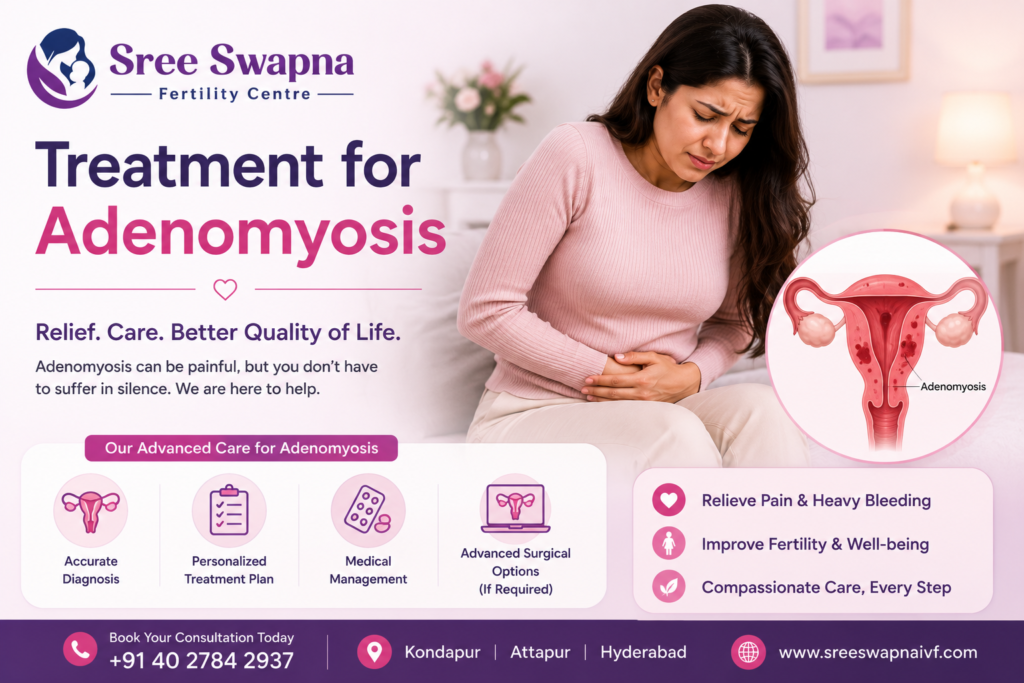
There’s no single “best” treatment for adenomyosis. The right answer depends entirely on your situation — your age, your symptoms, and whether you want to have children in the future.
What works well for one woman may be completely wrong for another. Instead of a generic list of options, this guide walks through common real-life scenarios, so you can see which treatment path is more likely to fit yours.
Scenario 1: “I’m in my 20s or early 30s, and I want children later.”
If future fertility is a priority, treatment usually focuses on controlling symptoms without removing the uterus or reducing fertility potential.
Typically recommended:
- Hormonal treatment (birth control pills, hormonal IUD, or dienogest) to manage pain and bleeding
- NSAIDs for period pain
- If a localised adenomyoma is present, adenomyomectomy may be considered to remove it while preserving the uterus
Usually avoided at this stage: Hysterectomy, since it ends the possibility of future pregnancy.
Scenario 2: “I’m trying to conceive right now, and I’ve just been diagnosed.”
Here, treatment isn’t just about symptom relief — it’s about improving the uterine environment for conception.
Typically recommended:
- A coordinated plan between your gynaecologist and a fertility specialist
- If undergoing IVF, an extended GnRH agonist downregulation protocol before your cycle may be considered, based on current research
- Frozen embryo transfer (FET), rather than fresh transfer, in some cases, allowing extra preparation time
Important: This scenario needs a specialist who handles both adenomyosis and fertility treatment together — not two separate doctors giving conflicting advice.
Scenario 3: “My periods are heavy and painful, but I’ve completed my family.”
If future pregnancy isn’t a priority, you have more treatment options available, including more permanent ones.
Typically recommended:
- Hormonal IUD, often highly effective at reducing bleeding and pain
- GnRH agonist therapy, for a defined treatment period
- Uterine artery embolisation, for some cases
- Hysterectomy, if symptoms are severe and you want a definitive, permanent solution
Scenario 4: “I’ve tried medication, but my symptoms haven’t improved.”
This is when specialists typically move toward more targeted options.
Typically recommended:
- A repeat, more detailed ultrasound or MRI to reassess the extent of adenomyosis
- Discussion of surgical options — adenomyomectomy for localised disease, or more definitive surgery for diffuse, severe cases
- A second opinion, if you haven’t already gotten one, since ongoing symptoms may warrant a fresh diagnostic look
Scenario 5: “I have both adenomyosis and fibroids.”
This combination is common and needs a plan that addresses both conditions together, not just one in isolation.
Typically recommended:
- Imaging that clearly distinguishes fibroid tissue from adenomyosis tissue, since treatment approaches differ
- A combined treatment plan, since surgery for fibroids doesn’t automatically treat adenomyosis, and vice versa
Scenario 6: “My symptoms are mild, and I was just told I have adenomyosis on a scan.”
Not every case needs immediate, aggressive treatment.
Typically recommended:
- Monitoring, with treatment introduced only if symptoms develop or worsen
- Simple pain management for occasional discomfort
- Regular follow-up imaging to track any changes over time
Why “Best” Really Means “Right for You”
Every treatment on this list is a legitimate, medically recognised option — the question is never which one is objectively superior, but which one fits your age, your symptoms, your fertility plans, and how you’ve responded to treatment so far.
This is exactly why a proper diagnostic evaluation should always come before a treatment recommendation, not the other way around.
How Sree Swapna Fertility Centre Approaches This Question
At Sree Swapna Fertility Centre, we don’t default to one treatment for every adenomyosis patient. Our clinical director, Dr. Swapna Naik (MBBS, MS in Obstetrics & Gynaecology, Fellowship in Reproductive Medicine & IVF), brings over 15 years of experience and has guided more than 5,000 successful pregnancies, giving her a broad, real-world view of how different treatment paths play out for different patients.
Every consultation starts with understanding your specific scenario — your symptoms, your age, your fertility goals — before any treatment is discussed. Both our Kondapur and Attapur clinics offer in-house diagnostic imaging, so your evaluation and treatment planning happen without unnecessary delays.
Frequently Asked Questions
1. Is there one universal best treatment for adenomyosis?
No, the right treatment depends on your age, symptom severity, and fertility plans.
2. What’s the best option if I want children in the future?
Hormonal management or adenomyomectomy (for localised cases) are generally preferred over hysterectomy.
3. Is hysterectomy always the best long-term solution?
It’s the only treatment that removes adenomyosis completely, but it’s generally reserved for women who have completed childbearing.
4. What if medication doesn’t help my symptoms?
Your specialist may recommend reassessing with more detailed imaging and discussing surgical options.
5. Can adenomyosis be treated without medication or surgery?
In mild, asymptomatic cases, monitoring alone may be appropriate, with treatment introduced only if needed later.
6. Is a hormonal IUD effective for adenomyosis?
Yes, it’s often effective at reducing bleeding and pain for many women.
7. What if I have adenomyosis and fibroids together?
Both conditions need to be addressed as part of a combined treatment plan, since treating one doesn’t automatically treat the other.
8. Does age affect which treatment is recommended?
Yes, age and fertility plans strongly influence whether conservative or more definitive treatment is suggested.
9. Can adenomyosis be treated while trying to conceive?
Yes, but the approach is different — usually coordinated with a fertility specialist rather than treated purely for symptom relief.
10. Is surgery always necessary for adenomyosis?
No, many women manage their symptoms successfully with medication alone.
11. What is the best treatment for severe, diffuse adenomyosis?
This often requires more comprehensive management, potentially including extended hormonal therapy or, in some cases, hysterectomy if fertility isn’t a priority.
12. How do I know if my adenomyosis is mild or severe?
This requires proper imaging — transvaginal ultrasound or MRI — reviewed by a specialist.
13. Can adenomyosis treatment change over time?
Yes, treatment often evolves based on how your symptoms and fertility goals change over the years.
14. Should I get a second opinion if treatment isn’t working?
Yes, especially if you’ve tried medication without improvement, a second opinion or repeat evaluation is a reasonable step.
15. Is GnRH agonist therapy a permanent treatment?
No, it’s typically used for a limited period to manage symptoms or prepare for another treatment, such as an IVF cycle.
16. Can non-surgical treatment fail?
Yes, for some women symptoms don’t respond adequately, which is when surgical options are usually discussed.
17. What if I’m unsure whether I want more children?
It’s worth discussing this openly with your specialist, since it directly affects which treatment options make sense for you right now.
18. Does adenomyosis treatment differ between Kondapur and Attapur clinics?
No, both clinics follow the same treatment approach and diagnostic standards under the same clinical team.
19. Can I switch treatment approaches if my situation changes?
Yes, treatment plans can be revisited as your symptoms, age, or fertility goals evolve.
20. Is monitoring alone ever a valid treatment approach?
Yes, for mild or asymptomatic cases, monitoring with periodic follow-up may be entirely appropriate.
21. What’s the first step in figuring out my best treatment option?
A thorough consultation and imaging evaluation with a specialist experienced in both gynaecology and fertility care.
22. How do I book a consultation to discuss my adenomyosis treatment options?
Call or WhatsApp Sree Swapna Fertility Centre, or book online through their website.
Conclusion
The best treatment for adenomyosis isn’t a fixed answer — it’s the one that matches your specific age, symptoms, and fertility goals. Working through your actual scenario with an experienced specialist is far more useful than searching for a single “best” option that applies to everyone.
Find the Right Treatment for Your Situation
Dr. Swapna Naik and the team at Sree Swapna Fertility Centre will help you understand which adenomyosis treatment genuinely fits your specific situation.
📞 Call: +91 76708 04424 / +91 40 4995 3719 💬 WhatsApp: Message us directly 📧 Email: sreeswapna.fertility@gmail.com 📍 Visit us at: Kondapur (flagship centre) or Attapur, Hyderabad 🌐 Book an appointment: sreeswapnaivf.com/contact-us
