
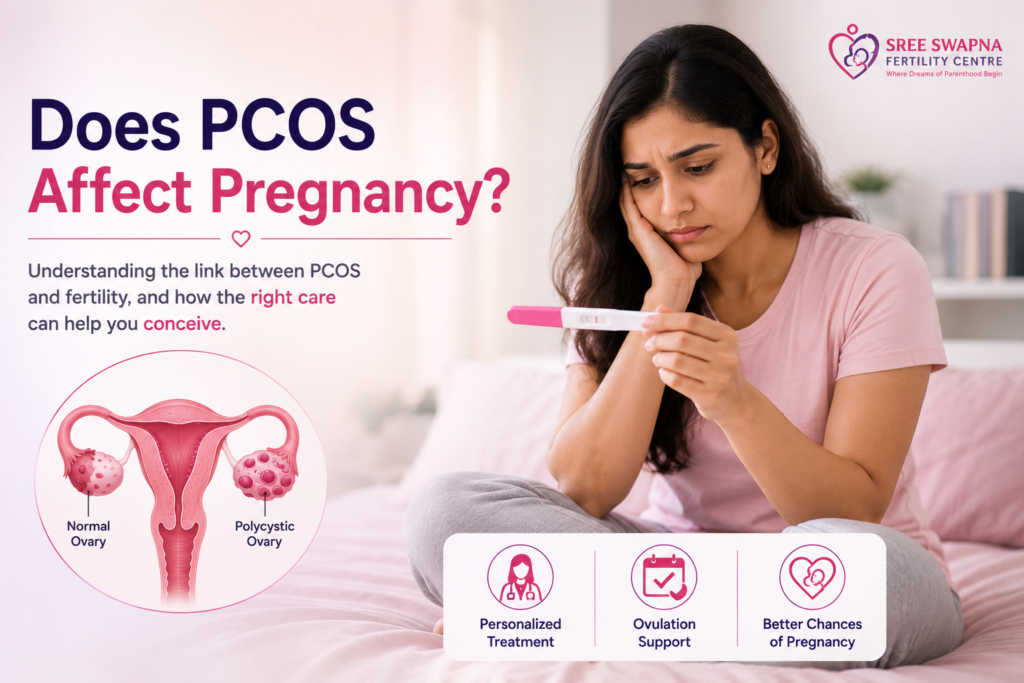
PCOS affects pregnancy in two distinct ways — first, by making it harder to conceive in the first place, and second, by increasing certain risks once pregnancy happens. Understanding both halves of this picture helps you prepare properly, rather than worrying about the wrong thing at the wrong time.
How PCOS Affects Getting Pregnant
The main barrier PCOS creates is irregular or absent ovulation. Without regular ovulation, there’s no egg released each month for sperm to fertilise — which is why irregular periods are often the first clue pointing toward PCOS during a fertility evaluation.
The encouraging part: this is also the most treatable part of PCOS-related infertility.
Ovulation Induction: What’s Changed
For years, clomiphene citrate was the standard first medication used to trigger ovulation in PCOS. That’s changed. Current international guidelines now recommend letrozole as the preferred first-line treatment for PCOS-related anovulatory infertility.
The evidence behind this shift is fairly striking. A major clinical trial found letrozole led to higher ovulation rates (61.7% vs. 48.3%) and higher clinical pregnancy rates (41.9% vs. 28.2%) compared to clomiphene. If you’ve read older information suggesting clomiphene is still the standard, it’s worth knowing this has genuinely moved on.
What About IVF for PCOS?
Here’s something many women with PCOS don’t expect to hear: they often respond very well to IVF stimulation, since PCOS is associated with a higher number of follicles. Some studies show non-obese women with PCOS reaching cumulative IVF live birth rates around 74%, compared to roughly 62% in women without PCOS.
How PCOS Affects Pregnancy Once It Happens
This is the part that deserves equally serious attention. Research consistently shows PCOS is associated with a genuinely higher risk of several pregnancy complications:
- Miscarriage: Often estimated at around 20–30%, roughly double the risk compared to women without PCOS
- Gestational diabetes: Occurring in roughly 15–30% of PCOS pregnancies, also about double the typical risk
- Gestational hypertension and preeclampsia: Consistently shown to occur more frequently in PCOS pregnancies
- Preterm birth: Also occurring at a somewhat higher rate
This is why PCOS is generally treated as a higher-risk pregnancy category, warranting closer monitoring rather than a “wait and see” approach.
An Important Nuance: PCOS Risk vs. Fertility Treatment Risk
It’s worth separating two different questions: does having PCOS itself increase pregnancy risk, and does treating PCOS infertility with IVF add further risk on top of that? Current guidance suggests assisted reproductive technology itself doesn’t appear to meaningfully add additional miscarriage, preterm birth, or growth restriction risk beyond what’s already associated with the underlying PCOS diagnosis. In other words — the increased risk largely comes from PCOS itself, not from the treatment used to help you conceive.
Does Metformin Prevent These Complications?
This is a common assumption worth correcting. Despite metformin’s popularity in PCOS management, current evidence has not shown it prevents gestational diabetes, late miscarriage, hypertension, preeclampsia, or larger-than-average babies in pregnant women with PCOS. It may still have a role in specific situations, but it isn’t a guaranteed shield against these pregnancy complications, and shouldn’t be relied on as one.
What Can Genuinely Help Reduce These Risks?
- Preconception weight management, where relevant, since higher BMI is independently linked to greater complication risk
- Early and repeated screening for gestational diabetes, often starting at the first prenatal visit rather than waiting for the standard mid-pregnancy window
- Closer blood pressure monitoring throughout pregnancy
- Regular fetal growth monitoring
- A coordinated care plan between your fertility specialist and obstetric team, rather than treating these as separate, disconnected phases of your journey
The Reassuring Bottom Line
Having PCOS doesn’t mean complications are inevitable — it means your pregnancy benefits genuinely from closer attention and proactive screening. Many women with PCOS go on to have healthy pregnancies and healthy babies, particularly when risks are anticipated and monitored rather than discovered late.
PCOS Pregnancy Care at Sree Swapna Fertility Centre
As one of the best fertility center in Hyderabad for comprehensive PCOS management, we approach PCOS as a condition requiring attention both before and during pregnancy — not just at the point of conception.
Dr. Swapna Naik, Clinical Director at Sree Swapna Fertility Centre, brings over 15 years of experience in reproductive medicine and has guided more than 5,000 successful pregnancies, including many women with PCOS. Our approach includes evidence-based ovulation induction using letrozole where appropriate, IVF planning tailored to PCOS-specific response patterns, and close coordination around pregnancy monitoring for gestational diabetes and hypertension risk.
Both our Kondapur and Attapur clinics offer in-house diagnostic and monitoring facilities, so your PCOS-related fertility treatment and pregnancy risk management stay properly coordinated under one experienced team.
Frequently Asked Questions
1. Does PCOS affect my chances of getting pregnant?
Yes, PCOS commonly causes irregular or absent ovulation, which is the main reason it affects fertility, though it’s often effectively treatable.
2. Is clomiphene still the first choice for PCOS ovulation induction?
No, current guidelines now recommend letrozole as the preferred first-line treatment, since research shows better ovulation and pregnancy rates compared to clomiphene.
3. Does PCOS increase miscarriage risk?
Yes, research suggests roughly double the miscarriage risk compared to women without PCOS, often estimated around 20–30%.
4. Does PCOS increase the risk of gestational diabetes?
Yes, gestational diabetes occurs in roughly 15–30% of PCOS pregnancies, about twice the typical risk.
5. Is preeclampsia more common in PCOS pregnancies?
Yes, research consistently shows a higher rate of preeclampsia and gestational hypertension in women with PCOS.
6. Does IVF add extra risk on top of PCOS itself?
Current guidance suggests assisted reproductive technology doesn’t meaningfully add additional risk beyond what’s already associated with the underlying PCOS diagnosis.
7. Does metformin prevent gestational diabetes in PCOS pregnancies?
No, current evidence hasn’t shown metformin prevents gestational diabetes or other major PCOS-related pregnancy complications.
8. Do women with PCOS respond well to IVF?
Yes, many women with PCOS respond strongly to IVF stimulation due to a higher number of follicles, with some studies showing notably high cumulative live birth rates.
9. Is PCOS considered a high-risk pregnancy?
Yes, PCOS pregnancies are generally treated as higher-risk, warranting closer monitoring for gestational diabetes, hypertension, and preterm birth.
10. Can weight management before pregnancy reduce PCOS-related risks?
Yes, preconception weight management, where relevant, is associated with reduced complication risk in PCOS pregnancies.
11. Does PCOS increase the risk of a larger-than-average baby?
Evidence on this is mixed, with some research not showing an increased risk over the general population once other factors are accounted for.
12. When should gestational diabetes screening start for women with PCOS?
Many providers recommend screening at the first prenatal visit, in addition to the standard later screening window.
13. Does PCOS increase preterm birth risk?
Yes, research shows a somewhat higher rate of preterm birth in PCOS pregnancies compared to the general population.
14. Can healthy PCOS pregnancies happen without complications?
Yes, many women with PCOS have healthy pregnancies, especially with proactive monitoring and management from early on.
15. Is letrozole safe to use for ovulation induction?
Current large trials and meta-analyses haven’t shown an increase in congenital anomalies or adverse outcomes with letrozole-induced pregnancies.
16. Should I see a specialist before trying to conceive if I have PCOS?
Yes, a preconception consultation can help address weight, ovulation induction options, and risk factors before you start trying.
17. Does PCOS affect pregnancy differently depending on severity?
Yes, factors like BMI, insulin resistance, and specific PCOS phenotype can all influence individual risk levels.
18. Can PCOS-related pregnancy risks be caught early with proper monitoring?
Yes, early and regular screening significantly improves the chances of catching and managing complications before they become serious.
19. Does having PCOS mean I’ll definitely need IVF to conceive?
No, many women with PCOS conceive with lifestyle changes and ovulation induction medication alone, without needing IVF.
20. Is blood pressure monitoring more important in PCOS pregnancies?
Yes, given the higher risk of gestational hypertension and preeclampsia, closer blood pressure monitoring is generally recommended throughout pregnancy.
21. Can PCOS affect pregnancy even if my periods are somewhat regular?
Yes, PCOS-related pregnancy risks like gestational diabetes and hypertension can still apply even with relatively regular cycles, since these relate to underlying metabolic factors.
22. Where can I find the best fertility center in Hyderabad for PCOS pregnancy planning?
Sree Swapna Fertility Centre offers comprehensive PCOS fertility and pregnancy risk management at both our Kondapur and Attapur clinics.
Conclusion
PCOS genuinely affects both your chances of conceiving and your pregnancy once it happens — but neither part of this story needs to be alarming. With current, evidence-based treatment for ovulation induction, and proactive monitoring for pregnancy-specific risks, many women with PCOS go on to have healthy pregnancies and healthy babies.
Plan Your PCOS Pregnancy Journey With Us
Dr. Swapna Naik and the team at Sree Swapna Fertility Centre — recognised as a leading, best fertility center in Hyderabad — are here to guide you through both conception and a well-monitored pregnancy.
📞 Call: +91 76708 04424 / +91 40 4995 3719 💬 WhatsApp: Message us directly 📧 Email: sreeswapna.fertility@gmail.com 📍 Visit us at: Kondapur (flagship centre) or Attapur, Hyderabad 🌐 Book an appointment: sreeswapnaivf.com/contact-us
