
For decades, if you wanted a confirmed endometriosis diagnosis, surgery was considered essential. That’s changed — significantly — and it’s worth understanding why, especially if a doctor has mentioned laparoscopy to you as a next step.
This guide explains what diagnostic laparoscopy actually involves, how its role has shifted in recent years, and when it’s genuinely still the right choice today.
What Is Diagnostic Laparoscopy?
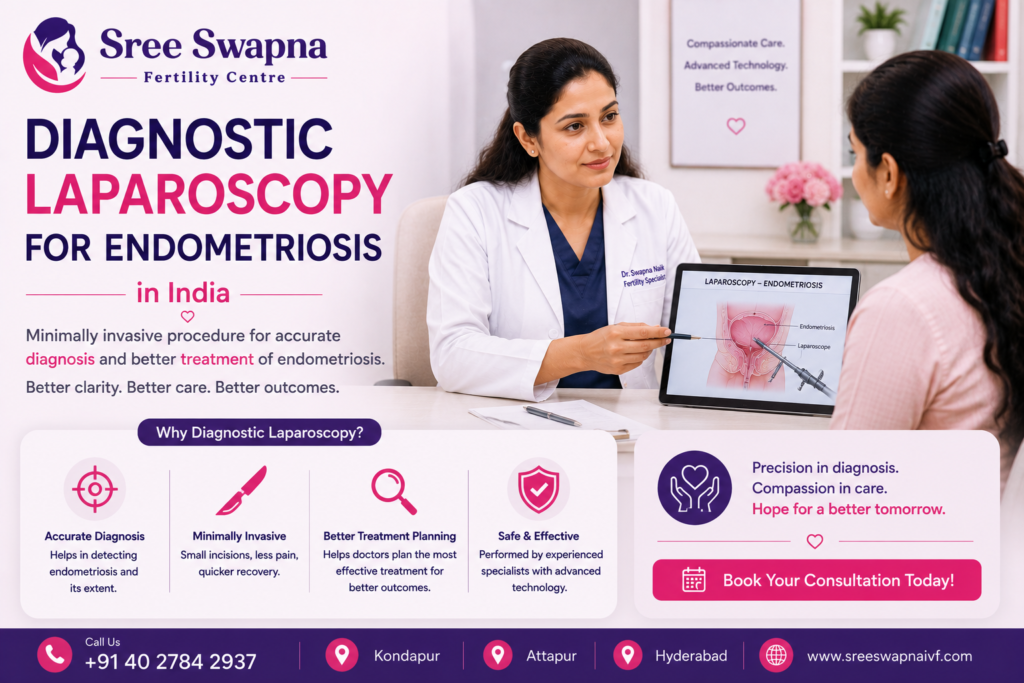
Diagnostic laparoscopy is a minimally invasive surgical procedure where a thin, lighted camera (laparoscope) is inserted through a small incision near the navel, allowing direct visualisation of the pelvic organs — including any visible endometriosis lesions, adhesions, or structural abnormalities.
Historically, this direct visual and tissue-sample (biopsy) confirmation was considered the only truly definitive way to diagnose endometriosis.
What Has Changed: Laparoscopy Is No Longer the “Gold Standard”
This is genuinely important to understand. In 2022, the European Society of Human Reproduction and Embryology (ESHRE) updated its clinical guidelines, moving away from laparoscopy as the diagnostic gold standard for endometriosis. Instead, imaging — transvaginal ultrasound and MRI — is now recommended as the first-line approach, with laparoscopy reserved for more specific situations.
This shift happened for good reason. Requiring surgery before diagnosis contributed to a well-documented, lengthy diagnostic delay — historically averaging 7 to 10 years between first symptoms and confirmed diagnosis. Meanwhile, advances in ultrasound technique (particularly a standardised, detailed protocol for evaluating the pelvis) have shown diagnostic accuracy for ovarian and deep endometriosis that’s now considered comparable to surgical visualisation in experienced hands.
When Is Diagnostic Laparoscopy Still Recommended?
Despite this shift, laparoscopy remains genuinely important in specific circumstances:
- Negative imaging with ongoing, unexplained symptoms: If ultrasound and/or MRI don’t show clear findings, but symptoms persist and haven’t responded to initial hormonal treatment, laparoscopy may still be recommended
- Suspected superficial endometriosis: This form is harder to detect on imaging than deep or ovarian endometriosis, so laparoscopy remains relevant when superficial disease is suspected despite negative imaging
- Atypical ovarian masses: If an ovarian cyst has features on imaging that raise concern for malignancy rather than a straightforward endometrioma, surgery may be needed to clarify the diagnosis
- Alongside planned therapeutic surgery: If you’re already having surgery to treat suspected endometriosis (rather than purely to diagnose it), biopsy and confirmation naturally happen during that same procedure
Importantly, current guidelines note that even a negative laparoscopy doesn’t fully rule out endometriosis either — no single test is considered perfectly definitive.
What Happens During Diagnostic Laparoscopy?
- Anaesthesia: General anaesthesia is used
- Access: A small incision is made near the navel, and the abdomen is gently inflated with gas to create working space
- Visualisation: The laparoscope allows direct viewing of the uterus, ovaries, fallopian tubes, and surrounding pelvic structures
- Biopsy: If suspicious tissue is identified, a small sample is taken for histological confirmation
- Additional treatment, if needed: In many cases, if endometriosis is found, your surgeon may treat visible lesions during the same procedure, rather than performing a purely diagnostic surgery and a separate treatment surgery later
What Does Recovery Look Like?
- Typically a same-day or overnight procedure, depending on findings and any additional treatment performed
- Mild shoulder or abdominal discomfort from the gas used during the procedure, usually resolving within a few days
- Most people return to normal activities within about a week, though this varies based on what was done during surgery
Why the Imaging-First Approach Matters for You
If you’re currently experiencing symptoms that suggest endometriosis, understanding this shift matters practically: a thorough ultrasound evaluation — ideally using a detailed, standardised scanning protocol — should generally come first, not surgery. This avoids unnecessary surgical risk and delay when imaging alone can often provide a confident diagnosis, particularly for ovarian and deep endometriosis.
Diagnostic Approach at Sree Swapna Fertility Centre
We follow current, evidence-based guidance rather than defaulting to surgery as a first step.
Dr. Swapna Naik, Clinical Director at Sree Swapna Fertility Centre, is a trained laparoscopic surgeon with over 15 years of experience, and our approach begins with thorough transvaginal ultrasound evaluation at both our Kondapur and Attapur clinics. Laparoscopy is recommended when imaging findings are inconclusive, symptoms persist despite initial treatment, or when therapeutic surgery is already planned — not as a routine first step for every suspected case.
Frequently Asked Questions
1. Is diagnostic laparoscopy still the gold standard for diagnosing endometriosis?
No, since 2022, updated international guidelines recommend imaging (ultrasound and/or MRI) as the first-line diagnostic approach, with laparoscopy reserved for specific situations.
2. Why did the approach to diagnosing endometriosis change?
Requiring surgery before diagnosis contributed to lengthy diagnostic delays, while imaging technology has improved enough to reliably detect ovarian and deep endometriosis in many cases.
3. When is laparoscopy still recommended for endometriosis diagnosis?
When imaging is negative but symptoms persist despite treatment, when superficial endometriosis is suspected, when an ovarian mass has atypical features, or alongside planned therapeutic surgery.
4. Can imaging alone confirm all types of endometriosis?
Not entirely — ultrasound and MRI are quite accurate for ovarian and deep endometriosis, but superficial endometriosis remains harder to detect through imaging alone.
5. Does a negative laparoscopy rule out endometriosis completely?
No, current guidelines note that even laparoscopy isn’t considered a perfectly definitive test — a negative result doesn’t fully exclude the condition.
6. What happens during diagnostic laparoscopy?
A thin camera is inserted through a small incision to directly visualise pelvic organs, with biopsy of any suspicious tissue for confirmation.
7. Is diagnostic laparoscopy painful?
It’s performed under general anaesthesia, and post-procedure discomfort is generally mild, often related to the gas used during surgery rather than the incisions themselves.
8. How long does recovery take after diagnostic laparoscopy?
Most people return to normal activities within about a week, though this depends on what was done during the procedure.
9. Can treatment be done during the same procedure as diagnosis?
Yes, if endometriosis is visually confirmed during laparoscopy, many surgeons treat visible lesions during the same procedure rather than scheduling separate surgeries.
10. What is the IDEA protocol mentioned in relation to ultrasound?
It’s a standardised, detailed ultrasound scanning approach shown to improve diagnostic accuracy for endometriosis, particularly deep and ovarian disease.
11. Why was the historical diagnostic delay for endometriosis so long?
Because laparoscopy was considered necessary for confirmation, and surgery isn’t something patients or doctors pursue quickly or lightly, leading to significant average delays before diagnosis.
12. Should I ask for an ultrasound before considering laparoscopy?
Yes, current guidance supports starting with thorough imaging evaluation before considering surgical diagnosis, in most cases.
13. Is MRI ever needed in addition to ultrasound?
Yes, particularly when ultrasound findings are inconclusive, or for detailed surgical planning if deep endometriosis is suspected.
14. Can blood tests like CA-125 diagnose endometriosis?
No, current guidelines don’t recommend blood tests like CA-125 for diagnosing or excluding endometriosis.
15. What if my ultrasound is negative but I still have symptoms?
Discuss this with your doctor — options may include empirical hormonal treatment first, with laparoscopy considered if symptoms don’t improve.
16. Is diagnostic laparoscopy a day procedure?
It’s often done as a same-day or overnight procedure, depending on findings and whether additional treatment is performed.
17. Does an ovarian cyst always need laparoscopy to confirm it’s an endometrioma?
Not always — typical endometriomas can often be confidently identified on ultrasound alone, though atypical-appearing cysts may need surgical evaluation to rule out other causes.
18. Can superficial endometriosis be missed on ultrasound?
Yes, this is one of the main reasons laparoscopy remains relevant — superficial disease is harder to detect through imaging compared to deep or ovarian endometriosis.
19. Is empirical hormonal treatment an alternative to laparoscopy?
Yes, in some cases, a trial of hormonal treatment based on clinical suspicion is considered a reasonable alternative to immediate laparoscopy.
20. Does having laparoscopy always mean I’ll need further surgery later?
Not necessarily — if endometriosis is confirmed during a diagnostic procedure, treatment is often performed during that same surgery.
21. How experienced does a sonographer need to be for accurate endometriosis imaging?
Diagnostic accuracy for endometriosis on ultrasound is closely tied to the specific training and experience of the person performing the scan, since it requires a detailed, systematic approach.
22. Where can I get thorough endometriosis imaging evaluation in Hyderabad?
Sree Swapna Fertility Centre offers in-house transvaginal ultrasound evaluation at both our Kondapur and Attapur clinics, following current imaging-first diagnostic guidance.
Conclusion
Diagnostic laparoscopy hasn’t disappeared from endometriosis care, but its role has genuinely changed. Thorough imaging is now the appropriate starting point for most patients, with laparoscopy reserved for specific situations where imaging alone isn’t enough. Understanding this shift can help you have a more informed conversation with your doctor about what’s really needed for your diagnosis.
Start With a Thorough Evaluation
Dr. Swapna Naik and the team at Sree Swapna Fertility Centre follow an evidence-based, imaging-first approach to endometriosis diagnosis, reserving surgery for when it’s genuinely needed.
📞 Call: +91 76708 04424 / +91 40 4995 3719 💬 WhatsApp: Message us directly 📧 Email: sreeswapna.fertility@gmail.com 📍 Visit us at: Kondapur (flagship centre) or Attapur, Hyderabad 🌐 Book an appointment: sreeswapnaivf.com/contact-us
