
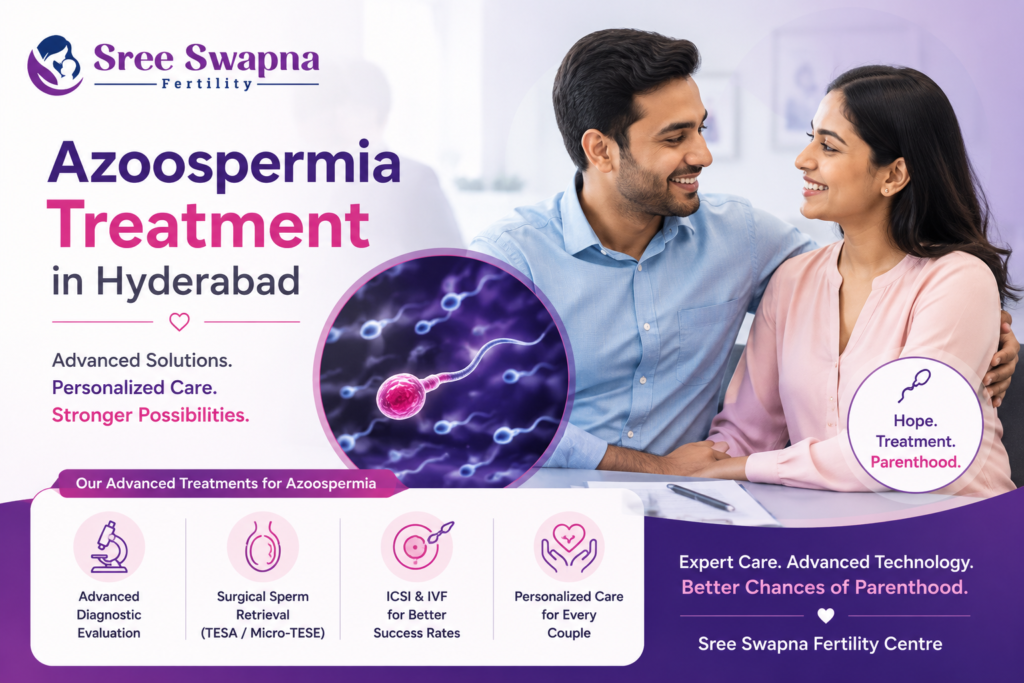
Hearing “zero sperm count” for the first time is genuinely frightening. Many men assume it means biological fatherhood is impossible.
That’s usually not true. Azoospermia — the medical term for zero sperm in the ejaculate — has multiple possible causes, and many of them are treatable.
This guide explains what causes azoospermia, how it’s diagnosed, what treatment options exist, and what affects the cost of treatment in Hyderabad.
What Is Azoospermia?
Azoospermia means no sperm is found in a man’s semen sample during a standard semen analysis. It affects a small percentage of men, and is one of the more serious findings in a male fertility work-up.
There are two main types, and the distinction matters a lot for treatment:
Obstructive Azoospermia
Sperm is being produced normally in the testes, but a blockage somewhere in the reproductive tract prevents it from reaching the ejaculate.
Non-Obstructive Azoospermia
The testes themselves are producing little to no sperm, due to a problem with sperm production itself — not a blockage.
What Causes Azoospermia?
Causes of Obstructive Azoospermia
- Previous vasectomy
- Congenital absence of the vas deferens (sometimes linked to genetic conditions)
- Infections causing scarring and blockage
- Prior surgery in the pelvic or groin area
Causes of Non-Obstructive Azoospermia
- Hormonal imbalances affecting sperm production
- Genetic conditions, such as Klinefelter syndrome or Y-chromosome microdeletions
- Varicocele, in some cases
- Prior chemotherapy or radiation exposure
- Undescended testicles in childhood, if untreated
- In some cases, no identifiable cause is found
How Is Azoospermia Diagnosed?
- Repeat semen analysis — a single sample isn’t enough; at least two separate tests are typically needed to confirm azoospermia
- Hormonal blood tests — checking FSH, LH, and testosterone levels helps distinguish obstructive from non-obstructive causes
- Scrotal ultrasound — to check testicular structure and rule out obstruction
- Genetic testing — recommended in cases of suspected non-obstructive azoospermia, to check for chromosomal or genetic causes
- Testicular biopsy — sometimes needed to directly assess sperm production
Getting the type of azoospermia right is the single most important diagnostic step, since obstructive and non-obstructive cases are treated very differently.
Treatment Options for Azoospermia
For Obstructive Azoospermia
- Surgical correction of the blockage (such as vasectomy reversal, if that’s the cause), which may restore natural sperm flow
- Surgical sperm retrieval — since sperm production is normal, retrieval techniques like PESA or TESA generally have a high success rate in these cases
For Non-Obstructive Azoospermia
- Hormonal treatment, if an imbalance is identified as the underlying cause
- Varicocele repair, if a varicocele is contributing to poor sperm production
- Surgical sperm retrieval (typically TESE or micro-TESE), which directly samples testicular tissue to search for any sperm present, even in small amounts
Surgical Sperm Retrieval Techniques Explained
| Technique | Best Suited For | General Approach |
|---|---|---|
| PESA (Percutaneous Epididymal Sperm Aspiration) | Obstructive azoospermia | Needle aspiration from the epididymis |
| TESA (Testicular Sperm Aspiration) | Both types | Needle aspiration directly from testicular tissue |
| TESE (Testicular Sperm Extraction) | Non-obstructive azoospermia | Small tissue biopsy from the testes |
| Micro-TESE | Severe non-obstructive azoospermia | Microscope-guided extraction targeting areas more likely to contain sperm |
Retrieval success rates are generally higher for obstructive azoospermia (often reported around 90% in clinical literature) compared to non-obstructive azoospermia (typically in the 40–60% range, depending on the underlying cause). Any sperm retrieved is generally used with ICSI during an IVF cycle, since the very low sperm numbers involved usually require this technique for fertilisation.
What Affects the Cost of Azoospermia Treatment?
- Diagnostic work-up — hormonal tests, ultrasound, and genetic testing all add to the initial cost
- Type of retrieval procedure — micro-TESE is generally more involved than PESA or TESA, which can affect pricing
- Anaesthesia used — local anaesthesia procedures are typically less costly than those requiring general anaesthesia
- Combined ICSI/IVF cycle — since retrieved sperm is usually used immediately with ICSI, the total cost often includes the IVF cycle itself, not just the retrieval procedure
- Need for repeat attempts — in some non-obstructive cases, more than one retrieval attempt may be needed
For an accurate cost estimate, this should be discussed after your diagnostic work-up, once your specific treatment pathway is clear — since obstructive and non-obstructive cases involve very different cost structures.
Setting Realistic Expectations
Not every case of non-obstructive azoospermia will result in successfully retrieved sperm, even with advanced techniques like micro-TESE. This is an important, honest conversation to have with your specialist before proceeding, so you understand the range of possible outcomes — including next steps like donor sperm, if retrieval is unsuccessful.
Azoospermia Treatment at Sree Swapna Fertility Centre
At Sree Swapna Fertility Centre, azoospermia is evaluated thoroughly before any treatment path is recommended. Our clinical director, Dr. Swapna Naik (MBBS, MS in Obstetrics & Gynaecology, Fellowship in Reproductive Medicine & IVF), brings over 15 years of experience and has guided more than 5,000 successful pregnancies, including cases involving significant male factor infertility.
Both our Kondapur and Attapur clinics offer in-house andrology testing and surgical sperm retrieval techniques (TESA/PESA), allowing diagnosis and treatment planning to happen without unnecessary delays or external referrals. Where retrieval is successful, our CLIA-certified embryology lab handles ICSI directly, keeping the entire process coordinated under one team.
We take time to explain whether your case is obstructive or non-obstructive, what that means for your treatment options, and what realistic outcomes look like — before any procedure is scheduled.
Frequently Asked Questions
1. Can a man with azoospermia still have biological children?
In many cases, yes — through surgical sperm retrieval combined with ICSI, though outcomes depend on the underlying cause and type of azoospermia.
2. What is the difference between obstructive and non-obstructive azoospermia?
Obstructive azoospermia involves normal sperm production blocked from reaching the ejaculate, while non-obstructive azoospermia involves a problem with sperm production itself.
3. Is azoospermia always permanent?
Not always — some causes, like certain blockages or hormonal imbalances, are treatable and may restore sperm presence.
4. How is azoospermia diagnosed?
Through repeat semen analysis, hormonal blood tests, scrotal ultrasound, and sometimes genetic testing or testicular biopsy.
5. What is PESA?
Percutaneous Epididymal Sperm Aspiration — a needle-based technique to retrieve sperm from the epididymis, mainly used for obstructive azoospermia.
6. What is TESE?
Testicular Sperm Extraction — a small tissue biopsy from the testes to search for sperm, typically used for non-obstructive azoospermia.
7. What is micro-TESE?
A more precise, microscope-guided version of TESE, generally used in more severe non-obstructive cases to improve the chance of finding sperm.
8. Does surgical sperm retrieval always find sperm?
No, especially in non-obstructive azoospermia, there’s a chance no viable sperm are found even with advanced techniques.
9. What happens if no sperm is found during retrieval?
Your specialist will discuss further options, which may include donor sperm for IVF/ICSI.
10. Is surgical sperm retrieval painful?
Most procedures are done under local or general anaesthesia, with manageable discomfort during recovery.
11. Can retrieved sperm be frozen for future use?
Yes, if enough sperm is retrieved, it can typically be cryopreserved for future IVF/ICSI cycles.
12. Does azoospermia affect testosterone levels?
Not always — azoospermia relates specifically to sperm production or transport, though some underlying causes can also affect hormone levels.
13. Can varicocele cause azoospermia?
Yes, in some cases of non-obstructive azoospermia, varicocele is a contributing factor, and repair may help.
14. Is genetic testing necessary for all azoospermia cases?
It’s generally recommended for non-obstructive azoospermia to check for genetic causes, though not always necessary for clear obstructive cases.
15. How successful is sperm retrieval in obstructive azoospermia?
Clinical literature often reports success rates around 90%, since sperm production itself is normal in these cases.
16. How successful is sperm retrieval in non-obstructive azoospermia?
Success rates are generally lower, often reported in the 40-60% range, depending on the underlying cause.
17. Does retrieved sperm require ICSI?
Yes, since retrieval typically yields very limited sperm numbers, ICSI is generally used to achieve fertilisation during IVF.
18. Can vasectomy reversal treat obstructive azoospermia?
Yes, if vasectomy is the cause, reversal surgery may restore natural sperm flow in some cases.
19. Is azoospermia treatment covered by insurance in India?
Coverage varies by insurer and policy. Confirm directly with your provider regarding your specific treatment plan.
20. How long does the diagnostic process take?
This varies, but typically involves multiple visits for semen analysis, hormonal testing, and imaging before a treatment plan is finalised.
21. Can lifestyle factors cause azoospermia?
Some non-obstructive cases have been linked to factors like heat exposure or toxin exposure, though many cases have hormonal, genetic, or unidentified causes.
22. Where can I get azoospermia treatment in Hyderabad?
Sree Swapna Fertility Centre offers diagnosis, surgical sperm retrieval, and ICSI treatment for azoospermia at both our Kondapur and Attapur clinics.
Conclusion
An azoospermia diagnosis isn’t the end of the road toward biological fatherhood. With the right diagnostic work-up to distinguish obstructive from non-obstructive causes, many men have real, evidence-based treatment options — from surgical correction to sperm retrieval combined with ICSI. The key is getting an accurate diagnosis first, before deciding on a treatment path.
Get Your Azoospermia Evaluated in Hyderabad
Dr. Swapna Naik and the team at Sree Swapna Fertility Centre can help you understand your specific diagnosis and the treatment options available to you.
📞 Call: +91 76708 04424 / +91 40 4995 3719 💬 WhatsApp: Message us directly 📧 Email: sreeswapna.fertility@gmail.com 📍 Visit us at: Kondapur (flagship centre) or Attapur, Hyderabad 🌐 Book an appointment: sreeswapnaivf.com/contact-us
