
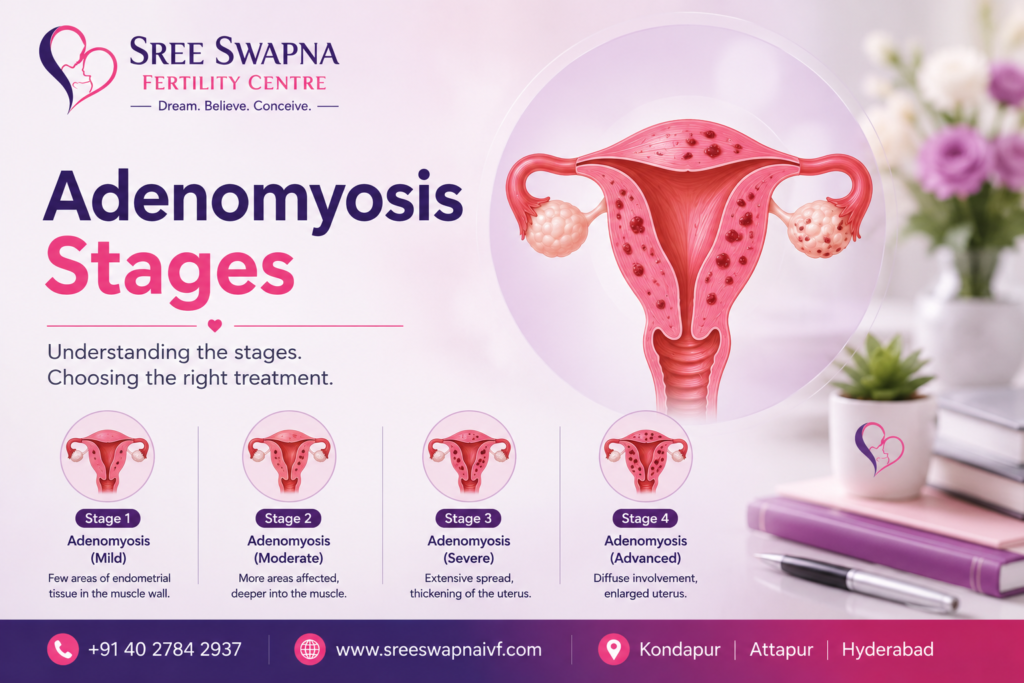
Not every adenomyosis case looks the same on a scan report. Some women have a small, localised patch. Others have widespread changes across the entire uterine wall.
This difference matters. It affects your symptoms, your fertility outlook, and the treatment your specialist recommends.
This guide explains how adenomyosis is classified by severity, how each level typically affects fertility, and what that means for your treatment plan.
How Is Adenomyosis Classified?
Unlike some conditions with a strict numbered staging system, adenomyosis is generally classified by two main factors:
1. Extent: Focal vs. Diffuse
- Focal adenomyosis — a localised patch of affected tissue, sometimes called an adenomyoma. It behaves somewhat like a fibroid in terms of being a defined area.
- Diffuse adenomyosis — widespread involvement across the uterine wall, without one clear boundary.
2. Depth: Inner vs. Outer Myometrium
Doctors also look at how deep the affected tissue extends into the muscle wall:
- Inner myometrium involvement — closer to the uterine cavity, generally associated with more classic symptoms like heavy bleeding
- Outer myometrium involvement — deeper into the muscle wall, sometimes linked to different symptom patterns and clinical outcomes
Severity Grading on Ultrasound
Radiologists increasingly use a standardised checklist (known as MUSA — Morphological Uterus Sonographic Assessment) to describe adenomyosis features on ultrasound. This includes noting uterine size, the extent of tissue involvement, and specific structural changes. This standardisation helps specialists communicate severity consistently, rather than relying on subjective descriptions.
How Does Severity Affect Fertility?
Research consistently points to one pattern: more extensive adenomyosis tends to have a greater impact on fertility than mild or focal cases.
Mild or Focal Adenomyosis
- Often has minimal impact on natural conception
- May still allow reasonably normal IVF outcomes with standard protocols
- Sometimes treatable with surgical removal (adenomyomectomy) if fertility is a priority
Diffuse or Extensive Adenomyosis
- More strongly associated with reduced IVF pregnancy rates in research studies
- Often linked to more disrupted uterine contractility and endometrial receptivity
- Usually requires more intensive treatment protocols before attempting conception
Depth of Involvement
Some research suggests that adenomyosis affecting the inner myometrium (closer to the uterine lining) may have a more direct effect on implantation than adenomyosis confined to the outer muscle layers, though this remains an active area of research.
It’s worth repeating: these are patterns seen across research studies, not predictions for any individual case. Two women with similar-looking scans can have very different fertility outcomes.
How Is Severity Diagnosed?
- Transvaginal Ultrasound — the first-line tool, now often using MUSA criteria for standardised reporting
- MRI — provides more precise detail on the extent and depth of involvement, especially useful when planning fertility treatment
- Correlation with symptoms — severity on imaging doesn’t always match symptom intensity, so both are considered together
Getting a detailed, well-documented scan report — not just a “yes, you have adenomyosis” diagnosis — genuinely changes how your treatment is planned.
Treatment Approaches Based on Severity
For Mild or Focal Cases
- Hormonal treatment (birth control pills, hormonal IUD, or dienogest) to manage symptoms
- Adenomyomectomy, if the adenomyoma is well-defined and fertility is a priority
- Standard IVF protocols, if trying to conceive
For Diffuse or Severe Cases
- Extended GnRH agonist downregulation before IVF, aimed at improving the uterine environment
- Closer monitoring throughout the treatment cycle
- In select cases, frozen embryo transfer (FET) rather than a fresh transfer, allowing more time to prepare the uterus
- For women not planning pregnancy, more definitive options like uterine artery embolisation or hysterectomy may be discussed
No treatment plan should be decided purely from a text report. Reviewing your actual scan images with a specialist experienced in adenomyosis makes a real difference to the plan you’re offered.
Why Getting the Right Specialist Matters More With Severe Cases
Milder adenomyosis often responds predictably to standard treatment. Severe or diffuse cases need more nuanced decision-making — balancing symptom control, fertility timelines, and realistic expectations about IVF success.
This is where experience matters. A specialist who has managed many adenomyosis cases across different severity levels is better placed to judge which protocol adjustments are worth making for your specific scan findings.
How Sree Swapna Fertility Centre Approaches Adenomyosis Staging
Dr. Swapna Naik, Clinical Director at Sree Swapna Fertility Centre, brings over 15 years of experience in reproductive medicine and has guided more than 5,000 successful pregnancies — including patients across the full spectrum of adenomyosis severity.
Every case starts with detailed transvaginal ultrasound imaging at our Kondapur or Attapur clinics, giving a clear picture of whether adenomyosis is focal or diffuse, and how deep it extends. This assessment directly shapes the treatment plan — whether that’s straightforward hormonal management, a discussion around adenomyomectomy, or a more extended protocol before an IVF cycle.
For patients with severe or diffuse adenomyosis, we take extra time to walk through realistic expectations, since research clearly shows outcomes can be more variable in these cases. Our goal is always an honest, personalised plan — not a generic one applied to every patient regardless of severity.
Frequently Asked Questions
1. Is there an official staging system for adenomyosis like cancer stages?
No, adenomyosis doesn’t have a universal numbered staging system, but it’s classified by extent (focal vs. diffuse) and depth of involvement.
2. What is focal adenomyosis?
A localised area of adenomyosis tissue, sometimes called an adenomyoma, rather than widespread involvement.
3. What is diffuse adenomyosis?
Widespread adenomyosis changes across the uterine wall, without one clearly defined boundary.
4. Does mild adenomyosis affect fertility?
Mild or focal adenomyosis generally has a smaller impact on fertility compared to diffuse or severe cases.
5. Can severe adenomyosis still allow successful IVF?
Yes, though research suggests outcomes may be more variable, and treatment protocols are often adjusted to improve chances.
6. What is MUSA in adenomyosis diagnosis?
MUSA (Morphological Uterus Sonographic Assessment) is a standardised checklist used on ultrasound to describe adenomyosis features consistently.
7. Is MRI always needed to determine adenomyosis severity?
Not always — ultrasound is often sufficient for diagnosis, but MRI may be recommended for more detailed staging, especially before fertility treatment.
8. Does the depth of adenomyosis in the uterine wall matter for fertility?
Some research suggests inner myometrium involvement may affect implantation more directly, though this is still being studied.
9. Can focal adenomyosis be surgically removed?
Yes, a well-defined adenomyoma can sometimes be surgically removed through adenomyomectomy, particularly when fertility is a priority.
10. Is diffuse adenomyosis treated differently from focal adenomyosis?
Yes, diffuse cases usually require more comprehensive hormonal or IVF protocol adjustments rather than a single localised surgical fix.
11. Does adenomyosis severity always match symptom severity?
Not necessarily — some women with extensive adenomyosis on imaging have mild symptoms, and vice versa.
12. Can adenomyosis severity change over time?
Adenomyosis can progress in some women, particularly as they age, though the rate of progression varies.
13. Does adenomyosis staging affect which IVF protocol is used?
Yes, more severe or diffuse cases often warrant extended downregulation protocols or closer cycle monitoring.
14. Is frozen embryo transfer better than fresh transfer for severe adenomyosis?
Some specialists prefer FET in severe cases, as it allows extra time to prepare the uterine environment, though the right approach depends on the individual case.
15. Can I ask for a detailed report on my adenomyosis severity?
Yes, and it’s worth requesting one — a detailed report helps your specialist plan treatment more precisely than a general diagnosis alone.
16. Does severity affect miscarriage risk?
Some studies suggest more extensive adenomyosis may carry a higher associated risk, though this varies by individual case and should be discussed with your specialist.
17. Can adenomyosis staging help predict how many IVF cycles I might need?
It can inform expectations, but it can’t predict an exact number, since fertility outcomes depend on multiple factors beyond adenomyosis alone.
18. Should every adenomyosis patient get an MRI?
Not necessarily — MRI is generally reserved for cases needing more detailed staging, particularly before fertility treatment planning.
19. Is adenomyosis staging available at Sree Swapna Fertility Centre?
Yes, both our Kondapur and Attapur clinics offer detailed diagnostic ultrasound to assess adenomyosis extent and severity.
20. Can two women with the same adenomyosis stage have different fertility outcomes?
Yes, staging shows patterns and tendencies, not guarantees — individual outcomes depend on multiple additional fertility factors.
21. Does severity affect treatment cost?
More severe cases may require additional imaging, extended protocols, or surgical options, which can affect overall treatment planning. Discuss specifics with the clinic directly.
22. What’s the first step if I want my adenomyosis severity properly assessed?
Book a consultation for a detailed transvaginal ultrasound, ideally with a specialist experienced in both gynaecology and fertility treatment.
Conclusion
Adenomyosis isn’t a single, uniform condition — its extent and depth genuinely shape both symptoms and fertility outlook. A detailed, well-documented diagnosis is the foundation for the right treatment plan, whether that’s simple hormonal management or a carefully adjusted IVF protocol.
Get Your Adenomyosis Properly Assessed
Dr. Swapna Naik and the team at Sree Swapna Fertility Centre can give you a clear picture of your adenomyosis severity and what it means for your fertility plans.
📞 Call: +91 76708 04424 / +91 40 4995 3719 💬 WhatsApp: Message us directly 📧 Email: sreeswapna.fertility@gmail.com 📍 Visit us at: Kondapur (flagship centre) or Attapur, Hyderabad 🌐 Book an appointment: sreeswapnaivf.com/contact-us
