
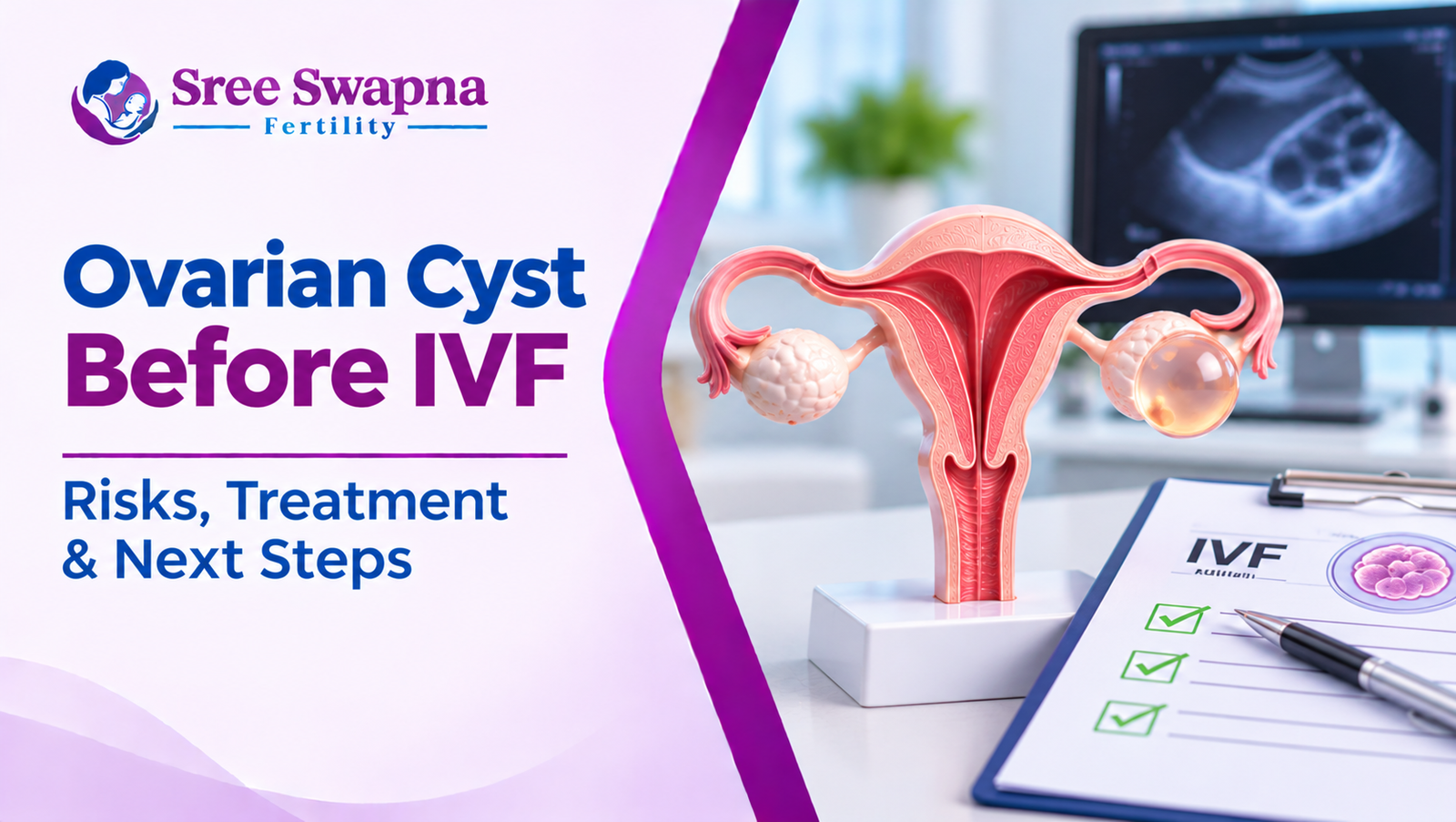
Functional Ovarian Cyst Before IVF: Should Treatment Be Delayed?
Finding a cyst on the scan before IVF can be disappointing when you are ready to start treatment. However, “ovarian cyst” is a description, not a complete diagnosis. The decision to proceed, repeat the scan or delay stimulation depends on what the finding represents and whether it affects the planned treatment.
Quick Answer
A functional ovarian cyst does not automatically mean IVF must be cancelled. The team considers ultrasound appearance, size, symptoms, persistence, possible hormone activity and the intended protocol. Some findings can be monitored; others need reassessment before treatment. Do not start or change IVF medicines until the clinic confirms the plan.
Sudden Severe Pain Needs Urgent Assessment
Sudden severe pelvic pain, particularly with nausea or vomiting, requires urgent medical assessment. Fainting, collapse or other severe symptoms are also urgent. Do not wait for a routine fertility appointment or an online callback; a complication such as torsion or rupture may need assessment.
What Is a Functional Ovarian Cyst?
Functional cysts arise from normal ovarian activity. They commonly include follicular cysts and corpus-luteum cysts. Many resolve spontaneously, but the clinician needs to assess whether the current finding fits that explanation.
Some functional cysts produce hormones such as estradiol or progesterone. Their relevance before IVF depends partly on whether that activity fits the baseline conditions intended for the chosen protocol.
A single scan should not lead you to label every ovarian cyst as functional. Persistence, symptoms and internal features can change the diagnostic discussion.
Why Does the Type of Cyst Matter?
| Finding | General context | Important distinction |
|---|---|---|
| Suspected functional cyst | May arise from normal follicular or corpus-luteum activity. | Hormone activity, symptoms and interval change influence the plan. |
| Endometrioma | A cyst associated with endometriosis. | It is not managed as a temporary functional cyst, and routine removal before IVF is not automatically beneficial. |
| Dermoid or another persistent mass | May require a different diagnostic and management assessment. | Persistence does not identify the exact diagnosis by itself. |
| Complex or otherwise concerning finding | Needs review of the full imaging appearance and clinical context. | “Complex” does not automatically mean cancer, but should not be assumed harmless without assessment. |
The NHS overview of ovarian cysts describes common types, symptoms and reasons for medical review.
What Does the IVF Baseline Assessment Check?
The team reviews the scan alongside your cycle, medicines, previous treatment and symptoms. A baseline scan is one part of deciding whether the intended cycle can start as planned.
- The location and measured size of the finding.
- Its internal appearance and other ultrasound features.
- Whether it is new or present on previous scans.
- Pain, pressure, bleeding or other symptoms.
- Estradiol or progesterone where clinically indicated.
- Both ovaries and the visible follicle pattern.
- The stimulation protocol and previous ovarian response.
The IVF treatment overview explains where baseline assessment fits before medication and monitoring.
Does Every Cyst Need Hormone Tests?
Not necessarily. Testing should answer a specific question, such as whether hormone activity affects the intended starting conditions. The team should explain why a result is needed and how it would change the plan.
Is There One Size That Always Cancels IVF?
No universal diameter should be used as a stand-alone decision rule. Size matters, but appearance, symptoms, hormone activity, access and the treatment context matter too.
A small-looking finding can need review if its features are concerning. A larger simple finding also needs individual assessment rather than an automatic conclusion from an internet chart.
Can IVF Proceed, or Should It Be Delayed?
ASRM’s 2024 committee opinion describes conflicting evidence about the effect of baseline cysts on IVF outcomes. Some studies found concerns; others did not find fewer retrieved eggs in the selected patients studied.
This does not prove that all cysts are harmless. Some studies excluded larger or hormonally active findings, so their results cannot automatically be applied to every baseline cyst.
| Situation | Possible next discussion |
|---|---|
| Reassuring appearance without relevant hormone activity | Whether proceeding with the planned protocol and appropriate monitoring is reasonable. |
| Hormonal activity affects the planned baseline | Repeat testing, interval imaging or delaying the start. |
| Persistent or uncertain finding | Further imaging or specialist review before treating it as a functional cyst. |
| Pain, size-related concern or difficult access | Whether safety or egg-collection planning requires a different strategy. |
| Sudden severe symptoms | Urgent medical assessment, not routine cycle scheduling. |
The ASRM discussion of cyst management before fertility treatment explains these evidence limitations. It notes that many clinicians postpone treatment when a large or functional cyst is present, but the individual rationale should be clear.
Does a Delay Mean IVF Is No Longer Possible?
No. A delay can be intended to establish the diagnosis, allow resolution or create more appropriate conditions for the planned protocol. Ask what needs to change before restarting and when reassessment will occur.
Do Birth-Control Pills Make an Existing Cyst Disappear Faster?
Hormonal contraception can be used for particular scheduling or pretreatment purposes, but that is different from proving it treats an already existing functional cyst.
A Cochrane review of oral contraceptives for functional cysts found that combined pills did not hasten resolution. ASRM’s 2024 opinion therefore advises against starting hormonal contraception solely to make an existing cyst resolve faster.
Do not stop a prescribed medicine based on this general statement. Your clinician may have a different reason for using it. Ask whether the purpose is cycle timing, prevention of new cysts, symptom management or something else.
Should a Cyst Be Drained or Removed Before IVF?
Aspiration Is Not a Routine Requirement
Aspiration removes fluid but does not necessarily provide a lasting solution. It also involves a procedure and potential risks.
A Cochrane review of cyst aspiration before IVF found insufficient evidence to determine whether drainage improves pregnancy outcomes, recruited follicles or collected eggs. It should not be presented as a proven step for every functional cyst.
Surgery Needs a Clear Indication
Surgery may be discussed for symptoms, concerning features or other specific reasons. It should not automatically be performed simply to obtain a cyst-free scan before IVF.
Discuss the likely diagnosis, alternatives, procedural risks and possible effects on healthy ovarian tissue. Previous operations and ovarian reserve are relevant to the benefit-risk balance.
What If It Is an Endometrioma?
Endometriomas need a separate discussion. They are not the same as functional cysts, and evidence does not clearly show that routine treatment before IVF improves the chance of a baby.
The Cochrane review of endometrioma treatment before fertility care highlights uncertainty and the need to consider symptoms, ovarian reserve, previous outcomes and patient preferences.
Does a Cyst Mean Low Ovarian Reserve?
Not automatically. A cyst is an imaging finding; ovarian reserve is a different assessment. A larger structure can make follicle counting more difficult, while surgery involving ovarian tissue can have implications for reserve.
Our AFC vs AMH guide explains the ultrasound and blood-test approaches. Neither one cyst nor one AMH result should become a complete fertility verdict.
Will a Baseline Cyst Reduce the Number of Eggs?
A specific reduction cannot be predicted from the presence of a cyst alone. Evidence is inconsistent, and outcomes depend on the type of finding, the patients included and the treatment protocol.
Ask about your own expected response and what uncertainty remains, rather than relying on one clinic-wide or study-wide average.
If Stimulation Proceeds, What Should You Do?
- Follow the exact medication and monitoring instructions.
- Know the next scan or blood-test appointment.
- Report new or worsening symptoms promptly.
- Do not independently adjust doses or procedure timing.
- Keep the clinic’s urgent-contact instructions available.
A baseline cyst and ovarian hyperstimulation syndrome are not the same condition. Stimulation safety monitoring remains important whether or not a cyst was present.
Later in treatment, the IVF trigger-shot timing guide explains why final-injection and retrieval instructions must be coordinated. It is not a substitute for your personal schedule.
Questions for Your Baseline-Scan Review
- What type of cyst is suspected, and how certain is that?
- How does it compare with previous scans?
- Is it hormonally active for the purposes of this protocol?
- Is there a safety or egg-collection access concern?
- What is the reason to proceed, repeat the scan or delay?
- Would a proposed medicine treat the cyst or serve another purpose?
- What benefit is expected from aspiration or surgery?
- When will the plan be reviewed?
Frequently Asked Questions
Does every ovarian cyst cancel an IVF cycle?
No. Type, symptoms, appearance, persistence, hormonal findings and the planned protocol guide the decision.
Can a functional cyst disappear without treatment?
Yes. Many resolve spontaneously. The interval for repeat imaging should follow the clinical assessment rather than a fixed rule for everyone.
Is a simple cyst always hormonally inactive?
No. Appearance and hormone production are different questions. A clinician may use relevant blood tests when that information would affect treatment.
Do birth-control pills reliably clear an existing cyst faster?
No. Randomised evidence reviewed by Cochrane did not show faster resolution of functional cysts with combined oral contraceptives.
Should every cyst be aspirated before stimulation?
No. Evidence is insufficient to support routine drainage for better IVF outcomes. Any procedure should have an individual explanation of expected benefit and risk.
Does a cyst mean that my AMH must be low?
No. Cyst assessment and reserve assessment answer different questions. Interpret AMH with age, ultrasound, treatment history and other relevant findings.
Can pregnancy happen naturally when an ovarian cyst is present?
Often it can. Many cysts do not prevent pregnancy, but the underlying diagnosis and other fertility factors still matter.
When should I seek urgent help?
Sudden severe pelvic pain, especially with nausea or vomiting, needs urgent assessment. Fainting, collapse or other severe symptoms should not wait for a callback.
Conclusion
An ovarian cyst before IVF is a reason to clarify the diagnosis and treatment conditions, not automatically cancel treatment or arrange surgery. The best plan explains what the finding means, why a particular next step is appropriate and when reassessment will happen.

About the specialist
Dr. Swapna Naik
Founder & Medical Director
Sree Swapna Fertility Centre
Her clinic profile describes fertility services including IVF, IUI, ovulation induction and fertility preservation.
Read Dr. Swapna Naik’s professional profile .
Request an appointmentAbout This Health Information
Purpose and evidence
This article provides general education, not an individual scan interpretation or recommendation to start, delay or cancel treatment. Evidence sources are linked in the discussion and listed below.
Publisher and commercial context
Sree Swapna Fertility Centre publishes this article and offers fertility services. Appointment and service links lead to the clinic’s own pages. No treatment guarantees pregnancy or live birth.
Questions and corrections
Use the contact page to report a possible error. Include the article title and relevant passage. Do not post scans or private health information in public comments.
Medical Sources
- ASRM: The use of hormonal contraceptives in fertility treatments (2024) — includes baseline ovarian-cyst management.
- Cochrane: Oral contraceptives for functional ovarian cysts (2014) .
- Cochrane: Ovarian cyst aspiration and IVF outcomes (2014) .
- Cochrane: Treating endometrioma before fertility treatment .
- NHS: Ovarian cyst overview, symptoms and assessment .
General educational information only. Do not start, stop or adjust IVF medicines based on this page. Seek urgent care for sudden severe pelvic pain or other acute symptoms. The callback form is not an emergency service.
FERTILITY HELPLINE
Contact the Clinic
Routine appointments and fertility consultation enquiries.
Not an emergency service. Seek urgent medical care for sudden severe pain. Do not send private scans through this panel.
