
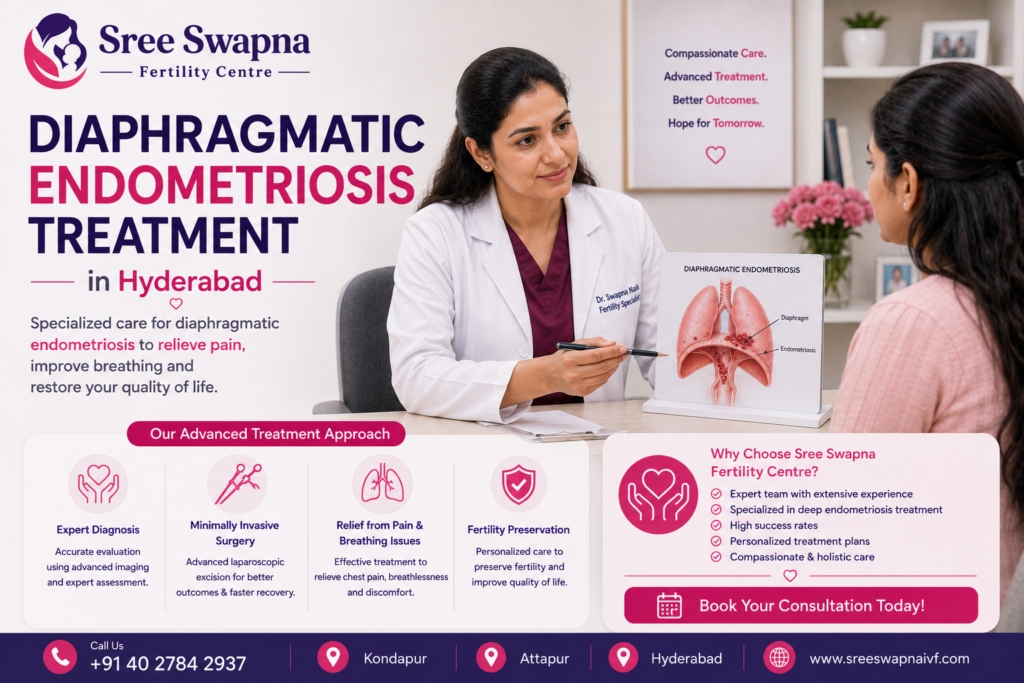
Chest pain or a collapsed lung might be the last thing you’d connect to your menstrual cycle — but for a small number of women, that’s exactly what’s happening. Diaphragmatic (thoracic) endometriosis is a rare but genuinely important condition to recognise, since it’s frequently missed for years.
This guide explains what it is, how it presents, and — importantly — how care is coordinated between gynaecology and thoracic surgery, since treating this condition properly requires both.
What Is Diaphragmatic or Thoracic Endometriosis?
Thoracic endometriosis occurs when endometrial-like tissue implants on the diaphragm, pleura (the lining around the lungs), or occasionally within the lung tissue itself. Like endometriosis elsewhere in the body, this tissue responds to your monthly hormonal cycle — which is exactly why symptoms tend to appear in a clear, cyclical pattern.
Collectively, the range of symptoms this can cause is referred to as Thoracic Endometriosis Syndrome (TES).
What Symptoms Does It Cause?
- Catamenial pneumothorax — a collapsed lung occurring within about 72 hours of your period starting; this is the most common presentation, accounting for roughly 73% of reported cases
- Catamenial haemothorax — bleeding into the space around the lung, tied to your cycle
- Catamenial haemoptysis — coughing up blood, occurring cyclically
- Pulmonary nodules — endometriosis deposits within lung tissue itself
- Cyclical chest pain, sometimes without any of the above complications
A striking pattern in this condition: around 90–95% of cases occur on the right side of the chest — a detail that’s helped researchers understand more about how this condition develops, though a fully agreed explanation still doesn’t exist.
Who Should Suspect This Condition?
Thoracic endometriosis should be genuinely suspected in a woman of reproductive age who experiences recurrent, right-sided chest pain or a pneumothorax that consistently occurs around the time of her period. This pattern is the single most important clue, and it’s frequently the detail that gets missed in a general emergency or pulmonology setting if the connection to menstruation isn’t specifically asked about.
How Is It Diagnosed?
- CT or MRI imaging: Can sometimes show diaphragmatic defects or suspicious findings, though imaging alone has real limitations and can miss subtle lesions
- Video-Assisted Thoracic Surgery (VATS): Considered the gold standard for both diagnosis and treatment — it allows direct visualisation of the diaphragm and pleura, along with tissue biopsy for definitive histological confirmation
Because thoracic endometriosis is rare and its symptoms overlap with other lung conditions, diagnostic delay is common — which is exactly why recognising the cyclical pattern matters so much.
How Is Diaphragmatic Endometriosis Treated?
This is genuinely a two-part treatment process, involving both thoracic surgery and gynaecological hormonal management.
Surgical Treatment (Thoracic Surgery)
VATS allows a thoracic surgeon to directly address the problem:
- Resection of diaphragmatic lesions or fenestrations (small holes or defects)
- Pleurodesis — a procedure that helps the lung stick to the chest wall, reducing the chance of another pneumothorax
- Diaphragm repair, sometimes requiring mesh reinforcement for larger defects
Hormonal Treatment (Gynaecological Management)
After surgery, hormonal therapy — typically GnRH agonists or progestins — is generally recommended to suppress ovarian hormone production and reduce the risk of recurrence. Research suggests hormonal therapy alone, without surgery, is associated with a significant recurrence rate, which is why the combined approach — surgery plus ongoing hormonal management — is generally considered the more effective path.
Why This Requires a Coordinated, Multidisciplinary Approach
We want to be transparent about this: the surgical component of thoracic endometriosis treatment (VATS) requires a thoracic surgeon, not a gynaecologist. This isn’t a limitation we work around quietly — it’s simply the appropriate standard of care, recognised by leading gynaecological endoscopy societies who have specifically called for better awareness and coordinated management of this condition.
What gynaecology contributes is recognising the pattern, coordinating the hormonal treatment before and after thoracic surgery, and managing any associated pelvic endometriosis at the same time — since thoracic endometriosis is associated with pelvic endometriosis in a substantial proportion of cases.
Diaphragmatic Endometriosis Care at Sree Swapna Fertility Centre
If your history suggests thoracic endometriosis — recurrent, cycle-linked chest symptoms — Dr. Swapna Naik, Clinical Director at Sree Swapna Fertility Centre, brings over 15 years of experience in gynaecology and endometriosis management, and can help recognise this pattern, evaluate for associated pelvic endometriosis, and coordinate a referral to an appropriate thoracic surgery team.
Following any thoracic surgical treatment, we can manage the ongoing hormonal suppression therapy and monitor for pelvic endometriosis, ensuring both sides of your treatment are properly coordinated rather than managed in isolation.
Frequently Asked Questions
1. What is diaphragmatic or thoracic endometriosis?
It’s a rare condition where endometrial-like tissue implants on the diaphragm, pleura, or lung tissue, causing symptoms that follow your menstrual cycle.
2. What is catamenial pneumothorax?
A collapsed lung occurring within about 72 hours of your period starting, and the most common presentation of thoracic endometriosis.
3. Why does thoracic endometriosis mostly affect the right side?
Around 90–95% of cases occur on the right side, though a fully agreed explanation for this pattern doesn’t yet exist in the medical literature.
4. Who should suspect this condition?
Women of reproductive age with recurrent, right-sided chest pain or pneumothorax that consistently coincides with their period.
5. How is thoracic endometriosis diagnosed?
CT or MRI imaging can suggest it, but VATS (Video-Assisted Thoracic Surgery) is the gold standard for definitive diagnosis through direct visualisation and biopsy.
6. Does Sree Swapna Fertility Centre perform the thoracic surgery for this condition?
No, the surgical component requires a thoracic surgeon. We help recognise the condition, coordinate referral, and manage hormonal treatment and any associated pelvic endometriosis.
7. What is pleurodesis?
A procedure performed during thoracic surgery that helps the lung adhere to the chest wall, reducing the risk of another pneumothorax.
8. Is hormonal treatment alone enough for thoracic endometriosis?
Research suggests hormonal treatment alone is associated with a significant recurrence rate, which is why combined surgical and hormonal treatment is generally preferred.
9. What hormonal treatments are used after thoracic surgery?
GnRH agonists or progestins are commonly used, with no clear evidence that one is definitively superior to the other.
10. Is thoracic endometriosis linked to pelvic endometriosis?
Yes, it’s associated with pelvic endometriosis in a substantial proportion of cases, which is why gynaecological evaluation matters alongside thoracic treatment.
11. How common is thoracic endometriosis?
It’s considered rare, and awareness of the condition has historically been limited, contributing to diagnostic delays.
12. Can thoracic endometriosis cause coughing up blood?
Yes, catamenial haemoptysis (cyclical coughing up blood) is one recognised presentation, though less common than pneumothorax.
13. Can imaging alone rule out thoracic endometriosis?
Not reliably — imaging has real limitations in detecting subtle lesions, which is why VATS remains the diagnostic gold standard when this condition is suspected.
14. What should I do if I have recurrent chest pain tied to my period?
Raise this specific cyclical pattern with your doctor, and ask about evaluation for thoracic endometriosis, since this connection is easy to miss without specifically asking about it.
15. Can thoracic endometriosis come back after surgery?
Yes, recurrence is possible, which is why postoperative hormonal therapy is generally recommended to reduce this risk.
16. Is thoracic endometriosis a life-threatening condition?
A pneumothorax can be a serious, acute medical event requiring prompt treatment, though with appropriate diagnosis and coordinated care, it’s manageable long-term.
17. What society has raised awareness about this condition?
The British Society for Gynaecological Endoscopy, along with the Royal College of Obstetricians and Gynaecologists, has released statements aimed at improving awareness and standardising care for this condition.
18. Does thoracic endometriosis affect fertility?
As a form of endometriosis, it may be associated with pelvic disease that can affect fertility, though this varies by individual case.
19. Can diaphragmatic hernia be related to endometriosis?
Yes, endometriosis-related diaphragmatic hernia is one of the recognised, less common presentations within thoracic endometriosis syndrome.
20. How soon after symptoms start should thoracic endometriosis be evaluated?
Given the risk of a serious pneumothorax event, any recurrent, cycle-linked chest symptoms should be evaluated promptly rather than delayed.
21. Can a gynaecologist help even if the surgery itself is done by a thoracic surgeon?
Yes, gynaecological evaluation, hormonal management, and coordination with your thoracic surgery team are all valuable parts of comprehensive care for this condition.
22. Where can I get gynaecological evaluation and coordinated care for suspected thoracic endometriosis in Hyderabad?
Sree Swapna Fertility Centre can evaluate for associated pelvic endometriosis, manage hormonal treatment, and coordinate referral to thoracic surgery at both our Kondapur and Attapur clinics.
Conclusion
Diaphragmatic endometriosis is rare, but recognising its distinctive cyclical pattern — chest symptoms tied closely to your period — can meaningfully shorten the path to proper diagnosis. Treating it well requires genuine coordination between thoracic surgery and gynaecological hormonal management, not one specialty working in isolation.
Get Coordinated Care for Suspected Thoracic Endometriosis
Dr. Swapna Naik and the team at Sree Swapna Fertility Centre can help evaluate your symptoms and coordinate the right multidisciplinary care.
📞 Call: +91 76708 04424 / +91 40 4995 3719 💬 WhatsApp: Message us directly 📧 Email: sreeswapna.fertility@gmail.com 📍 Visit us at: Kondapur or Attapur, Hyderabad 🌐 Book an appointment: sreeswapnaivf.com/contact-us
